




1mm Aluminum Sheet: Weight, Tolerance, Alloy Choice, Inspection
1mm aluminum sheet is light and easy to cut and fold, so it is widely used for small...


1mm aluminum sheet is the thinnest gauge that fabrication shops still use as a self-supporting panel rather than just a wrap or facing. It is light and cuts quickly on a shear, a laser or a CNC punch, so it shows up in small electrical enclosures, equipment housings, decorative cladding, signs and folded parts. Because it is so thin, it is also the easiest gauge to buy wrong: a few hundredths of a millimetre off means a few percent of weight off, and the sheet waves and dents easily in transit. This article helps you calculate weight, read tolerances, choose the alloy and inspect 1mm aluminum sheet on delivery.
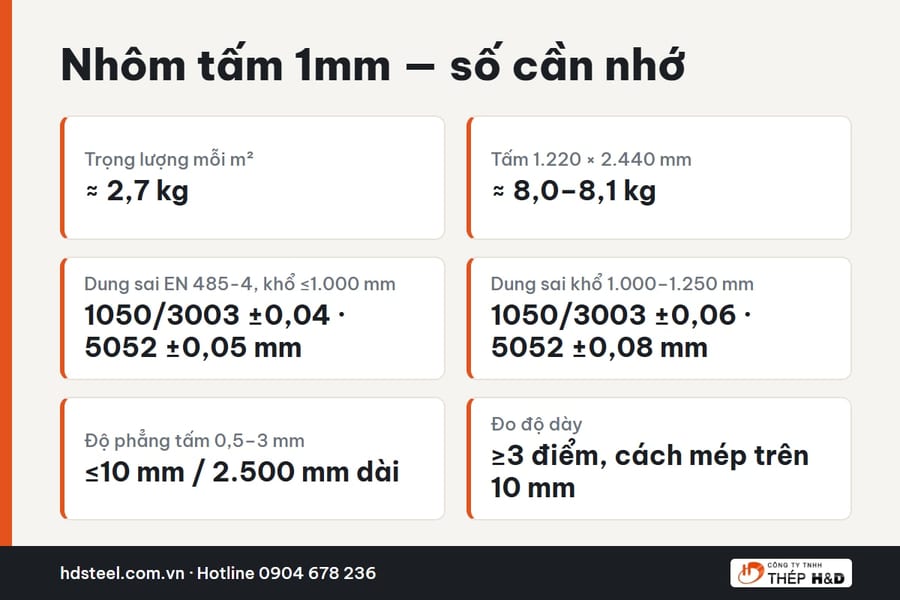
Key figures to remember when buying 1mm aluminum sheet (compiled by H&D Steel)
Sheet weight equals density times volume. According to the Aalco and Dinco datasheets, density is about 2.71 g/cm³ for 1050A, 2.73 g/cm³ for 3003 and 2.68 g/cm³ for 5052. At exactly 1 mm this converts directly to kilograms per square metre:
| Alloy | Per m² | 1,220 × 2,440 mm sheet | 1,250 × 2,500 mm sheet |
|---|---|---|---|
| 1050A | ≈ 2.71 kg | ≈ 8.1 kg | ≈ 8.5 kg |
| 3003 | ≈ 2.73 kg | ≈ 8.1 kg | ≈ 8.5 kg |
| 5052 | ≈ 2.68 kg | ≈ 8.0 kg | ≈ 8.4 kg |
Quick rule: each millimetre of aluminum thickness weighs roughly 2.7 kg per square metre. A standard 1 mm sheet weighs only about 8 kg, so one person can carry it, but it is light and soft enough to crease if lifted by one end. These are theoretical weights at exactly 1.00 mm; real sheets vary within the tolerance described below.
Cold-rolled aluminum sheet imported into Vietnam usually follows the European EN 485-4 or the American ASTM B209. EN 485-4 places 1050A and 3003 in group I and 5052 in group II. A 1.0 mm sheet falls in the “over 0.8 up to 1.0 mm” row of the cold-rolled table. The Color Metal table and the Aalco summary give the same values:
| Sheet width | Group I (1050A, 3003) | Group II (5052) |
|---|---|---|
| Up to 1,000 mm | ±0.04 mm | ±0.05 mm |
| Over 1,000 up to 1,250 mm | ±0.06 mm | ±0.08 mm |
| Over 1,250 mm to the next width band | ±0.08 mm | ±0.09 mm |
The two sources differ only in the third width band: Aalco labels it 1,500 mm, Color Metal over 1,250 up to 1,600 mm; the tolerance figures are identical. So a compliant 3003 sheet 1,250 mm wide must measure between 0.94 and 1.06 mm. A sheet measuring 0.90 mm is 10% short of metal, almost twice the allowed deviation. On 3 mm sheet, 0.1 mm short is just over 3%; on 1 mm sheet the same 0.1 mm is 10%. That is why measuring thickness matters far more for thin sheet than for thick plate. Ignore a 10 mm zone at the edges when measuring, as noted with the EN 485-4 table, because rolled edges are always thinner than the centre. ASTM B209 has its own inch-based tolerance tables in the paid part of the standard, so this article only cites its scope.
The Aalco EN summary allows cold-rolled sheet of 0.5–3.0 mm a maximum flatness deviation of 10 mm over 2,500 mm length and 5 mm over 1,250 mm width. On 1 mm sheet this bow is much easier to see than on thick plate, and edges can also wave if the sheet was cut from coil without levelling. For face cladding, signs or cabinet doors that must be flat, ask whether the sheet was levelled when cut from coil, request a PE protective film on one side, and transport sheets flat on a level pallet rather than standing on edge or strapped directly over the edges.
At 1 mm the difference in stiffness between alloys is obvious the moment you pick the sheet up. The properties below are EN 485-2 values quoted in distributor datasheets, in the half-hard tempers commonly stocked:
| Alloy / temper | Proof stress Rp0.2 | Tensile strength Rm | Suited to |
|---|---|---|---|
| 1050A-H14 | ≥85 MPa | 105–145 MPa | Decorative cladding, signs, reflectors, heat-conducting parts |
| 3003-H14 | ≥125 MPa | 145–185 MPa | Small electrical enclosures, equipment housings, ducting, gutters, household goods |
| 5052-H32 | ≥130 MPa | 210–260 MPa | Outdoor equipment housings, vibration-loaded parts, humid or salt-laden environments |
Quick guide: if the 1 mm sheet only covers, faces or is bonded to a frame, 1050A is enough and the most economical. If the panel must stand on its own in a housing or small door, 3003 is noticeably stiffer and still folds easily. 5052 is for outdoor corrosion resistance or long-term vibration. One important note: the Dinco 3003-H14 datasheet guarantees only 2% minimum elongation in the 0.5–1.5 mm range, so deep-drawn parts from 1 mm sheet should be ordered in O or H12 temper rather than H14. Alloy details are on the 1050 aluminum sheet, 3003 aluminum sheet and 5052 aluminum sheet pages.
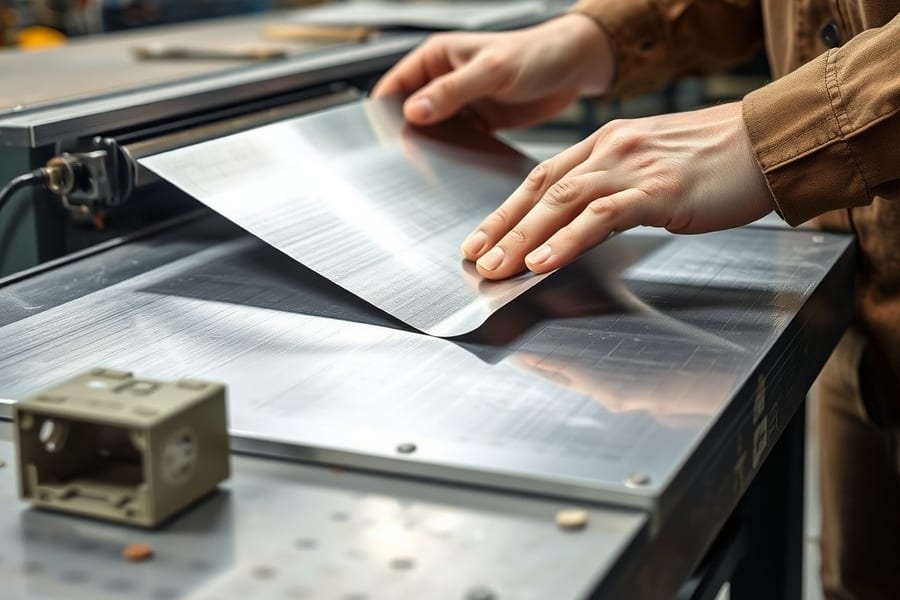
Folded edges and ribs make 1 mm aluminum sheet stiffer without adding thickness — AI-generated illustration
If the panel must carry foot traffic or impact, such as truck body walls and work platforms, or spans wide areas without a solid frame, 1 mm will dent quickly. In that case consider 2mm aluminum sheet, or read the article on 3mm aluminum sheet weight, tolerance and alloy choice for load-bearing parts. Conversely, for even thinner wrapping or facing, narrow aluminum coil is usually more economical than sheet.
If you need 1mm aluminum sheet in 1050, 3003 or 5052 in the right size, with protective film and a mill certificate, please send a request through the aluminum sheet and coil quotation page or call hotline/Zalo 0904 678 236 (Sales Department) for advice on the right alloy and thickness for your job.
1mm aluminum sheet is light and easy to cut and fold, so it is widely used for small...

The SMM A00 aluminium ingot price ended week 43/2026 at 23,670 CNY/t on 23 October, 2...

On 21 October 2026, VIR reported that foreign investors are adding billions of dollar...
Weekly table of SMM A00 ingot prices, LME 3-month and USD/VND, updated every Monday,...

Aluminum is used in everything from cookware to truck bodies, but each job suits a sp...

The SMM A00 aluminium ingot price ended week 42/2026 at 23,460 CNY/t on 16 October, 1...

5052 aluminum sheet in O, H32 and H34 tempers differs clearly in strength, ductility...

Shanghai reopened after National Day with two down sessions: the SMM A00 aluminium in...

From 20 October 2026, Decree 344/2026/ND-CP opens a state ordering mechanism and ince...

Aluminum's physical figures differ between alloys, and each figure drives a concrete...


