091 327 0770 - 090 326 2566
info@hdsteel.com.vn

Aluminum Sheet Applications in Fabrication: 1050, 3003 or 5052

Ask what aluminum is used for and the answer is very broad: cookware, aluminum windows, beverage cans, aircraft. For a fabrication shop about to order material, the question is much narrower: should the job use sheet or coil, alloy 1050, 3003 or 5052, and how thick. This article covers common aluminum sheet applications in four groups of workshops: automotive, electronics, machinery and household fabrication, with guidance on alloy, thickness and the usual buying mistakes.

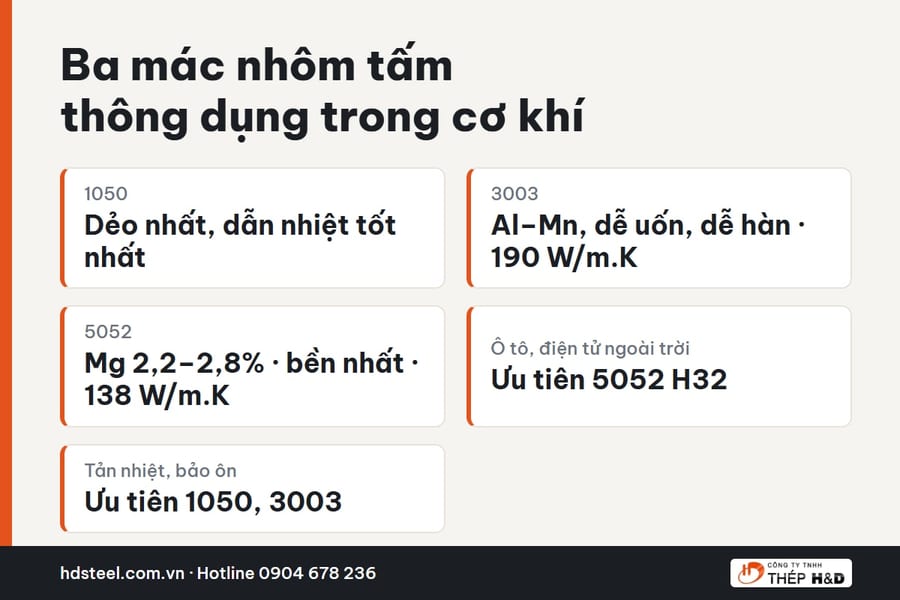
Summary card of aluminum sheet applications for alloys 1050, 3003 and 5052

Three common aluminum sheet alloys and their main uses (compiled by H&D Steel)

Three common sheet alloys and their strengths

Most sheet and coil applications in fabrication revolve around three alloys: 1050, 3003 and 5052. None of them can be strengthened by heat treatment; sheet hardness comes from cold rolling and is shown by the temper code after the alloy, such as O (annealed), H14 or H32. The main difference between the three lies in the alloying element:

  • 1050 (1xxx series): almost pure aluminum. It is the most ductile, has the best thermal conductivity, a bright surface and good corrosion resistance, but low strength. Aalco's datasheet lists chemical process equipment, food containers, architectural flashings, lamp reflectors and cable sheathing.
  • 3003 (3xxx series): an aluminum–manganese alloy, stronger than 1050 but still easy to bend and weld. Both Aalco and Dinco list roofing, corrugated sheet, acoustic ceilings, insulation panels, storage tanks, vehicle radiators, heat exchangers and cooking utensils.
  • 5052 (5xxx series): contains 2.2–2.8% magnesium and 0.15–0.35% chromium, the strongest of the three, with good resistance to marine and industrial atmospheres. Listed applications include tread plate, pressure vessels, tanks, road signs, outdoor enclosures, cladding panels and small boats.

The table below summarizes the ratings from the two datasheets. The ratings are the distributors' own scale and are only useful for comparing the alloys with each other.

Property 1050 3003 5052
Strength Low Medium Highest of the three
Cold working (bending, pressing) Excellent Very good Good
Arc welding Excellent Very good Very good
Thermal conductivity (W/m.K) Highest of the three 190 138
Best environment Indoor, food, mild chemicals Normal atmosphere Outdoor, coastal, industrial atmosphere

Detailed physical data for each alloy (density, thermal expansion, elastic modulus) is in our article on physical properties of aluminum 1050, 3003, 5052. A general overview is in applications of aluminum from daily life to industry.

Aluminum applications in automotive workshops

Truck body, special vehicle and component builders use aluminum to cut tare weight, so the vehicle carries more cargo within the same permitted load.

  • Body floors, steps, recovery truck decks: 3003 or 5052 tread plate. Heavy loads or coastal operation favour 5052. Pattern and thickness selection is covered in aluminum tread plate: alloy, pattern and thickness.
  • Body side walls, doors, tool boxes: 5052 H32 is common because it is stiffer and more dent-resistant than 3003 while still bendable.
  • Refrigerated body linings, insulation panels: thin 3003 or 1050 coil, where a flat, easy-to-clean surface matters more than strength.
  • Radiators, heat exchangers: 3003 is named explicitly in both datasheets.

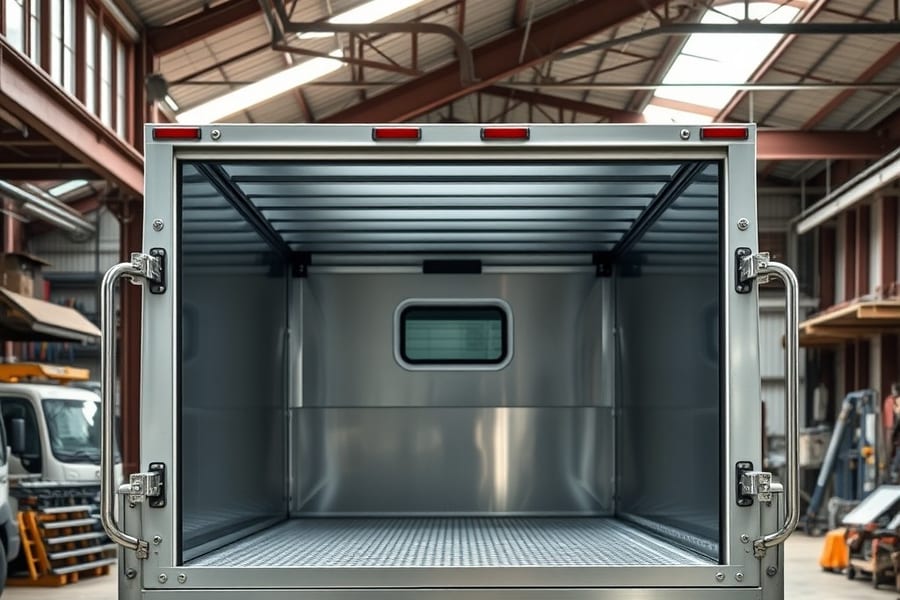
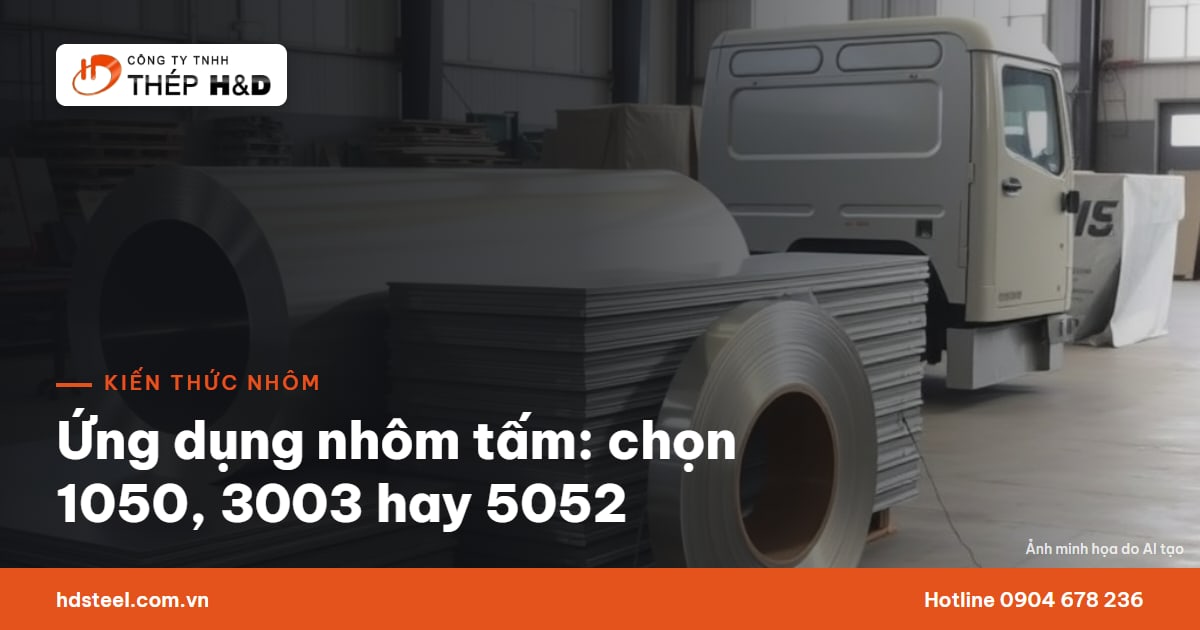
Aluminum sheet truck body with aluminum tread plate floor in a body shop

Truck bodies are a common aluminum sheet application in automotive workshops — AI-generated illustration

Aluminum applications in electronics workshops

This group makes electrical cabinets, equipment housings, machine frames, heat sinks and brackets for electronics plants, data centers and solar systems.

  • Outdoor cabinets and housings: 5052 H32. Dinco's datasheet names outdoor enclosures as a typical use, since the alloy bends at 1.5 times thickness and resists corrosion well.
  • Indoor cabinets, trays, covers: 3003 or 5052, depending on the panel stiffness needed. Temper selection for multi-bend panels is covered in 5052 aluminum: O, H32 or H34.
  • Heat spreaders, heat sink bases, lamp reflectors: prefer 1050. 5052 conducts only 138 W/m.K, lower than 3003 (190 W/m.K) and well below 1050, so the strongest alloy is not the best heat spreader.

Aluminum applications in machinery workshops

  • Tanks, containers, food and chemical equipment: 3003 or 5052; pressure vessels and welded structures lean towards 5052.
  • Machine guards, protective covers, body panels: 5052 H32 for stiff, dent-resistant flat panels.
  • Pipe and tank insulation jacketing: thin 1050 or 3003 coil; see choosing A1050 and A3003 coil for insulation jacketing.
  • Deep-drawn parts, 180° hems: choose the O temper of 1050 or 3003.

Aluminum applications in household and building workshops

  • Outdoor signs and billboards: 5052 (Aalco lists road signs) or 3003 for small sheltered signs.
  • Cladding, ceilings, roofing, gutters: 3003, for good atmospheric resistance and easy corrugating and edge bending.
  • Household goods, trays, baking moulds, lamp shades: 1050 or 3003.
  • Ladders, steps, balcony floors: 3003 or 5052 tread plate.

Quick selection table by application

Thicknesses in the table are common ordering ranges for reference only; the final gauge must follow the drawing, load and support spacing.

Application Alloy to check first Product form Reference thickness
Truck floors, steps 5052, 3003 Tread plate 2–5 mm
Body walls, tool boxes 5052 H32 Sheet 1.5–3 mm
Outdoor electrical cabinets 5052 H32 Sheet 1.5–2.5 mm
Heat spreaders, reflectors 1050 Sheet, coil 0.5–3 mm
Insulation jacketing 1050, 3003 Coil 0.3–0.8 mm
Signs, cladding panels 3003, 5052 Sheet, coil 1–3 mm

Available thicknesses and widths are listed on our aluminum sheet 1050, 3003, 5052 page; coil and slit strip are on the aluminum coil and slit strip page.

Five common mistakes when choosing aluminum by application

  1. Choosing 1050 for load-bearing parts because it bends easily. It bends nicely but dents and sags. Impact-prone parts should move up to 3003 or 5052.
  2. Assuming every aluminum dissipates heat equally. 5052 conducts about a quarter less heat than 3003. Heat spreaders should use 1050 or 3003.
  3. Choosing a strong alloy, then bending too tight. 5052 H32 needs a larger bend radius than annealed 1050 or 3003; punches sized for steel can crack the outer edge.
  4. Not stating the service environment. The same cabinet indoors and outdoors near the sea needs different alloys. When asking for a quote, say where the part will be used.
  5. Designing welds on the as-bought temper. Welding heat softens the zone next to the weld, so buying a harder temper does not make the weld stronger.

References

If you need aluminum sheet or coil for truck bodies, electrical cabinets, tanks or signs and are not sure which alloy to choose, please send a request via our aluminum sheet and coil quotation page or call hotline/Zalo 0904 678 236 (Sales Department) for advice on the right alloy and thickness for each job.


Bài viết liên quan

Ứng dụng nhôm tấm trong cơ khí: chọn mác 1050, 3003 hay 5052

Ứng dụng nhôm tấm trong cơ khí: chọn mác 1050, 3003 hay 5052

Nhôm có mặt từ nồi chảo đến thùng xe tải, nhưng mỗi việc hợp với một mác và một độ dà...

Giá nhôm tấm tuần 42/2026: SMM A00 giảm còn 23.460 CNY/tấn

Giá nhôm tấm tuần 42/2026: SMM A00 giảm còn 23.460 CNY/tấn

Giá nhôm thỏi SMM A00 chốt tuần 42/2026 ở 23.460 CNY/tấn ngày 16/10, thấp hơn 190 CNY...

Nhôm A5052: chọn O, H32 hay H34, bán kính chấn và lỗi khi mua

Nhôm A5052: chọn O, H32 hay H34, bán kính chấn và lỗi khi mua

Cùng là nhôm A5052 nhưng tấm trạng thái O, H32 và H34 có độ bền, độ dẻo và bán kính c...

Giá nhôm tấm tuần 41/2026: SMM A00 rơi về 23.650 CNY/tấn sau lễ

Giá nhôm tấm tuần 41/2026: SMM A00 rơi về 23.650 CNY/tấn sau lễ

Sàn Thượng Hải mở cửa lại sau Quốc khánh với hai phiên giảm liền: giá nhôm thỏi SMM A...

Nghị định 344: ưu đãi chế tạo thiết bị điện trong nước từ 20/10

Nghị định 344: ưu đãi chế tạo thiết bị điện trong nước từ 20/10

Từ ngày 20/10/2026, Nghị định 344/2026/NĐ-CP mở cơ chế đặt hàng và ưu đãi cho doanh n...

Tính chất vật lý của nhôm: số liệu 1050, 3003, 5052 cho xưởng

Tính chất vật lý của nhôm: số liệu 1050, 3003, 5052 cho xưởng

Các con số vật lý của nhôm không giống nhau giữa các mác, và mỗi con số dẫn tới một q...

Giá nhôm tấm tuần 40/2026: SMM A00 giảm còn 24.030 CNY/tấn

Giá nhôm tấm tuần 40/2026: SMM A00 giảm còn 24.030 CNY/tấn

Giá nhôm thỏi SMM A00 giảm ba phiên liên tiếp trong tuần 40/2026, chốt 24.030 CNY/tấn...

Thị trường ô tô 8 tháng 2026 tăng nhanh nhất Đông Nam Á

Thị trường ô tô 8 tháng 2026 tăng nhanh nhất Đông Nam Á

Sau 8 tháng 2026, thị trường ô tô Việt Nam bán 432.548 xe, mức tăng cao nhất trong 6...

Nhôm tấm 3mm: trọng lượng, dung sai, chọn mác và lỗi khi mua

Nhôm tấm 3mm: trọng lượng, dung sai, chọn mác và lỗi khi mua

Nhôm tấm 3mm là độ dày được hỏi nhiều nhất trong nhóm tấm mỏng vì đủ cứng để làm thùn...

Nhôm A6061: chọn T6 hay T651, độ dày và lỗi khi mua tấm

Nhôm A6061: chọn T6 hay T651, độ dày và lỗi khi mua tấm

Nhôm A6061 là hợp kim nhôm–magie–silic hoá bền bằng nhiệt luyện, được dùng nhiều nhất...