






Nhôm A5052: chọn O, H32 hay H34, bán kính chấn và lỗi khi mua
Cùng là nhôm A5052 nhưng tấm trạng thái O, H32 và H34 có độ bền, độ dẻo và bán kính c...


Many workshops order simply "5052 aluminum, 2 mm thick", then find the outer edge cracking on the press brake, or the sheet softer than the drawing requires. The cause is usually not the alloy but the temper code that follows it: O, H32 or H34. Within the same aluminum–magnesium alloy, these three tempers give clearly different strength, ductility and bend radius. This article compares the three most common tempers of 5052 aluminum sheet using standard data, then suggests how to choose for electrical enclosures, truck bodies and pressed parts.
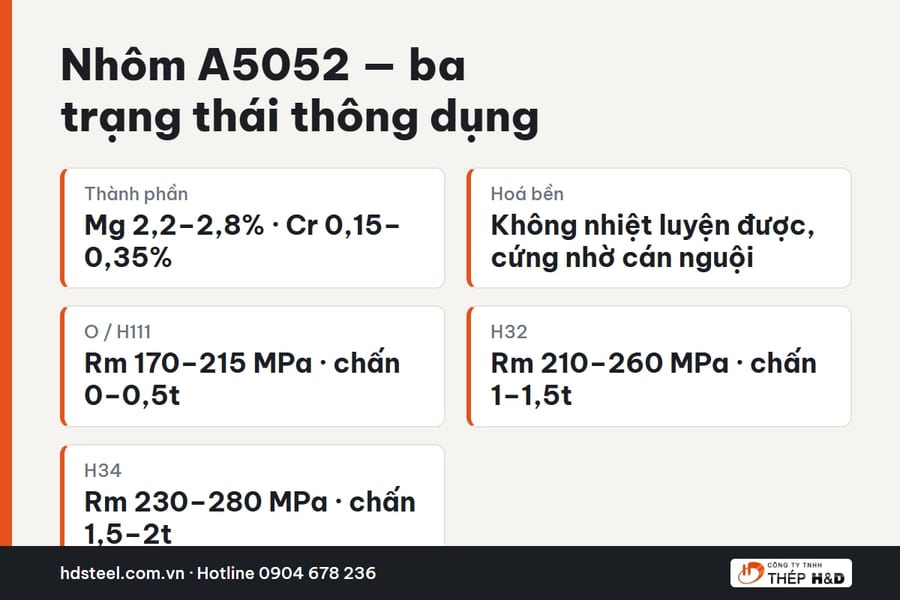
Three common tempers of 5052 aluminum, 1.5–3 mm sheet (compiled by H&D Steel)
5052 belongs to the 5xxx series, containing 2.2–2.8% magnesium and 0.15–0.35% chromium per EN 573-3. Unlike the 6xxx series, 5052 cannot be strengthened by heat treatment. Its strength comes from cold rolling: the more it is rolled, the harder and less bendable the sheet becomes. The same alloy is therefore sold at several hardness levels, and the code after the letter H tells you how the sheet was processed.
The first digit after H describes the process: 1 is cold rolled only, 2 is cold rolled then partially annealed, 3 is cold rolled then stabilised. The second digit describes the hardness level; the higher the number, the harder the sheet. Temper changes only the mechanical properties; density, elastic modulus and thermal conductivity stay almost the same, as explained in our article on physical properties of aluminum 1050, 3003, 5052.
The table combines data for 1.5–3 mm sheet from two standard systems. EN values follow EN 485-2 as published in datasheets by Dinco, Aalco and thyssenkrupp; ASTM values follow the ASTM B209 and AMS limits published by Aircraft Materials, converted from ksi to MPa. For H34, the EN source found lists only H24 at the same half-hard level, so H24 values are shown for reference.
| Property (1.5–3 mm sheet) | O / H111 | H32 | H34 |
|---|---|---|---|
| Tensile strength Rm (MPa) | 170–215 | 210–260 | 230–280 |
| Minimum yield strength, EN (MPa) | 65 | 130 | 150 (H24 value) |
| Yield strength, ASTM (MPa) | about 65 | about 160 | about 180 |
| Elongation (%) | 16–19 | 7 | 6 |
| Reference hardness (HB) | 47 | 61 | 67 |
| Minimum 90° bend radius | 0–0.5t | 1–1.5t | 1.5–2t |
Tensile strength is almost identical in both systems: under ASTM, H32 is 31–38 ksi (about 214–262 MPa) and H34 is 34–41 ksi (about 234–283 MPa). HB hardness in EN is for information only, not an acceptance criterion. The symbol t is the sheet thickness.
The row to watch is yield strength. For H32, EN 485-2 requires a minimum of only 130 MPa, while ASTM B209 requires about 160 MPa (23 ksi). At half hard, EN lists 150 MPa for H24 while ASTM lists about 180 MPa (26 ksi) for H34. Two sheets both marked H32 on their mill test certificate (the mill's test report for each lot) can therefore both conform, yet differ by about 30 MPa in yield strength.
For enclosures or cladding the gap matters little. For parts designed on yield strength, such as gusset plates, brackets or load-bearing floors, state the standard and the minimum value on the order, then read the Rp0.2 line on the certificate rather than just the letters H32.
Bend radius is given as a multiple of thickness. For example, 2 mm H32 sheet needs an inside radius of about 2–3 mm; H34 of the same thickness needs about 3–4 mm; O temper can be bent almost flat. The two sources differ slightly: Aircraft Materials gives 1t for H32 and 1.5t for H34, while the EN table gives 1.5t for H32 and 2t for H24 in the 1.5–3 mm range. For series production, use the larger figure.
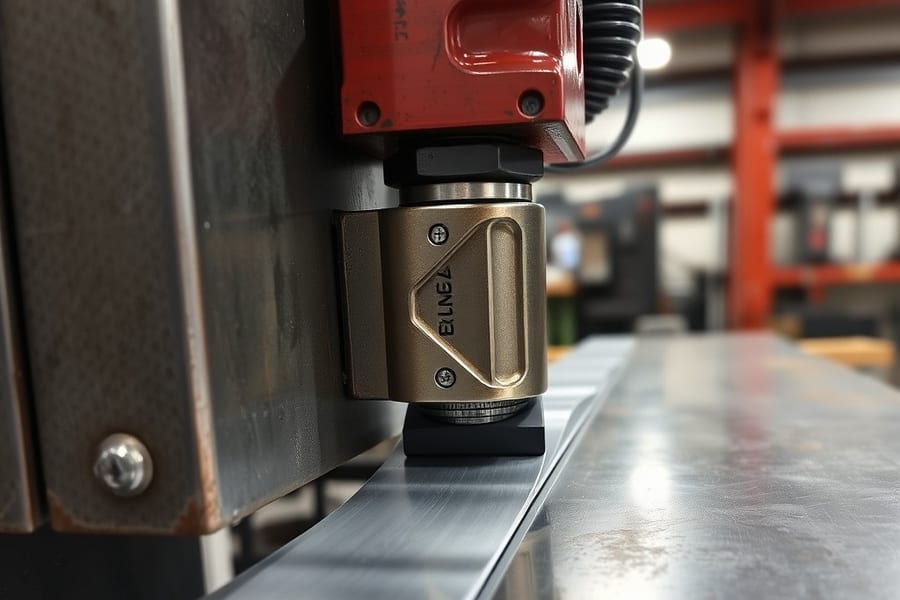
The punch radius decides whether the aluminum sheet cracks at the bend — AI-generated illustration
Also remember that H34 does not make a panel deflect less. The elastic modulus of every temper is about 70 GPa; to make a panel stiffer you must increase thickness or add formed ribs. Available thicknesses and sheet sizes are listed on our aluminum sheet 1050, 3003, 5052 page.
If you need 5052 aluminum sheet or coil in the right temper and thickness for electrical enclosures, truck bodies or pressed parts, please send a request via our aluminum sheet and coil quotation page or call hotline/Zalo 0904 678 236 (Sales Department) for advice on the right temper for each job.
Cùng là nhôm A5052 nhưng tấm trạng thái O, H32 và H34 có độ bền, độ dẻo và bán kính c...
Sàn Thượng Hải mở cửa lại sau Quốc khánh với hai phiên giảm liền: giá nhôm thỏi SMM A...
Từ ngày 20/10/2026, Nghị định 344/2026/NĐ-CP mở cơ chế đặt hàng và ưu đãi cho doanh n...
Các con số vật lý của nhôm không giống nhau giữa các mác, và mỗi con số dẫn tới một q...
Giá nhôm thỏi SMM A00 giảm ba phiên liên tiếp trong tuần 40/2026, chốt 24.030 CNY/tấn...
Sau 8 tháng 2026, thị trường ô tô Việt Nam bán 432.548 xe, mức tăng cao nhất trong 6...
Nhôm tấm 3mm là độ dày được hỏi nhiều nhất trong nhóm tấm mỏng vì đủ cứng để làm thùn...
Nhôm A6061 là hợp kim nhôm–magie–silic hoá bền bằng nhiệt luyện, được dùng nhiều nhất...
Chỉ số cước container nội Á của Drewry chốt ngày 24/9/2026 ở 1.491 USD/40ft, tăng 6%...
Giá nhôm thỏi SMM A00 chốt tuần 39/2026 ở 24.240 CNY/tấn, cao hơn 60 CNY/tấn so với t...


