





Aluminium sheet price, week 41/2026: SMM A00 drops to 23,650
Shanghai reopened after National Day with two down sessions: the SMM A00 aluminium in...


Most articles on the physical properties of aluminum stop at general statements: light, conductive, corrosion resistant. Those points are covered in our article on six outstanding physical properties of aluminum. This guide takes a different route: it places the physical data of three common sheet alloys, 1050, 3003 and 5052, next to structural steel and explains what each figure is used for in a fabrication shop. Truck body builders, electrical cabinet makers and machine frame fabricators all run these calculations, even if they rarely call them by name.
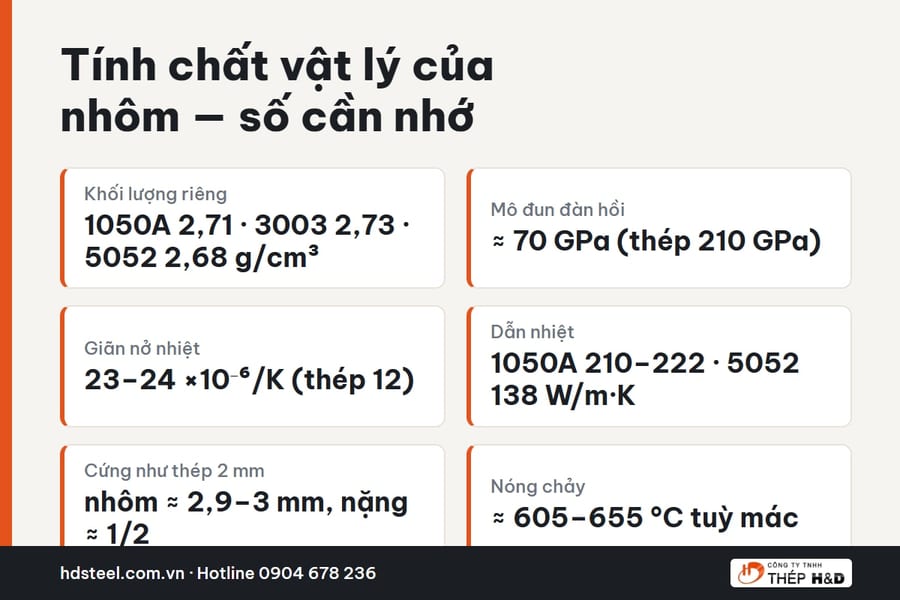
Key physical figures to remember when choosing aluminum sheet (compiled by H&D Steel)
The figures below are typical values from the datasheets of European distributors (Aalco, Dinco, BIKAR), cross-checked between at least two sources for each alloy. Where sources differ, a range is given. Structural steel uses the design values of EN 1993-1-1.
| Property | 1050A | 3003 | 5052 | Structural steel |
|---|---|---|---|---|
| Density (g/cm³) | 2.70–2.71 | 2.73 | 2.68 | ≈7.85 |
| Elastic modulus E (GPa) | 69–71 | about 69.5 | 70 | 210 |
| Thermal expansion (×10⁻⁶/K) | 23.5–24 | 23.1–23.2 | 23.7 | 12 |
| Thermal conductivity (W/m·K) | 210–222 | 160–200 | 138 | — |
| Electrical conductivity (MS/m) | about 34–36 | about 23–29 | about 20 | — |
| Melting point (°C) | about 650 | about 655 | 605–608 | — |
Two notes when reading the table. First, these are typical design values, not guaranteed limits: EN 485-2 specifies mechanical properties (proof stress, tensile strength), while physical properties do not appear on the mill certificate of a delivery. Second, thermal and electrical conductivity change with temper, which is why BIKAR gives 3003 a range of 160–200 W/m·K instead of a single value.
According to Total Materia, aluminum weighs about one third as much as steel. In concrete terms, one square metre of 1 mm sheet weighs 2.68 kg in 5052, 2.71 kg in 1050A and 2.73 kg in 3003, against roughly 7.85 kg for steel. A 5052 sheet of 1,250 × 2,500 mm at 2 mm weighs about 16.8 kg; the same steel sheet weighs almost 49 kg.
The difference between aluminum alloys is only about 2%, but when buying several tonnes by weight it is enough to shift the expected sheet count. Multiply area and thickness by the density of the exact alloy ordered rather than dividing a steel factor by three. Our article on 3mm aluminum sheet weight, tolerance and alloy choice shows a worked example.
This is the most overlooked figure. All three aluminum alloys have an elastic modulus of about 70 GPa, roughly one third of steel (210 GPa). At the same thickness and span, an aluminum sheet deflects about three times as much as steel under the same load.
The key point is that the modulus barely changes between alloys. 5052 is far stronger in tension than 1050, but its stiffness is the same. Changing alloy does not fix deflection; only more thickness, folded edges, embossed ribs or added stiffeners do.
The bending stiffness of a plate is proportional to E times the cube of thickness. To match the stiffness of steel, aluminum needs about 1.44 times the thickness: a 2 mm steel sheet corresponds to roughly 2.9–3 mm of aluminum. Even when thicker, the aluminum sheet still weighs only about half as much. That is why truck body walls and floors converted to aluminum usually go one gauge thicker than the old steel design.
Aluminum expands at about 23–24 ×10⁻⁶/K, nearly twice the rate of steel (12 ×10⁻⁶/K). A 3 m aluminum panel that sees a 40 °C swing between early morning and midday sun grows by about 2.8 mm; a steel bar of the same length grows by only about 1.4 mm.
That 1.4 mm difference is behind many cases of bulging cladding, torn screw holes and ticking noises on truck bodies and canopies. When fixing long aluminum panels to an outdoor steel frame, drill slotted holes along the length, leave gaps at both ends and do not fully clamp every fastener. In the shop, let freshly machined aluminum parts cool before final dimensional inspection.
According to Total Materia, aluminum conducts heat about three times better than steel. Yet the gap between alloys is large: 1050A conducts 210–222 W/m·K, 3003 about 160–200 and 5052 only 138 W/m·K, so 1050A conducts heat roughly 50–60% better than 5052. For electrical conductivity, 5052 reaches only about 57% of 1050A.

Aluminum heat sinks: the purer the alloy, the better the heat conduction — Photo: SHOX ART / Pexels
For electronics fabricators: heat sink plates, power component mounting bases and parts that must carry current should favour 1050, then 3003. Outdoor electrical enclosures, covers and vibration-loaded frames need the strength and corrosion resistance of 5052 more than conductivity. See the alloys available on our aluminum sheet page; for parts stamped in volume from strip, see aluminum coil and slit strip.
High conductivity also affects welding. Heat from the torch spreads quickly through the sheet, while aluminum melts at only about 605–655 °C depending on alloy. Welders moving from steel to aluminum should test settings on scrap of the same alloy and thickness before welding the real part.
To learn how aluminum reacts with acids, alkalis and the environment, read our article on the chemical properties of aluminum.
If you need 1050, 3003 or 5052 aluminum sheet or coil in the right thickness for truck bodies, electrical cabinets or heat sinks, send your enquiry through our aluminum sheet and coil quotation page or call our hotline/Zalo 0904 678 236 (Sales Department) for advice on the right alloy and thickness for your job.
Shanghai reopened after National Day with two down sessions: the SMM A00 aluminium in...
From 20 October 2026, Decree 344/2026/ND-CP opens a state ordering mechanism and ince...
Aluminum's physical figures differ between alloys, and each figure drives a concrete...
The SMM A00 aluminium ingot price fell in all three sessions of week 40/2026, closing...
Vietnam's car market sold 432,548 vehicles in the first eight months of 2026, the fas...
3mm aluminum sheet is the most requested thickness in the thin-to-medium range: stiff...
A6061 is a heat-treatable aluminium–magnesium–silicon alloy widely used for machine f...
Drewry's Intra-Asia Container Index closed at 1,491 USD/40ft on 24 September 2026, up...
The SMM A00 aluminium ingot price ended week 39/2026 at 24,240 CNY/t, up 60 CNY/t fro...
Aluminum tread plate is sheet with a raised pattern on one face, used for truck floor...


.jpg)