




5mm Aluminum Sheet: Weight, Tolerance, Alloy Choice, Fabrication
5mm aluminum sheet is stiff enough for truck floors, machine bases, fixtures and load...


5mm aluminum sheet is where sheet starts to become plate: stiff enough for truck floors, machine bases, fixtures and load-bearing gussets, yet still easy to cut, drill and bend on the machines of an ordinary fabrication shop. Because it sits on that boundary, 5 mm material may be cold-rolled or hot-rolled, each with its own tolerance table. A standard sheet already weighs over 40 kg, so a few percent off in thickness means more than a kilogram of aluminum per sheet. This article helps you calculate weight, read tolerances, choose the alloy and plan fabrication of 5mm aluminum sheet.
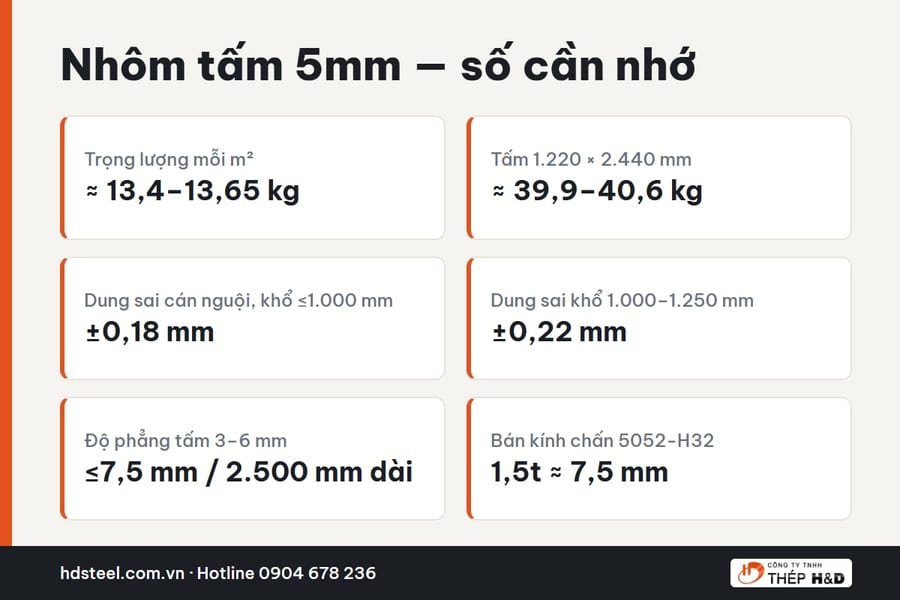
Key figures to remember when buying 5mm aluminum sheet (compiled by H&D Steel)
Sheet weight equals density times volume. According to the Aalco and Dinco datasheets, density is about 2.71 g/cm³ for 1050A, 2.73 g/cm³ for 3003 and 2.68 g/cm³ for 5052. At exactly 5 mm:
| Alloy | Per m² | 1,220 × 2,440 mm sheet | 1,250 × 2,500 mm sheet |
|---|---|---|---|
| 1050A | ≈ 13.55 kg | ≈ 40.3 kg | ≈ 42.3 kg |
| 3003 | ≈ 13.65 kg | ≈ 40.6 kg | ≈ 42.7 kg |
| 5052 | ≈ 13.40 kg | ≈ 39.9 kg | ≈ 41.9 kg |
Quick rule: each millimetre of aluminum thickness weighs roughly 2.7 kg per square metre, so 5 mm sheet is about 13.5 kg/m². A 1,220 × 2,440 mm sheet weighs about 40 kg, needs two people or a forklift to handle, and is the figure to compare against the weighbridge ticket on delivery. These are theoretical weights at exactly 5.00 mm; real sheets vary within the tolerance described below.
Cold-rolled aluminum sheet follows the European EN 485-4, hot-rolled plate follows EN 485-3, and American-standard material uses ASTM B209. At 5 mm both rolling routes are on the market, so before inspecting a delivery ask the supplier whether the sheet is cold-rolled or hot-rolled. For cold-rolled material, a 5.0 mm sheet falls in the “over 4.0 up to 5.0 mm” row of the EN 485-4 table. The Color Metal table and the Aalco summary give the same values:
| Sheet width | Thickness tolerance (1050A, 3003, 5052) |
|---|---|
| Up to 1,000 mm | ±0.18 mm |
| Over 1,000 up to 1,250 mm | ±0.22 mm |
| Over 1,250 mm to the next width band | ±0.24 mm |
Unlike thin sheet, at this thickness the table no longer separates alloy groups: 1050A, 3003 (group I) and 5052 (group II) share the same tolerance. The two sources differ only in how they label the third width band: Aalco shows 1,500 mm, Color Metal over 1,250 up to 1,600 mm; the tolerance figures are identical. So a compliant cold-rolled sheet 1,250 mm wide must measure between 4.78 and 5.22 mm. On 5 mm sheet, 0.1 mm short is only 2% less metal, far less than on thin sheet; but a sheet measuring 4.7 mm is outside tolerance and about 2.5 kg light on every 1,250 × 2,500 mm sheet. Hot-rolled material has its own, wider tolerance table, so check the standard printed on the mill certificate to know which table applies. Ignore a 10 mm zone at the edges when measuring, as noted with the EN 485-4 table. ASTM B209 has its own inch-based tolerance tables in the paid part of the standard, so this article only cites its scope.
The Aalco EN summary allows cold-rolled sheet of 3.0–6.0 mm a maximum flatness deviation of 7.5 mm over 2,500 mm length and 3.75 mm over 1,250 mm width, tighter than the 10 mm allowed for 0.5–3.0 mm sheet. A 5 mm sheet is stiff enough not to wave at the edges like thin sheet, but once bowed it is very hard to straighten in the shop. For machine bases, fixture tables or parts to be CNC milled, check with a straightedge on delivery and require sheets to be transported flat on a pallet, not stacked over widely spaced supports.
The properties below are EN 485-2 values quoted in distributor datasheets for the thickness range that includes 5 mm, in commonly stocked tempers:
| Alloy / temper | Proof stress Rp0.2 | Tensile strength Rm | Suited to |
|---|---|---|---|
| 1050A-H14 | ≥85 MPa | 105–145 MPa | Heat-conducting plates, electrical parts, non-load-bearing liners |
| 3003-H14 | ≥125 MPa | 145–185 MPa | Indoor equipment bases and covers, gutters, lightly loaded panels |
| 5052-H32 | ≥130 MPa | 210–260 MPa | Truck floors and walls, machine bases, gussets, vibration-loaded parts, outdoor or humid and salt-laden environments |
Quick guide: at 5 mm most parts carry load, so 5052-H32 is the most common choice thanks to its clearly higher tensile strength while remaining weldable and bendable. 3003-H14 is more economical for moderately loaded indoor parts; the Dinco datasheet gives a minimum elongation of 4% for 3003-H14 in the 3.0–6.0 mm range. 1050A is the softest and is best kept for heat or electrical conduction or unloaded panels. Alloy details are on the 1050 aluminum sheet, 3003 aluminum sheet and 5052 aluminum sheet pages.
5 mm aluminum plate needs a suitable punch radius to avoid cracking at the bend — AI-generated illustration
For housings and covers that carry no load, 5 mm is usually more than needed; see the article on 3mm aluminum sheet weight, tolerance and alloy choice or 2mm aluminum sheet for a lighter, cheaper option. Conversely, machine bases with deep milled pockets, fixtures or heavily loaded gussets call for 10mm aluminum plate. Truck floors and steps that must be slip-resistant can use aluminum tread plate instead of flat sheet.
If you need 5mm aluminum sheet in 1050, 3003 or 5052 in the right size with a mill certificate, please send a request through the aluminum sheet and coil quotation page or call hotline/Zalo 0904 678 236 (Sales Department) for advice on the right alloy and thickness for your job.
5mm aluminum sheet is stiff enough for truck floors, machine bases, fixtures and load...

The SMM A00 aluminium ingot price ended week 44/2026 at 23,780 CNY/t on 30 October, 1...

On 26 October 2026, CHALIECO announced it had won an EPC contract worth about US$833...

1mm aluminum sheet is light and easy to cut and fold, so it is widely used for small...

The SMM A00 aluminium ingot price ended week 43/2026 at 23,670 CNY/t on 23 October, 2...

On 21 October 2026, VIR reported that foreign investors are adding billions of dollar...
Weekly table of SMM A00 ingot prices, LME 3-month and USD/VND, updated every Monday,...

Aluminum is used in everything from cookware to truck bodies, but each job suits a sp...

The SMM A00 aluminium ingot price ended week 42/2026 at 23,460 CNY/t on 16 October, 1...

5052 aluminum sheet in O, H32 and H34 tempers differs clearly in strength, ductility...


