




Aluminum floor plate for truck beds: weight, fitting, mistakes
A weight table for aluminum floor plate by thickness, a comparison with steel tread p...


Aluminum floor plate (tread plate, checker plate) is a common choice for truck body builders, special-purpose vehicles and work platforms. The main reason is weight: every kilogram saved on the floor is a kilogram of extra payload. This article does not revisit alloy and pattern selection; it answers three questions body shops ask when estimating material: how much tread plate weighs, how much lighter it is than steel, and how to fit it to a steel frame so it lasts.
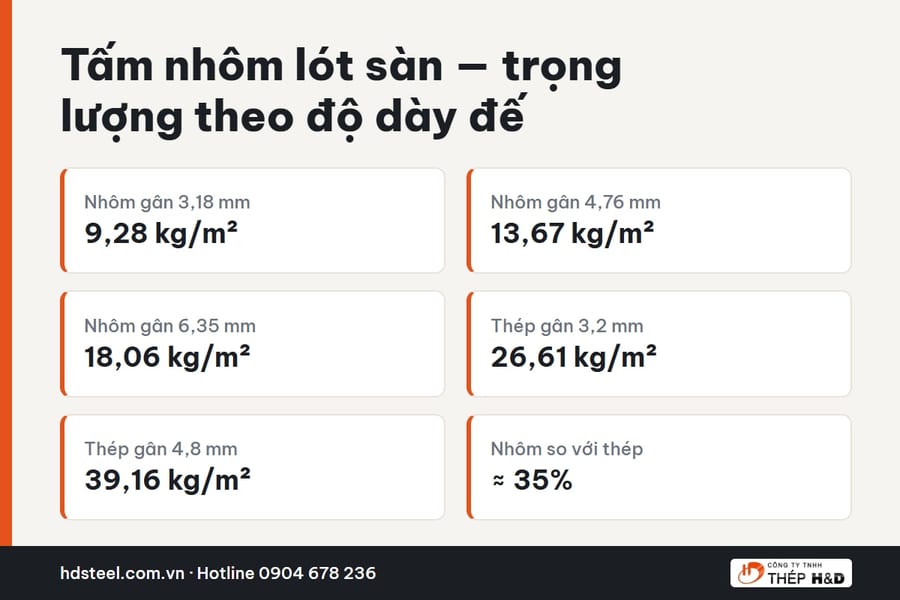
Aluminum and steel tread plate weights converted from Russel Metals tables (compiled by H&D Steel)
In Europe, EN 1386 sets the delivery conditions, mechanical properties and tolerances for rolled aluminum products used for floor plating, with a raised pattern on one side and a smooth reverse. Its scope explicitly mentions vehicle construction, shipbuilding and metal structures. For alloy, five-bar and diamond patterns, see our article on choosing alloy, pattern and thickness for tread plate (in Vietnamese).
One thing to agree on first: major distributors such as Russel Metals (Canada) and Alumeco (Europe) measure tread plate thickness excluding the pattern height. An Alumeco “5/7” plate has a 5 mm base and a 2 mm pattern. All weights below refer to base thickness.
Russel Metals’ tread plate table for 3003-H22 and 5086-H112 lists weights in pounds per square foot. Converted to metric (1 lb/ft² ≈ 4.88 kg/m²):
| Base thickness | lb/ft² (table) | kg/m² (converted) | 1250 × 2500 mm sheet |
|---|---|---|---|
| 3.18 mm (1/8 in) | 1.90 | 9.28 | ≈ 29 kg |
| 4.76 mm (3/16 in) | 2.80 | 13.67 | ≈ 42.7 kg |
| 6.35 mm (1/4 in) | 3.70 | 18.06 | ≈ 56.4 kg |
Tread plate is always heavier than flat sheet of the same base thickness, because the raised pattern is aluminum too. When buying by weight, do not estimate tread plate from a flat-sheet table; the gap per square meter is small but adds up across a lot.
Russel Metals’ steel floor plate reference chart shows how much heavier steel is at similar thickness:
| Thickness | Steel tread plate (kg/m²) | Nearest aluminum (kg/m²) | Aluminum is about |
|---|---|---|---|
| 3.2 mm | 26.61 | 9.28 (3.18 mm) | 35% |
| 4.8 mm | 39.16 | 13.67 (4.76 mm) | 35% |
| 6 mm | 48.53 | 18.06 (6.35 mm) | 37% |
In short, at the same thickness an aluminum tread floor weighs about one third of a steel one. Aluminum is less stiff than steel, so when replacing steel many shops go one size thicker or use heavier cross-members. Even going from 3.2 mm steel to 4.76 mm aluminum, the floor is still about half the weight (13.67 vs 26.61 kg/m²).
The floor area is 6.2 × 2.35 ≈ 14.57 m². With 4.76 mm base tread plate, the aluminum covering the floor weighs about 14.57 × 13.67 ≈ 199 kg. With 4.8 mm steel tread plate it would be about 571 kg, so the aluminum floor is roughly 370 kg lighter.
For sheet count, the 1250 × 2500 mm size suits a 2.35 m wide body: run the 2500 mm side across the body (trimming 150 mm) and the 1250 mm side along it, so 5 sheets cover 6.2 m. Five sheets weigh about 213 kg; the difference from 199 kg is trim loss. This layout also keeps every joint running across the body, making it easy to place each joint directly over a cross-member.
For light trucks with compact loads, a base of about 3 mm is common; for heavy loads or pallet trucks rolling on and off, consider a 4–6 mm base and have an engineer check cross-member spacing. The tables are for material estimates, not a substitute for structural calculation.
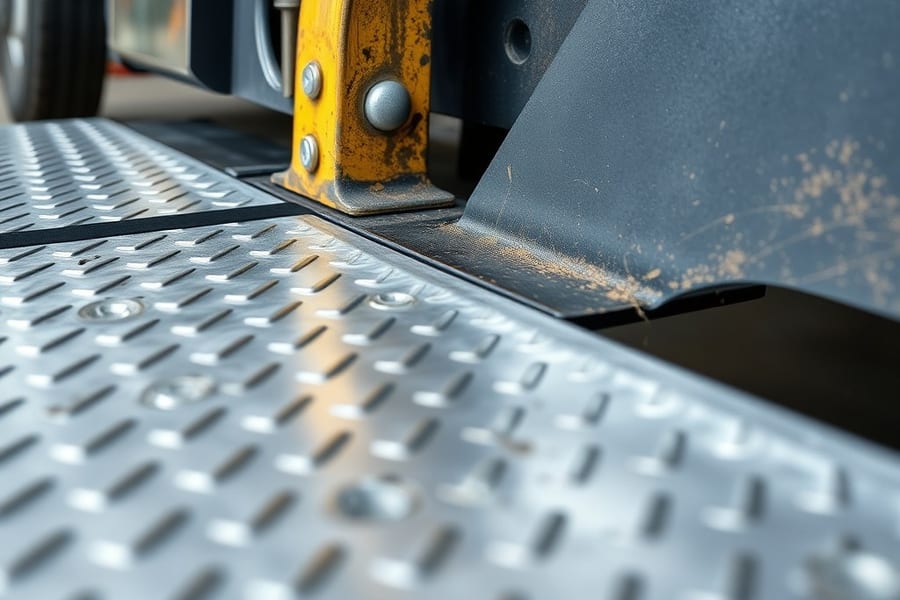
Isolation strip between aluminum plate and steel cross-member, with the joint over the beam — AI-generated illustration
Most truck body frames in Vietnam are still steel, so the aluminum–steel contact is the point to watch. According to Atlas Steels (Australia) Tech Note No. 7, galvanic corrosion needs three conditions at once: two metals far apart on the galvanic series, electrical contact between them, and an electrolyte bridging the joint. The note treats a potential difference of about 200 mV as the level where concern starts, and warns that chloride-bearing water such as seawater is especially aggressive. Aluminum sits at the less noble end, so where water collects, it is the aluminum plate that corrodes.
To make the floor last, remove one of those conditions:
H&D supplies five-bar aluminum tread plate in 3003 and 3105F in several thicknesses and sheet sizes, suitable for truck beds, steps and work platforms.
For aluminum floor plate for truck beds or work platforms, send us your floor dimensions and preferred thickness via our aluminum coil and sheet quotation page, or call hotline/Zalo 0904 678 236 (Sales Department) for advice on specification and a low-waste sheet layout.
A weight table for aluminum floor plate by thickness, a comparison with steel tread p...

The SMM A00 aluminium ingot price ended week 47/2026 at 22,340 CNY/t on 20 November,...

Registered FDI in Vietnam reached US$54.85 billion in the first ten months of 2026, u...

The aluminum jacket over pipe insulation decides whether the insulation stays dry and...

Vietnam's domestic car assembly rose 25.1% in the first ten months of 2026, yet impor...

10mm aluminum plate is true thick plate, used for machine bases, fixture tables, load...

The third Vietbuild Hanoi 2026 international exhibition runs from 11 to 14 November a...

5mm aluminum sheet is stiff enough for truck floors, machine bases, fixtures and load...

The SMM A00 aluminium ingot price ended week 44/2026 at 23,780 CNY/t on 30 October, 1...

On 26 October 2026, CHALIECO announced it had won an EPC contract worth about US$833...


