




Nhôm tấm 10mm: trọng lượng, dung sai, chọn mác và gia công
Nhôm tấm 10mm là tấm bản dày dùng làm đế máy, bàn gá, bản mã chịu tải và chi tiết pha...


10mm aluminum plate is thick plate in the full sense. Fabrication shops use it for machine bases, fixture tables, flanges, load-bearing gussets, welding jigs and CNC-milled parts with deep pockets. Buying it is very different from buying thin sheet: a standard plate weighs about 80 kg, it is often hot-rolled and therefore follows a different tolerance table, and not every alloy can be bent. This guide helps you calculate weight, read tolerances, choose the alloy and plan the machining of 10mm aluminum plate.
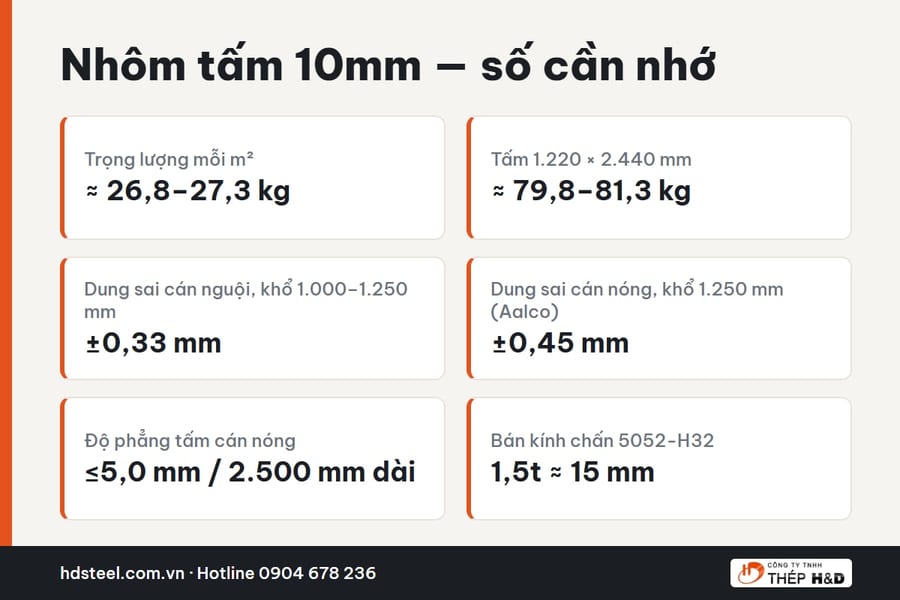
Key figures to remember when buying 10mm aluminum plate (compiled by H&D Steel)
Plate weight equals density times volume. According to datasheets from the distributors Aalco and Dinco, the density of 1050A is about 2.71 g/cm³, 3003 about 2.73 g/cm³ and 5052 about 2.68 g/cm³. For a plate exactly 10 mm thick:
| Alloy | Per m² | 1,220 × 2,440 mm plate | 1,250 × 2,500 mm plate |
|---|---|---|---|
| 1050A | ≈ 27.1 kg | ≈ 80.7 kg | ≈ 84.7 kg |
| 3003 | ≈ 27.3 kg | ≈ 81.3 kg | ≈ 85.3 kg |
| 5052 | ≈ 26.8 kg | ≈ 79.8 kg | ≈ 83.8 kg |
Quick rule: each millimetre of aluminum weighs about 2.7 kg per square metre, so 10 mm plate is about 27 kg/m², twice the weight of 5 mm. A 1,220 × 2,440 mm plate weighs about 80 kg and needs a forklift or hoist for handling and enough support points in transport. These are theoretical weights at exactly 10.00 mm; real plates vary within the tolerances below.
Hot-rolled aluminum plate follows the European standard EN 485-3 and cold-rolled plate follows EN 485-4; American-standard material uses ASTM B209. 10 mm plate may be either hot-rolled or cold-rolled, so ask your supplier and check the standard stated on the mill certificate before inspecting. For cold-rolled material, 10 mm falls in the “over 8.0 up to 10.0 mm” row of EN 485-4; the Color Metal table and Aalco’s summary give the same values:
| Plate width | Cold-rolled EN 485-4 | Hot-rolled EN 485-3 (per Aalco) |
|---|---|---|
| Up to 1,000 mm | ±0.27 mm | – |
| Over 1,000 up to 1,250 mm | ±0.33 mm | ±0.45 mm |
| 1,500 mm wide | ±0.36 mm | ±0.50 mm |
In this thickness range the cold-rolled table does not split alloy groups: 1050A, 3003 (group I) and 5052 (group II) share the same tolerance. The two sources only differ in how they name the third width band: Aalco shows a 1,500 mm column, Color Metal a band over 1,250 up to 1,600 mm; the tolerance values are identical. The hot-rolled column comes from Aalco only and has not been cross-checked against a second source, so treat it as a reference and rely on the standard stated on the certificate. A conforming 1,250 mm wide plate should therefore measure 9.67–10.33 mm if cold-rolled, and about 9.55–10.45 mm if hot-rolled. When measuring, ignore a 10 mm zone from the edges, as noted in EN 485-4. ASTM B209 has its own inch-based tolerance tables in the paid part of the standard, so this guide only cites its scope.
Aalco’s summary of the EN standards allows hot-rolled plate 6–200 mm thick a maximum flatness deviation of 5.0 mm over 2,500 mm length and 2.5 mm over 1,250 mm width. For a machine base or fixture table, 5 mm of bow over a long plate is enough to spoil a part if it is clamped straight onto the milling table. 10 mm plate is too stiff to straighten in the shop; the usual fix is to face-mill both sides, so allow machining stock when choosing the thickness. On delivery, check flatness with a straight edge and ask for plates to be stored flat on pallets, not stacked over sparse supports.
According to Dinco’s datasheet quoting EN 485-2, 5052-H32 in the over 6.0 to 12.5 mm range has a tensile strength of 210–260 MPa, a minimum proof stress of 130 MPa and a minimum elongation of 12%. These strength values match those Aalco lists for 5052-H32 sheet up to 6 mm, meaning the H32 temper keeps the same strength as the plate gets thicker.
| Alloy | Characteristics at 10 mm | Best for |
|---|---|---|
| 1050A | Softest, good thermal and electrical conductivity | Busbars, heat-spreading plates, non-load-bearing liners |
| 3003 | Stronger than 1050, good corrosion resistance, economical | Bases and support plates for indoor equipment, moderate loads |
| 5052-H32 | Tensile strength 210–260 MPa, good vibration and salt-air resistance, weldable | Machine bases, fixture tables, gussets, flanges, CNC-milled parts, special-vehicle floors and frames |
Quick guide: at 10 mm most parts are load-bearing or will be machined, so 5052 is the most common choice. 1050 and 3003 at 10 mm are often supplied in H112 (as-rolled) or H14 temper; properties differ by temper and we did not have two sources to cross-check this range, so ask for a mill certificate stating the temper and mechanical properties of the actual lot. Details for each alloy are on the 1050 aluminum sheet, 3003 aluminum sheet and 5052 aluminum sheet pages.
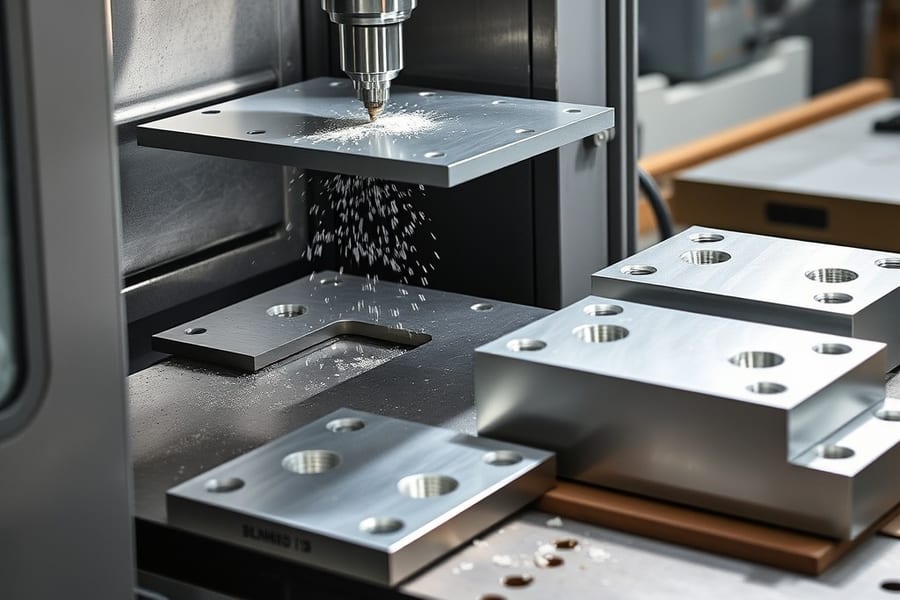
10 mm aluminum plate is usually face-milled on both sides before finishing — AI-generated illustration
Parts that only need stiffness without pockets, such as floors, load-bearing panels or small gussets, are often fine in 5 mm plate, at half the weight; see our article 5mm aluminum sheet: weight, tolerance, alloy choice and fabrication or the 5mm aluminum sheet page. Conversely, if a part must be face-milled on both sides and still finish at 10 mm, order thicker plate to allow machining stock.
If you need 10mm aluminum plate in 1050, 3003 or 5052, cut to size with a mill certificate, send a request via our aluminum sheet and coil quotation page or call hotline/Zalo 0904 678 236 (Sales Department) for advice on the right alloy and thickness for each job.
Nhôm tấm 10mm là tấm bản dày dùng làm đế máy, bàn gá, bản mã chịu tải và chi tiết pha...

Triển lãm Quốc tế Vietbuild Hà Nội 2026 lần III diễn ra từ 11 đến 14/11 tại VEC Đông...

Nhôm tấm 5mm đủ cứng để làm sàn xe, đế máy, gá và bản mã chịu lực mà vẫn cắt, khoan,...

Giá nhôm thỏi SMM A00 chốt tuần 44/2026 ở 23.780 CNY/tấn ngày 30/10, cao hơn 110 CNY/...

Ngày 26/10/2026, CHALIECO công bố trúng gói tổng thầu EPC khoảng 833 triệu USD cho nh...

Nhôm tấm 1mm nhẹ, dễ cắt gấp nên được dùng nhiều cho vỏ tủ điện, hộp thiết bị, ốp tra...

Giá nhôm thỏi SMM A00 chốt tuần 43/2026 ở 23.670 CNY/tấn ngày 23/10, cao hơn 210 CNY/...

Ngày 21/10/2026, VIR đưa tin các nhà đầu tư nước ngoài tiếp tục rót hàng tỷ USD vào đ...
Bảng giá nhôm thỏi SMM A00, LME 3 tháng và tỷ giá USD/VND các tuần gần nhất, cập nhật...

Nhôm có mặt từ nồi chảo đến thùng xe tải, nhưng mỗi việc hợp với một mác và một độ dà...


