



FDI tăng 74%, công nghiệp hỗ trợ cơ khí vẫn khó vào chuỗi
Vốn FDI đăng ký 10 tháng 2026 đạt 54,85 tỷ USD, tăng 74%, nhưng trong khoảng 1.000 do...


On 14 and 15 November 2026, two Vietnamese newspapers raised the same question: foreign direct investment (FDI) into Vietnam is growing at its fastest pace in years, so why do local machine shops still struggle to become suppliers to foreign-invested factories? This article summarizes the key figures, the localization target for mechanical engineering, and practical steps shops can take now, including material choice.
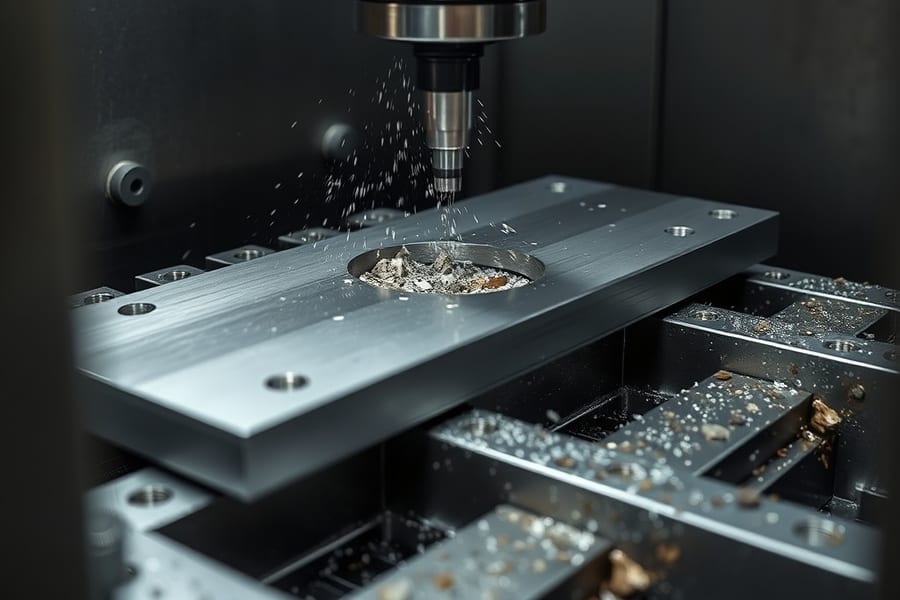
Jigs, base plates and housings are work local machine shops can take on for foreign-invested factories — AI-generated illustration
According to data up to 31 October 2026 cited by Thuong hieu & Cong luan, registered FDI in the first ten months reached US$54.85 billion, up 74% year on year; disbursed FDI reached US$24.08 billion, up about 13%. Manufacturing and processing alone attracted US$25.2 billion, or 45.9% of registered capital, leading all sectors.
The supply side looks different. Cong Thuong newspaper cited Pham Van Quan, Deputy Director of the Industry Agency (Ministry of Industry and Trade): Vietnam has about 7,000 supporting industry companies, around 88% of them small and medium-sized. Only about 1,000 are able to supply multinationals directly, and local firms account for about 30% of those. About 20% hold ISO 9000 certification, just over 10% use automation equipment and fewer than 10% use robots.
Samsung Vietnam is a concrete example: according to the article, it has 340 Vietnamese tier-1 and tier-2 suppliers, but most provide consumables, packaging and low-value parts. Nguyen Hoang, chairman of the Hanoi Supporting Industry Business Association (HANSIBA), said many mechanical manufacturers still have to find machining partners on their own because there is no shared database linking provinces.
The two sources give different tier-1 figures: Thuong hieu & Cong luan quotes an expert estimate of about 100 Vietnamese companies acting directly as tier-1 suppliers to multinationals, while Samsung's 340 combines tier 1 and tier 2. The scopes differ, so the numbers cannot be compared directly.
Decision 929/QD-TTg of 25 May 2026 approved the Supporting Industry Development Programme for 2026–2035. According to the Ministry of Industry and Trade, the localization target for mechanical engineering is 40% by 2030 and 50% by 2035; for electronics 25–30% and then 35–40%; for automobiles 22–30% and then 32–40%. The programme plans to support about 600 companies with management systems and about 80 with R&D and technology transfer by 2030. Cong Thuong also mentions Politburo Resolution 10-NQ/TW, which sets an average localization target of 45–50% for key industries; this is a separate, higher target than the 40–45% in Decision 929.
Trials are already under way in the north. On 28 October 2026 in Bac Ninh, Samsung and the provincial Department of Industry and Trade reviewed two projects that helped 16 northern companies build smart factories and smart moulds. One company raised productivity in its pressing and stamping stage by 53.8%.
Foreign-invested factories need many mechanical parts around their production lines: jigs, base plates, trays, equipment housings, guards and light machine frames. This is work local shops can do, and aluminum sheet is a common material because it is light, rust-free, easy to mill and easy to bend.
Foreign customers often require material traceability. When buying aluminum, shops should ask for a mill certificate stating grade, temper, thickness and lot number, and keep it with the order file. A common mistake is mixing several sources for the same part, so the shop cannot prove origin when the customer audits. Weekly reference prices are available in the weekly aluminum sheet price table.
For 5052, 3003, 1050 aluminum sheet or coil for jigs, equipment housings and stamped parts, please send a request via our aluminum sheet and coil quotation page or call hotline/Zalo 0904 678 236 (Sales Department) for advice on the right grade and thickness.
Vốn FDI đăng ký 10 tháng 2026 đạt 54,85 tỷ USD, tăng 74%, nhưng trong khoảng 1.000 do...

Lớp nhôm bọc bên ngoài bảo ôn quyết định bảo ôn có khô và bền hay không. Bài viết đưa...

Sản lượng ô tô lắp ráp trong nước 10 tháng 2026 tăng 25,1%, nhưng nhập khẩu linh kiện...

Nhôm tấm 10mm là tấm bản dày dùng làm đế máy, bàn gá, bản mã chịu tải và chi tiết pha...

Triển lãm Quốc tế Vietbuild Hà Nội 2026 lần III diễn ra từ 11 đến 14/11 tại VEC Đông...

Nhôm tấm 5mm đủ cứng để làm sàn xe, đế máy, gá và bản mã chịu lực mà vẫn cắt, khoan,...

Giá nhôm thỏi SMM A00 chốt tuần 44/2026 ở 23.780 CNY/tấn ngày 30/10, cao hơn 110 CNY/...

Ngày 26/10/2026, CHALIECO công bố trúng gói tổng thầu EPC khoảng 833 triệu USD cho nh...

Nhôm tấm 1mm nhẹ, dễ cắt gấp nên được dùng nhiều cho vỏ tủ điện, hộp thiết bị, ốp tra...

Giá nhôm thỏi SMM A00 chốt tuần 43/2026 ở 23.670 CNY/tấn ngày 23/10, cao hơn 210 CNY/...


