

Aluminum Sheet Applications in Fabrication: 1050, 3003 or 5052
Aluminum is used in everything from cookware to truck bodies, but each job suits a sp...


Ask what aluminum is used for and the answer is very broad: cookware, aluminum windows, beverage cans, aircraft. For a fabrication shop about to order material, the question is much narrower: should the job use sheet or coil, alloy 1050, 3003 or 5052, and how thick. This article covers common aluminum sheet applications in four groups of workshops: automotive, electronics, machinery and household fabrication, with guidance on alloy, thickness and the usual buying mistakes.
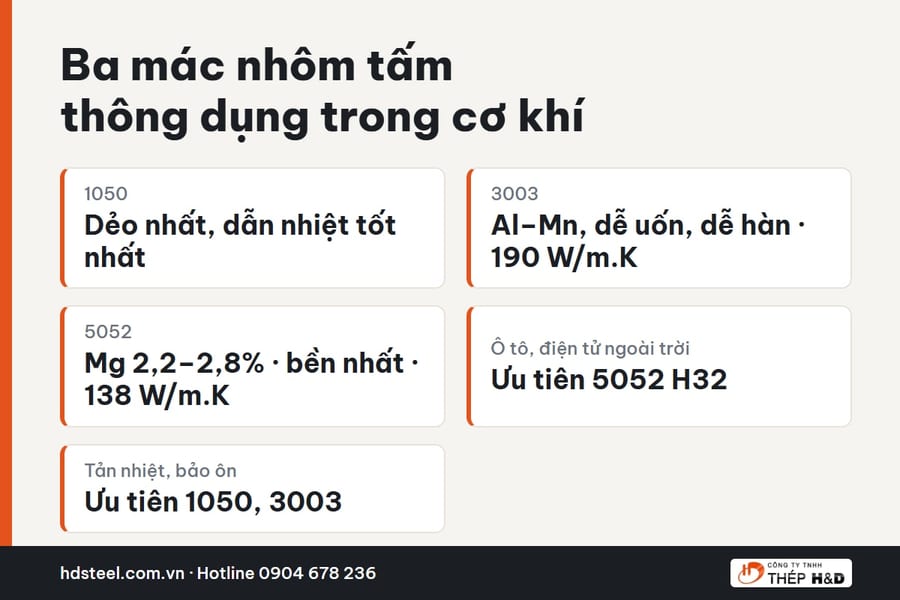
Three common aluminum sheet alloys and their main uses (compiled by H&D Steel)
Most sheet and coil applications in fabrication revolve around three alloys: 1050, 3003 and 5052. None of them can be strengthened by heat treatment; sheet hardness comes from cold rolling and is shown by the temper code after the alloy, such as O (annealed), H14 or H32. The main difference between the three lies in the alloying element:
The table below summarizes the ratings from the two datasheets. The ratings are the distributors' own scale and are only useful for comparing the alloys with each other.
| Property | 1050 | 3003 | 5052 |
|---|---|---|---|
| Strength | Low | Medium | Highest of the three |
| Cold working (bending, pressing) | Excellent | Very good | Good |
| Arc welding | Excellent | Very good | Very good |
| Thermal conductivity (W/m.K) | Highest of the three | 190 | 138 |
| Best environment | Indoor, food, mild chemicals | Normal atmosphere | Outdoor, coastal, industrial atmosphere |
Detailed physical data for each alloy (density, thermal expansion, elastic modulus) is in our article on physical properties of aluminum 1050, 3003, 5052. A general overview is in applications of aluminum from daily life to industry.
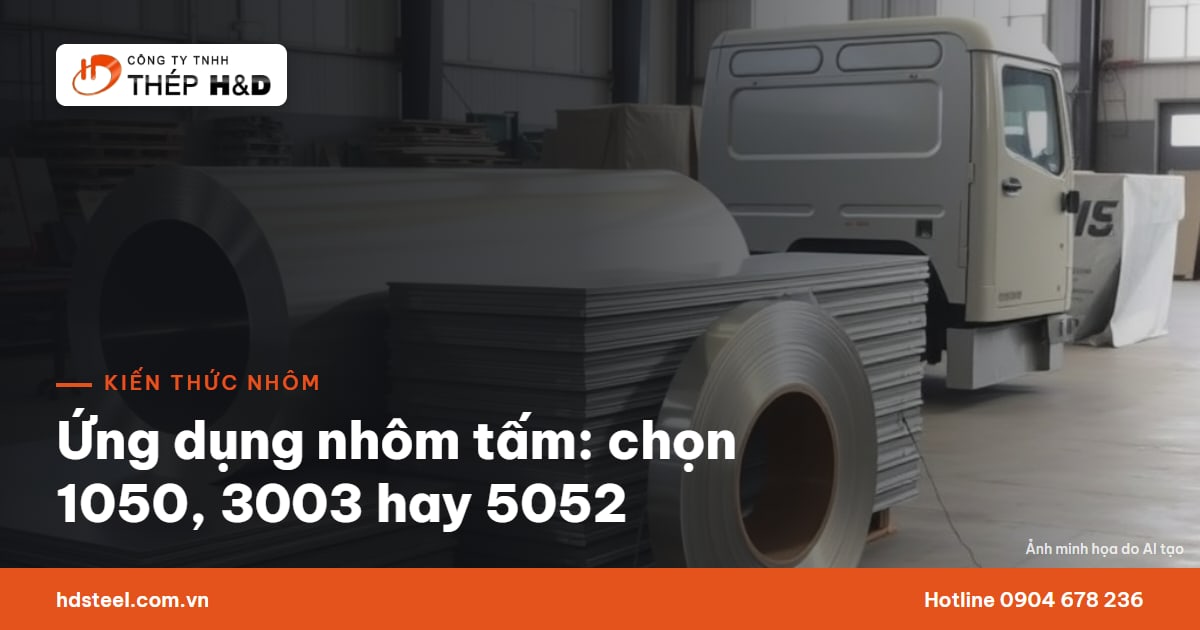
Truck body, special vehicle and component builders use aluminum to cut tare weight, so the vehicle carries more cargo within the same permitted load.
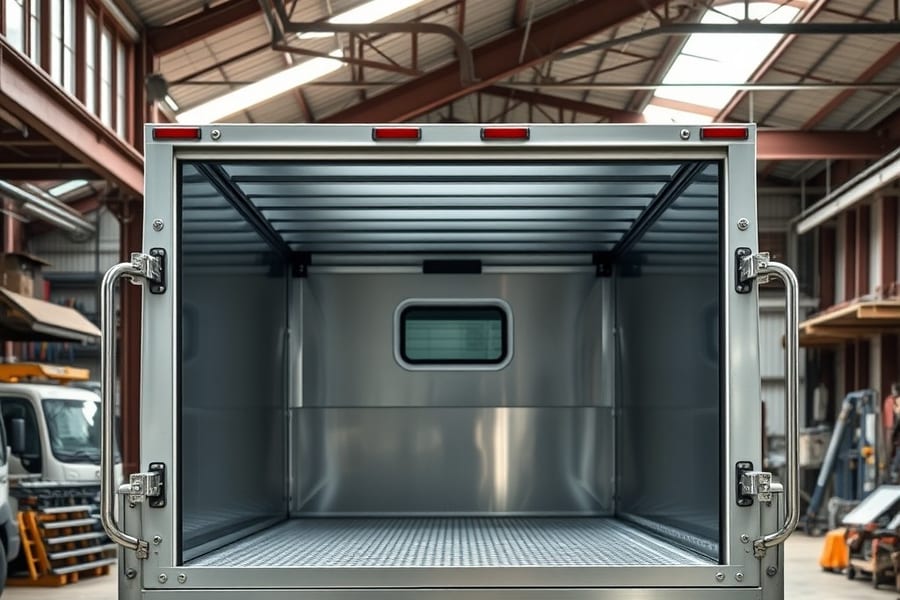
Truck bodies are a common aluminum sheet application in automotive workshops — AI-generated illustration
This group makes electrical cabinets, equipment housings, machine frames, heat sinks and brackets for electronics plants, data centers and solar systems.
Thicknesses in the table are common ordering ranges for reference only; the final gauge must follow the drawing, load and support spacing.
| Application | Alloy to check first | Product form | Reference thickness |
|---|---|---|---|
| Truck floors, steps | 5052, 3003 | Tread plate | 2–5 mm |
| Body walls, tool boxes | 5052 H32 | Sheet | 1.5–3 mm |
| Outdoor electrical cabinets | 5052 H32 | Sheet | 1.5–2.5 mm |
| Heat spreaders, reflectors | 1050 | Sheet, coil | 0.5–3 mm |
| Insulation jacketing | 1050, 3003 | Coil | 0.3–0.8 mm |
| Signs, cladding panels | 3003, 5052 | Sheet, coil | 1–3 mm |
Available thicknesses and widths are listed on our aluminum sheet 1050, 3003, 5052 page; coil and slit strip are on the aluminum coil and slit strip page.
If you need aluminum sheet or coil for truck bodies, electrical cabinets, tanks or signs and are not sure which alloy to choose, please send a request via our aluminum sheet and coil quotation page or call hotline/Zalo 0904 678 236 (Sales Department) for advice on the right alloy and thickness for each job.
Aluminum is used in everything from cookware to truck bodies, but each job suits a sp...
The SMM A00 aluminium ingot price ended week 42/2026 at 23,460 CNY/t on 16 October, 1...
5052 aluminum sheet in O, H32 and H34 tempers differs clearly in strength, ductility...
Shanghai reopened after National Day with two down sessions: the SMM A00 aluminium in...
From 20 October 2026, Decree 344/2026/ND-CP opens a state ordering mechanism and ince...
Aluminum's physical figures differ between alloys, and each figure drives a concrete...
The SMM A00 aluminium ingot price fell in all three sessions of week 40/2026, closing...
Vietnam's car market sold 432,548 vehicles in the first eight months of 2026, the fas...
3mm aluminum sheet is the most requested thickness in the thin-to-medium range: stiff...
A6061 is a heat-treatable aluminium–magnesium–silicon alloy widely used for machine f...