




Northern Vietnam semiconductor supply chain: Hanyang expands
Hanyang Digitech, which makes DRAM modules and SSDs for Samsung at Phu Ha Industrial...


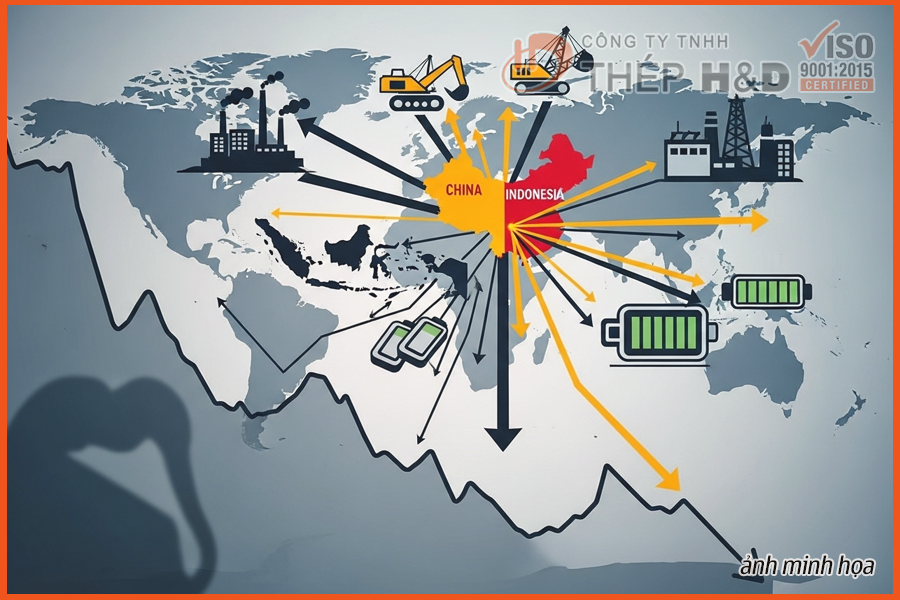
As of September 4, 2025, the global metals market is witnessing a significant geopolitical shift, driven by the collapse in nickel prices. Nickel prices have plummeted to just over $15,000 per ton, roughly one-third of their 2022 peaks. This sharp decline not only imposes severe financial strain on nickel producers worldwide but also significantly consolidates China's and Indonesia's grip on the global nickel supply chain, undermining Western efforts to diversify sources of this strategic material.
The fundamental reason for the nickel price collapse is the persistent oversupply in the market. The International Nickel Study Group (INSG) projects a surplus of approximately 198,000 tonnes of nickel in 2025, with global output reaching about 3.735 million tonnes, exceeding consumption of 3.537 million tonnes. This imbalance is primarily fueled by Indonesia's aggressive production expansion.
Indonesia has emerged as a global nickel powerhouse, now controlling about 65% of the world's nickel production through low-cost, Chinese-operated facilities. The Southeast Asian nation is not only boosting ore output but also extending its control downstream into more refined processing stages, including battery and electric vehicle (EV) manufacturing. Indonesia's production growth is expected to increase by another 8.5% this year, further exerting downward pressure on global prices. Analysts forecast nickel to average around $15,700 – $15,730 per ton throughout 2025, indicating a prolonged bearish outlook.
Beyond supply factors, demand dynamics are also shifting, contributing to nickel's price weakness:
Amidst the nickel price collapse, China has made strategic moves to solidify its position. Since late 2024, China has doubled its reserves of high-purity Class 1 nickel. This strategic stockpiling not only reshapes global inventory and market dynamics but also reinforces China's long-term strategic positioning in battery-grade nickel supply. This stockpiling acts as a physical buffer that could stabilize the structurally oversupplied market over time and enhance China's control over this critical material supply.
Low nickel prices have had severe consequences for producers outside the China-Indonesia axis. Over 50% of global nickel producers are operating at negative cash margins at current prices, leading to significant supply attrition. For instance, Australia's output has fallen by 25%, and New Caledonia's by half. Mining giant BHP is also reviewing the sale of its Western Australian nickel assets, signaling industry strain.
These market conditions severely undermine Western efforts to reduce reliance on China and Indonesia for nickel, a metal of strategic importance in defense and EV manufacturing. US policy changes, including the abolition of EV tax credits and the imposition of new tariffs, dampen US demand and create uncertainty, disadvantaging Western supply chain diversification efforts. This raises concerns about future supply vulnerability for Western nations.
The short-term outlook for nickel remains challenging. Persistent oversupply, particularly from Indonesia, combined with subdued demand from key industries, will continue to exert downward pressure on prices. While total nickel demand may remain stable, a qualitative shift is occurring—from stainless steel applications to battery applications. This transition, along with the evolution of new battery technologies, will affect pricing dynamics and long-term demand forecasting.
For investors and technical experts, understanding these factors is crucial. Companies need to re-evaluate their production strategies and supply chains to adapt to the low-price environment and increased competition. To learn more about other important materials, you can refer to the article What is Aluminum? All you need to know about its properties and applications. Additionally, a solid grasp of technical standards is essential to ensure product quality in a volatile market, for example, Important Aluminum Standards: ASTM, EN, JIS, GB/T Lookup Guide.
Conclusion: The collapse in nickel prices has solidified China's and Indonesia's dominant positions in the global supply chain, creating significant challenges for Western industrial and strategic autonomy. Oversupply driven by Indonesian production, coupled with subdued demand from the EV sector due to policy rollbacks, is putting prolonged downward pressure on prices, threatening producers outside this axis and complicating global supply diversification efforts.
Hanyang Digitech, which makes DRAM modules and SSDs for Samsung at Phu Ha Industrial...

A weight table for aluminum floor plate by thickness, a comparison with steel tread p...

The SMM A00 aluminium ingot price ended week 47/2026 at 22,340 CNY/t on 20 November,...

Registered FDI in Vietnam reached US$54.85 billion in the first ten months of 2026, u...

The aluminum jacket over pipe insulation decides whether the insulation stays dry and...

Vietnam's domestic car assembly rose 25.1% in the first ten months of 2026, yet impor...

10mm aluminum plate is true thick plate, used for machine bases, fixture tables, load...

The third Vietbuild Hanoi 2026 international exhibition runs from 11 to 14 November a...

5mm aluminum sheet is stiff enough for truck floors, machine bases, fixtures and load...

The SMM A00 aluminium ingot price ended week 44/2026 at 23,780 CNY/t on 30 October, 1...


