




Northern Vietnam semiconductor supply chain: Hanyang expands
Hanyang Digitech, which makes DRAM modules and SSDs for Samsung at Phu Ha Industrial...


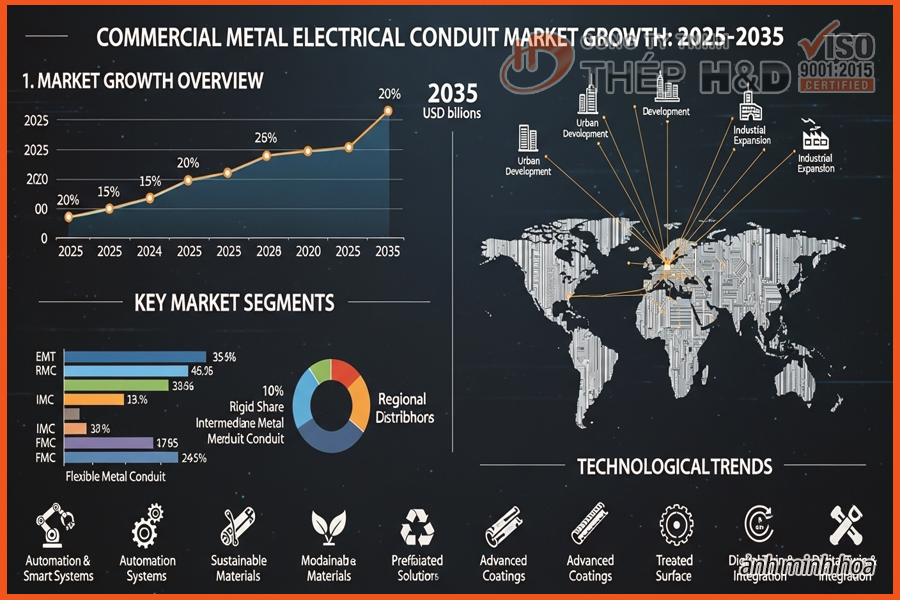
The commercial metal electrical conduit market is projected to reach USD 723.2 million in 2025 and expand to USD 1.3 billion by 2035, registering a compound annual growth rate (CAGR) of 6.1% during the forecast period. This growth demonstrates moderate resilience to macroeconomic fluctuations, particularly those related to construction volume, industrial electricity usage, and building code compliance.
Between 2025 and 2030, the market is expected to grow cumulatively by 34.4%, driven by infrastructure budgets and expansion of industrial output in middle-income economies. From 2030 to 2035, growth will continue at a similar pace, with the market size increasing from USD 972.3 million to USD 1.3 billion.
Key growth drivers include stricter building codes, increasing non-residential construction, and enhanced focus on electrical safety and fire resistance. Adoption of metal conduits instead of plastic options has accelerated due to regulations mandating protection of electrical conductors from mechanical damage.
Metal conduit systems are preferred for their superior grounding capabilities and reduced electromagnetic interference, which are crucial in high-performance wiring applications. Investments in smart building technologies and energy-efficient retrofits are expected to boost conduit replacement cycles.
Manufacturers are developing lightweight, easy-to-install, and prefabricated conduit products to improve labor efficiency across commercial installations. Electrification efforts worldwide, especially in emerging markets, sustain strong demand prospects for commercial metal conduit systems.
The market is segmented by trade size (½ to 1, 1 ¼ to 2, 2 ½ to 3, 3 to 4, 5 to 6, and others), by configuration (Electrical Metal Tubing (EMT), Rigid Metal Conduit (RMC), Galvanized Rigid Conduit (GRC), and Intermediate Metal Conduit (IMC)) and by geography (North America, Latin America, Western Europe, Eastern Europe, Balkan & Baltic countries, Russia & Belarus, Central Asia, East Asia, South Asia & Pacific, Middle East & Africa).
The ½ to 1 trade size segment holds a leading 33.00% revenue share in 2025, favored for standard commercial wiring that requires compact routing and space efficiency. Electrical Metal Tubing (EMT) leads conduit configurations with a 37.00% revenue share due to its lightweight, cost-effectiveness, ease of bending, and galvanized steel construction suitable for exposed commercial wiring.
North America, Asia-Pacific, and Europe dominate in growth momentum. Leading companies include Atkore, American Conduit, Anamet Electrical, B.E.C. Conduits, Flexa, Gibson Stainless & Specialty, HellermannTyton, Legrand, Nucor Tubular Products, Schneider Electric, Techno Flex, Weifang East Steel Pipe, and Zekelman Industries.
These companies focus on product innovation, manufacturing flexibility, and stringent safety standards while expanding global distribution to leverage urbanization and infrastructure modernization trends.
The market is poised for sustained growth supported by long-term utility projects and regional electrification policies. Volatility in raw material prices such as steel and aluminum, alongside fluctuating interest rates and labor costs, present potential cost and consumption risks.
Advancements in smart buildings, enhanced electrical safety requirements, and infrastructure upgrading remain key growth prospects for commercial metal electrical conduit manufacturers.
Hanyang Digitech, which makes DRAM modules and SSDs for Samsung at Phu Ha Industrial...

A weight table for aluminum floor plate by thickness, a comparison with steel tread p...

The SMM A00 aluminium ingot price ended week 47/2026 at 22,340 CNY/t on 20 November,...

Registered FDI in Vietnam reached US$54.85 billion in the first ten months of 2026, u...

The aluminum jacket over pipe insulation decides whether the insulation stays dry and...

Vietnam's domestic car assembly rose 25.1% in the first ten months of 2026, yet impor...

10mm aluminum plate is true thick plate, used for machine bases, fixture tables, load...

The third Vietbuild Hanoi 2026 international exhibition runs from 11 to 14 November a...

5mm aluminum sheet is stiff enough for truck floors, machine bases, fixtures and load...

The SMM A00 aluminium ingot price ended week 44/2026 at 23,780 CNY/t on 30 October, 1...


