




Northern Vietnam semiconductor supply chain: Hanyang expands
Hanyang Digitech, which makes DRAM modules and SSDs for Samsung at Phu Ha Industrial...


Trong những tháng cuối năm 2025, xuất khẩu thép của Trung Quốc dự kiến sẽ tiếp tục duy trì ở mức cao, mặc dù có thể có những biến động hàng tháng. Các yếu tố như chính sách kinh tế vĩ mô của Trung Quốc, tình hình ngành bất động sản, và các biện pháp bảo hộ thương mại từ các quốc gia khác sẽ là những yếu tố then chốt định hình xu hướng này.
Các nhà đầu tư và chuyên gia trong ngành thép cần theo dõi sát sao các chỉ số kinh tế của Trung Quốc, đặc biệt là các chỉ số liên quan đến ngành xây dựng và sản xuất. Ngoài ra, việc phân tích các động thái chính sách thương mại từ các khu vực nhập khẩu lớn như châu Âu và Bắc Mỹ cũng rất quan trọng.
Đối với các nhà sản xuất thép bên ngoài Trung Quốc, thách thức sẽ là tìm cách duy trì khả năng cạnh tranh thông qua đổi mới công nghệ, tối ưu hóa chi phí và tập trung vào các sản phẩm thép đặc biệt, giá trị gia tăng cao. Đồng thời, việc vận động chính phủ áp dụng các biện pháp thương mại công bằng cũng là một chiến lược cần thiết.
Nguồn tham khảo:
---
: ## China's Steel Exports Surge 10% in First Eight Months of 2025: An In-Depth Analysis of Global Market Dynamics
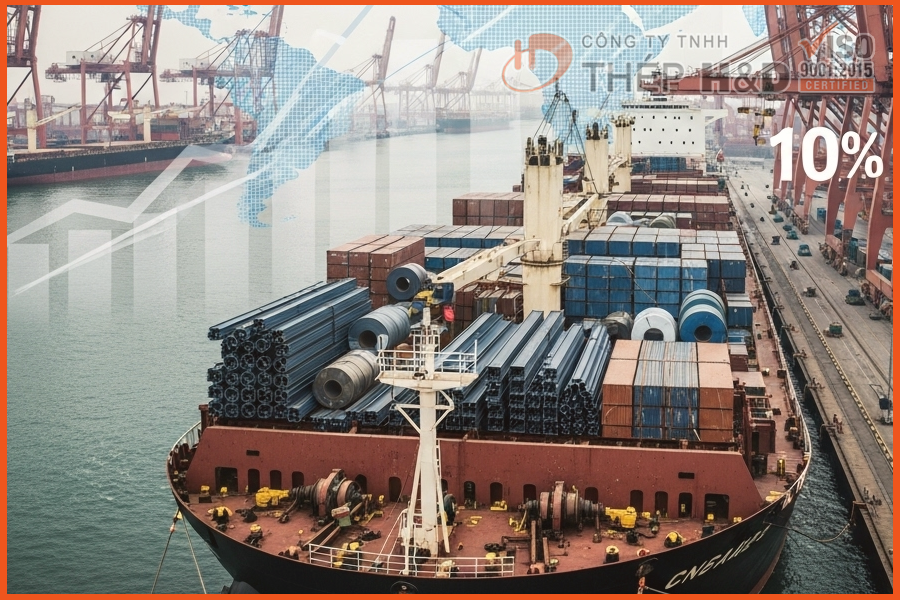
Beijing, China – September 09, 2025 – China's steel industry continues to be a dominant force in the global market, with the latest data revealing a significant 10% year-on-year increase in the country's steel exports during the January-August 2025 period, totaling 77.49 million tons. Despite a slight month-on-month dip of 3.4% in August to 9.51 million tons, the overall trend points to a robust surge, reflecting complex dynamics in both global steel supply and demand.
The 10% increase in China's steel exports during the first eight months of 2025 is an impressive figure, especially considering the immense scale of the country's steel industry. According to S&P Global Commodity Insights, exports of semi-finished and finished steel combined for January-July 2025 had already risen by 20.1% year-on-year, reaching approximately 75.46 million tons, indicating strong momentum in the earlier months. Although August saw a minor monthly adjustment in export volumes, the overall level remains high.
This growth occurs against a backdrop of persistent weakness in China's domestic steel demand, particularly from the construction and real estate sectors, which are facing numerous challenges. The overcapacity in domestic steel production has compelled mills to seek export markets to maintain operations and alleviate inventory pressures.
The significant increase in China's steel exports has far-reaching implications for the global steel market:
In the remaining months of 2025, China's steel exports are expected to remain at elevated levels, although monthly fluctuations may occur. Factors such as China's macroeconomic policies, the state of its real estate sector, and trade protectionist measures from other countries will be key in shaping this trend.
Investors and professionals in the steel industry should closely monitor China's economic indicators, particularly those related to the construction and manufacturing sectors. Furthermore, analyzing trade policy moves from major importing regions like Europe and North America is crucial.
For steel producers outside China, the challenge will be to maintain competitiveness through technological innovation, cost optimization, and a focus on specialized, high-value-added steel products. Simultaneously, advocating for fair trade measures from their respective governments will also be a necessary strategy.
References:
Hanyang Digitech, which makes DRAM modules and SSDs for Samsung at Phu Ha Industrial...

A weight table for aluminum floor plate by thickness, a comparison with steel tread p...

The SMM A00 aluminium ingot price ended week 47/2026 at 22,340 CNY/t on 20 November,...

Registered FDI in Vietnam reached US$54.85 billion in the first ten months of 2026, u...

The aluminum jacket over pipe insulation decides whether the insulation stays dry and...

Vietnam's domestic car assembly rose 25.1% in the first ten months of 2026, yet impor...

10mm aluminum plate is true thick plate, used for machine bases, fixture tables, load...

The third Vietbuild Hanoi 2026 international exhibition runs from 11 to 14 November a...

5mm aluminum sheet is stiff enough for truck floors, machine bases, fixtures and load...

The SMM A00 aluminium ingot price ended week 44/2026 at 23,780 CNY/t on 30 October, 1...


