




Northern Vietnam semiconductor supply chain: Hanyang expands
Hanyang Digitech, which makes DRAM modules and SSDs for Samsung at Phu Ha Industrial...


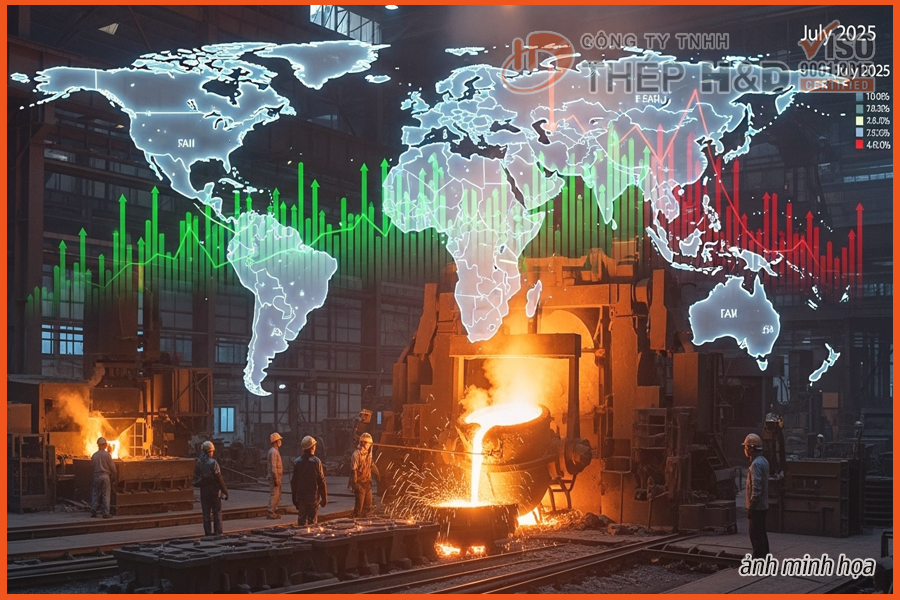
According to the latest report from the World Steel Association (WSA) on August 26, 2025, global crude steel production for July 2025 reached 150.1 million tonnes, a 1.3% decrease compared to the same period last year. However, this aggregate figure conceals a deep and contrasting divergence among key economies and regions, reflecting the complex economic and geopolitical dynamics shaping the global steel market.
Asia, the world's largest steel-producing region, exhibited a clear split. China, the leading producer, saw its output fall by 4.0% to 79.7 million tonnes, signaling efforts to control production and restructure its industry amid signs of slowing domestic demand. In stark contrast, India continued to establish itself as a bright spot, with production soaring by 14.0% to 14.0 million tonnes, fueled by large-scale infrastructure projects and robust construction demand. Meanwhile, Japan recorded a 2.5% decline, producing 6.9 million tonnes, mirroring the broader economic challenges faced by developed industrial nations.
Western economies also displayed different trajectories. The European Union (EU) continued to face headwinds as its output dropped sharply by 7.0% to 10.2 million tonnes, impacted by high energy costs and sluggish industrial activity. Conversely, North America posted positive growth of 5.8%, reaching 9.4 million tonnes. Notably, the United States contributed to this trend with a 4.8% increase to 7.1 million tonnes, indicating a resilient domestic manufacturing and construction sector, possibly supported by protectionist policies and infrastructure investment.
One of the most significant developments was the production boom in the Middle East, which recorded an impressive 27.7% growth to 4.4 million tonnes, showcasing a shift in investment and economic diversification efforts in the region. On the other end of the spectrum, Russia and the CIS countries continued their decline with a 5.1% drop, producing only 6.7 million tonnes, reflecting the prolonged impact of geopolitical factors on their industrial supply chains. Overall, the July 2025 steel market is not just a story of supply and demand, but a map reflecting shifting economic power and geopolitical tensions across the globe.
Hanyang Digitech, which makes DRAM modules and SSDs for Samsung at Phu Ha Industrial...

A weight table for aluminum floor plate by thickness, a comparison with steel tread p...

The SMM A00 aluminium ingot price ended week 47/2026 at 22,340 CNY/t on 20 November,...

Registered FDI in Vietnam reached US$54.85 billion in the first ten months of 2026, u...

The aluminum jacket over pipe insulation decides whether the insulation stays dry and...

Vietnam's domestic car assembly rose 25.1% in the first ten months of 2026, yet impor...

10mm aluminum plate is true thick plate, used for machine bases, fixture tables, load...

The third Vietbuild Hanoi 2026 international exhibition runs from 11 to 14 November a...

5mm aluminum sheet is stiff enough for truck floors, machine bases, fixtures and load...

The SMM A00 aluminium ingot price ended week 44/2026 at 23,780 CNY/t on 30 October, 1...


