




Northern Vietnam semiconductor supply chain: Hanyang expands
Hanyang Digitech, which makes DRAM modules and SSDs for Samsung at Phu Ha Industrial...


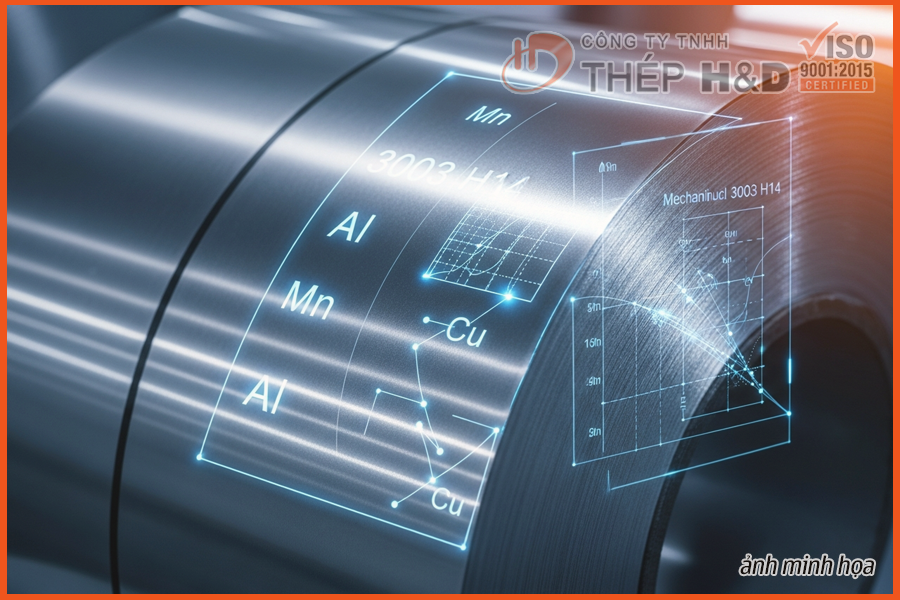
Aluminum 3003 is a 3xxx series alloy, renowned for its excellent formability, high corrosion resistance, and moderate strength. It is a non-heat-treatable alloy, meaning its strength is primarily enhanced through cold working. The primary alloying element is Manganese (Mn), which significantly improves strength compared to pure aluminum (1xxx series) while maintaining the necessary ductility for various applications. Thanks to this balance of properties, Aluminum 3003 has become one of the most widely used aluminum alloys across multiple industries.
The H14 temper of 3003 aluminum indicates that the material has been strain-hardened (cold worked) to approximately 1/2 of its maximum potential hardness. The 'H' signifies strain-hardened, and '14' denotes the specific degree of hardness. The H14 temper provides an optimal balance between strength and ductility, making it an ideal choice for applications requiring good formability while needing higher rigidity than the annealed (O) state. In machining, the H14 temper helps the material retain its shape better after forming, minimizing unwanted deformation, yet remains ductile enough for bending and deep drawing operations without cracking.
The chemical composition of 3003 aluminum is strictly controlled to ensure desired properties. Below is the typical composition:
| Element | Percentage (% by weight) |
|---|---|
| Al | Remainder |
| Mn | 1.0 – 1.5% |
| Si | ≤ 0.6% |
| Fe | ≈ 0.7% |
| Cu | 0.05 – 0.20% |
| Zn | ≈ 0.10% |
Aluminum 3003 H14 typically exhibits the following mechanical values:
| Property / Alloy | Aluminum 1100 (O) | Aluminum 3003 H14 | Aluminum 5052 (H32) |
|---|---|---|---|
| Main Component | Pure Al (min 99%) | Mn (1.0-1.5%) | Mg (2.5%) |
| Tensile Strength (UTS) | Low (90-120 MPa) | Medium (170-210 MPa) | High (210-260 MPa) |
| Yield Strength (YS) | Very Low (35-60 MPa) | Medium (70-140 MPa) | High (150-215 MPa) |
| Ductility | Very High | Good | Moderate |
| Corrosion Resistance | Excellent | Excellent | Excellent (Marine grade) |
| Cost | Low | Moderate | Higher |
Aluminum 3003 H14 is a versatile alloy providing an optimal balance of moderate strength, good formability, and excellent corrosion resistance. Adherence to standards like ASTM B209 ensures material quality and consistency for manufacturing across global markets.
Hanyang Digitech, which makes DRAM modules and SSDs for Samsung at Phu Ha Industrial...

A weight table for aluminum floor plate by thickness, a comparison with steel tread p...

The SMM A00 aluminium ingot price ended week 47/2026 at 22,340 CNY/t on 20 November,...

Registered FDI in Vietnam reached US$54.85 billion in the first ten months of 2026, u...

The aluminum jacket over pipe insulation decides whether the insulation stays dry and...

Vietnam's domestic car assembly rose 25.1% in the first ten months of 2026, yet impor...

10mm aluminum plate is true thick plate, used for machine bases, fixture tables, load...

The third Vietbuild Hanoi 2026 international exhibition runs from 11 to 14 November a...

5mm aluminum sheet is stiff enough for truck floors, machine bases, fixtures and load...

The SMM A00 aluminium ingot price ended week 44/2026 at 23,780 CNY/t on 30 October, 1...


