




Northern Vietnam semiconductor supply chain: Hanyang expands
Hanyang Digitech, which makes DRAM modules and SSDs for Samsung at Phu Ha Industrial...


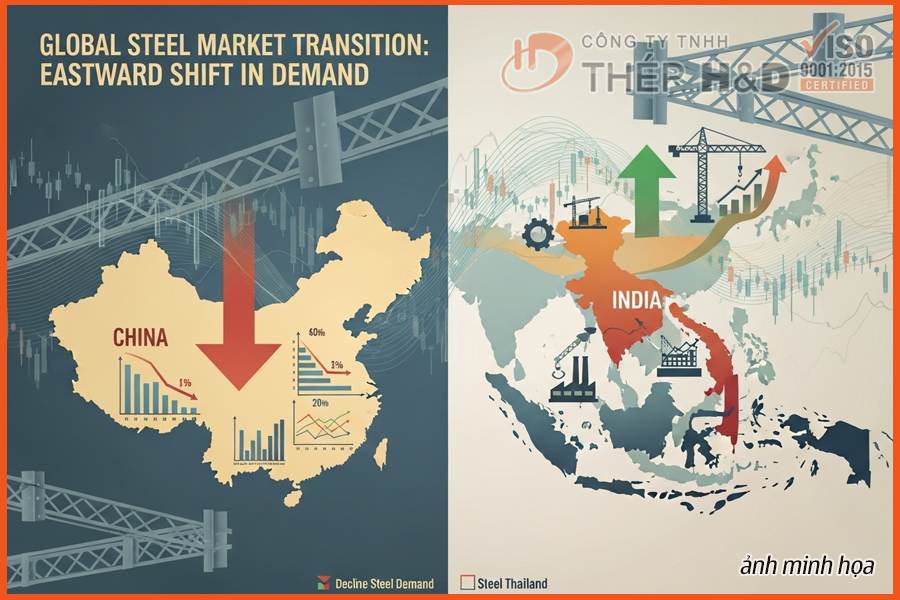
As of September 4, 2025, the global steel industry stands at a historic juncture as China, once its primary growth engine, faces a significant decline in demand. According to in-depth analysis from Wood Mackenzie, China's steel demand is projected to decrease by an average of 3.2% annually between 2024 and 2050. This shift not only reflects internal dynamics within the Chinese economy but also profoundly reshapes global steel supply-demand dynamics and trade, creating new opportunities and challenges for investors, managers, and technical experts.
China's declining steel demand stems from several critical macroeconomic and policy factors:
Despite declining demand, China still grapples with massive steel production overcapacity. Wood Mackenzie forecasts a surplus of 50 million tonnes by 2025, potentially increasing to over 350 million tonnes in the long term without aggressive adjustment measures. To cope, China is expected to cut a total of approximately 240 million tonnes of steel output between 2024 and 2050. However, given its immense production scale, China will maintain its dominant position in global steel supply.
China's declining demand and overcapacity also have direct implications for global steel trade. Global steel trade volumes, estimated at 381 million tonnes in 2024, are projected to decline by 5.4% in 2025. This creates intense competitive pressure and forces producers worldwide to restructure to adapt.
While China slows down, India and Southeast Asia are emerging as new bright spots in the global steel industry:
The global steel industry is undergoing a profound restructuring process. Alongside the geographical shift in demand, there is also a change in the nature of demand. Sectors related to the energy transition, such as wind, solar, and electric vehicles (EVs), are expected to account for about 10% of China's total steel demand by 2030. This necessitates investments by producers in green steel technologies and more specialized steel products.
Wood Mackenzie emphasizes that China's steel sector requires significant restructuring and consolidation to address oversupply and declining profit margins. The lack of strong government support and clear regulatory frameworks for "green steel" investments could hinder the global transition to low-carbon steel production, particularly in China and Europe.
China's declining steel demand marks a new era for the global steel industry. The growth focus is shifting decisively towards India and Southeast Asia, where infrastructure projects and industrialization are generating robust demand. Investors and technical experts must be acutely aware of these changes to adjust their investment and business strategies. Focusing on new growth markets, investing in efficient and sustainable production technologies, and mastering technical standards are key to success in this new landscape. To gain a deeper understanding of fundamental materials, you can refer to the article What is Aluminum? All you need to know about its properties and applications. Furthermore, a solid grasp of Important Aluminum Standards: ASTM, EN, JIS, GB/T Lookup Guide will help in assessing product quality and market potential.
The steel industry is at a crossroads, where adaptability and innovation will determine success in a world no longer solely reliant on traditional growth drivers from China.
Hanyang Digitech, which makes DRAM modules and SSDs for Samsung at Phu Ha Industrial...

A weight table for aluminum floor plate by thickness, a comparison with steel tread p...

The SMM A00 aluminium ingot price ended week 47/2026 at 22,340 CNY/t on 20 November,...

Registered FDI in Vietnam reached US$54.85 billion in the first ten months of 2026, u...

The aluminum jacket over pipe insulation decides whether the insulation stays dry and...

Vietnam's domestic car assembly rose 25.1% in the first ten months of 2026, yet impor...

10mm aluminum plate is true thick plate, used for machine bases, fixture tables, load...

The third Vietbuild Hanoi 2026 international exhibition runs from 11 to 14 November a...

5mm aluminum sheet is stiff enough for truck floors, machine bases, fixtures and load...

The SMM A00 aluminium ingot price ended week 44/2026 at 23,780 CNY/t on 30 October, 1...


