





Giá nhôm tấm tuần 41/2026: SMM A00 rơi về 23.650 CNY/tấn sau lễ
Sàn Thượng Hải mở cửa lại sau Quốc khánh với hai phiên giảm liền: giá nhôm thỏi SMM A...


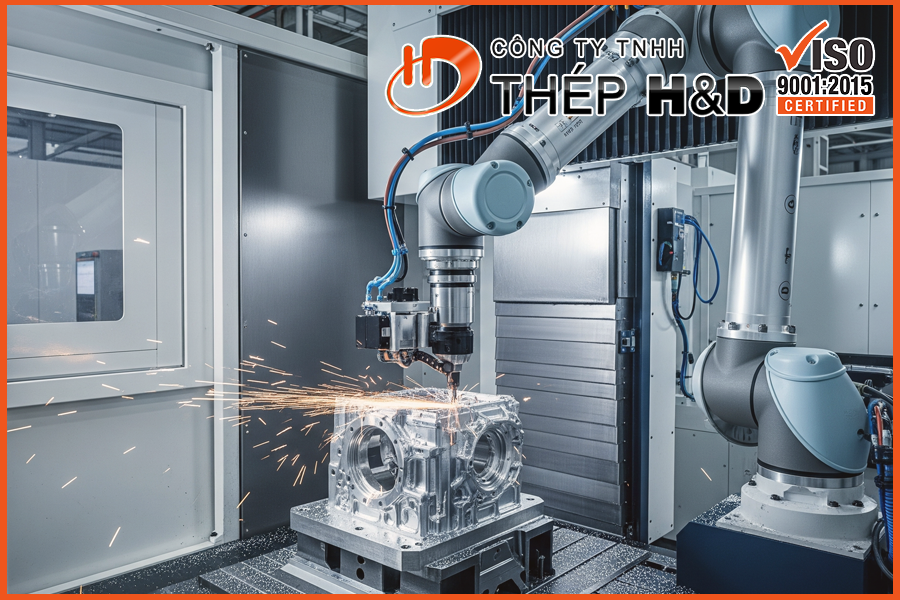
In the rapid development of modern mechanical engineering, materials are the core factor determining breakthroughs in design, durability, and equipment performance. Among countless options, engineering aluminum has risen to become a strategic material. So why do aluminum alloys play such a crucial role in fields ranging from precision machining and machine building to automation and industrial robotics? This article will analyze these aspects in detail.
Not all types of aluminum are the same. Depending on their alloy composition, they are divided into various series with distinct properties, suitable for different machining needs. You can learn more about how to look up these grades here.
The following properties explain why aluminum is an indispensable choice in the machine manufacturing industry.
| Property | Technical Significance & Benefits |
|---|---|
| Lightweight | Reduces inertia in moving parts, allowing machines to operate faster and more accurately while saving energy. |
| Corrosion Resistance | Increases the lifespan of machinery and parts in humid or chemical industrial environments; significantly reduces maintenance costs. |
| Excellent CNC Machinability | Allows for high-speed machining (milling, turning, drilling) with a great surface finish, saving time and production costs. |
| Good Thermal Conductivity | Ideal for heat sinks in machinery, electrical cabinets, or various types of molds requiring precise temperature control. |
| Non-Magnetic | Completely safe for use in electronic devices, medical equipment, or environments with strong magnetic fields. |
| 100% Recyclable | An environmentally friendly material, helping businesses meet sustainable manufacturing standards (ESG). |
To enhance the properties of aluminum, especially its hardness and wear resistance, the following surface treatment technologies are often applied:
| Technology | Main Effect |
|---|---|
| Anodizing | Creates an extremely hard oxide layer, significantly increasing wear and corrosion resistance, and allows for dyeing. |
| Powder Coating | Enhances aesthetics with a wide range of colors and creates an effective protective layer against environmental factors. |
| Laser / Waterjet Cutting | A technology for cutting aluminum sheets into parts with complex profiles with high precision and speed. |
| MIG/TIG Welding | Specialized welding methods for joining aluminum parts to create large, complex machine frame structures. |
The choice between aluminum, steel, and plastic depends on the specific requirements for strength, weight, and cost of the mechanical part.
| Criteria | Aluminum (e.g., 6061) | Stainless Steel (e.g., 304) | Engineering Plastic (e.g., POM) |
|---|---|---|---|
| Weight | Very Light | Heavy | Very Light |
| Strength | Medium - High | Very High | Low - Medium |
| Machinability | Very Good | Fair | Good |
| Corrosion Resistance | Good | Very Good | Good (with chemicals) |
| Cost | Medium | High | Medium |
With its ideal combination of superior technical properties and economic efficiency, engineering aluminum is not just an alternative but has become a critical foundational material in the machine building industry. Its ability to help optimize performance, reduce energy costs, and develop smarter, more sustainable products affirms aluminum's unshakeable strategic position in the 21st century.
Sàn Thượng Hải mở cửa lại sau Quốc khánh với hai phiên giảm liền: giá nhôm thỏi SMM A...
Từ ngày 20/10/2026, Nghị định 344/2026/NĐ-CP mở cơ chế đặt hàng và ưu đãi cho doanh n...
Các con số vật lý của nhôm không giống nhau giữa các mác, và mỗi con số dẫn tới một q...
Giá nhôm thỏi SMM A00 giảm ba phiên liên tiếp trong tuần 40/2026, chốt 24.030 CNY/tấn...
Sau 8 tháng 2026, thị trường ô tô Việt Nam bán 432.548 xe, mức tăng cao nhất trong 6...
Nhôm tấm 3mm là độ dày được hỏi nhiều nhất trong nhóm tấm mỏng vì đủ cứng để làm thùn...
Nhôm A6061 là hợp kim nhôm–magie–silic hoá bền bằng nhiệt luyện, được dùng nhiều nhất...
Chỉ số cước container nội Á của Drewry chốt ngày 24/9/2026 ở 1.491 USD/40ft, tăng 6%...
Giá nhôm thỏi SMM A00 chốt tuần 39/2026 ở 24.240 CNY/tấn, cao hơn 60 CNY/tấn so với t...
Nhôm chống trượt là tấm nhôm có gân nổi một mặt, dùng cho sàn xe, cầu thang và sàn xư...


.jpg)