





Aluminium sheet price, week 41/2026: SMM A00 drops to 23,650
Shanghai reopened after National Day with two down sessions: the SMM A00 aluminium in...


"
As of August 9, 2025, a quiet yet powerful technological revolution is underway in the manufacturing industry for spirits and beverage closures. Led by Guala Closures, one of the world's leading groups, the application of advanced robotics and automation is not only transforming production processes but also setting new standards for quality, precision, and innovation. This represents a quantum leap from traditional manufacturing to the smart factory model of Industry 4.0.
The shift to automation is not a random trend but stems from the increasingly stringent demands of the market. Premium spirits and beverage brands require closures that not only feature sophisticated and complex designs to enhance product value but also integrate advanced anti-counterfeiting features. Manually assembling small components with high precision and consistency on a scale of millions of units is an enormous challenge.
Robotics and automation are the answer to this problem. They enable the performance of repetitive tasks with near-perfect accuracy, 24/7, eliminating the element of human error and ensuring that every product leaving the factory is of uniform quality.
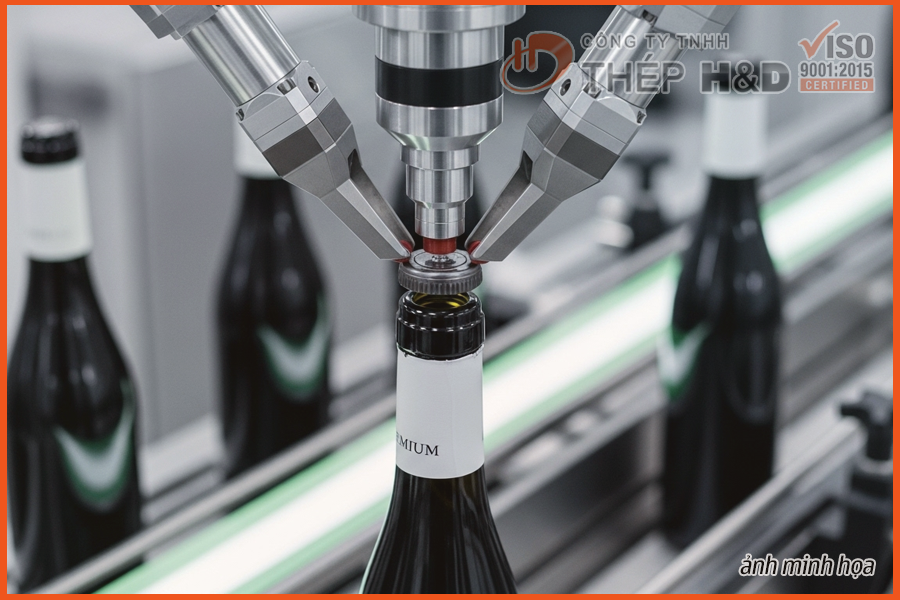
At Guala Closures' advanced factories, particularly at the Magenta facility in Italy, a comprehensive automation ecosystem has been implemented. Key technologies include:
1. Robotic Arm Assembly: Industrial robots are programmed to perform complex assembly tasks, from placing tiny components into their correct positions to joining the different parts of the closure. The speed and precision of robots far exceed human capabilities, leading to a significant increase in productivity.
2. Machine Vision Quality Control Systems: Instead of random sampling, Guala Closures employs a system of high-resolution cameras combined with artificial intelligence (AI) to inspect 100% of products on the line. This system can detect the slightest defects in color, dimension, or printing that are invisible to the human eye, ensuring a near-zero defect rate.
3. Automated Internal Logistics: Automated Guided Vehicles (AGVs) are used to transport raw materials to the production lines and move finished products to the warehouse area, creating a seamless and fully automated production flow.
The robotic revolution at Guala Closures has far-reaching impacts. For the company, it enhances competitiveness, reduces per-unit production costs, and enables the creation of groundbreaking closure designs that were previously impossible. For beverage brands, they receive higher quality, more secure products that help protect their brand integrity.
In the long term, this smart factory model is projected to become the industry standard. It also changes the role of the workforce, shifting from manual labor to higher-skilled positions such as robot technicians, data analysts, and quality control supervisors. This is a clear testament to how technology is reshaping the future of global manufacturing.
Main Reference: Based on analysis and synthesis from the article by The Drinks Business and other specialized automation industry sources, verified on August 9, 2025.
"
Shanghai reopened after National Day with two down sessions: the SMM A00 aluminium in...
From 20 October 2026, Decree 344/2026/ND-CP opens a state ordering mechanism and ince...
Aluminum's physical figures differ between alloys, and each figure drives a concrete...
The SMM A00 aluminium ingot price fell in all three sessions of week 40/2026, closing...
Vietnam's car market sold 432,548 vehicles in the first eight months of 2026, the fas...
3mm aluminum sheet is the most requested thickness in the thin-to-medium range: stiff...
A6061 is a heat-treatable aluminium–magnesium–silicon alloy widely used for machine f...
Drewry's Intra-Asia Container Index closed at 1,491 USD/40ft on 24 September 2026, up...
The SMM A00 aluminium ingot price ended week 39/2026 at 24,240 CNY/t, up 60 CNY/t fro...
Aluminum tread plate is sheet with a raised pattern on one face, used for truck floor...


.jpg)