






5052 Aluminum: O, H32 or H34, Bend Radius and Buying Mistakes
5052 aluminum sheet in O, H32 and H34 tempers differs clearly in strength, ductility...


According to SMM, last week, processing fees for aluminum billets in the Chinese domestic market showed a distinct trend: a dip followed by a rebound. The primary cause of this fluctuation was the sharp volatility in aluminum prices. When aluminum prices were high, demand from downstream factories weakened, forcing billet producers to lower processing fees to stimulate orders. However, as aluminum prices slightly adjusted downwards, restocking activities resumed, pushing processing fees back up.
Understanding what aluminum is and the factors affecting its price is crucial. The entire production chain, from the aluminum smelting process from bauxite ore to the finished product, impacts the final cost.
The fluctuation in processing fees was not uniform across key markets:
Shandong & Henan Markets: At the beginning of the week, due to high aluminum prices and weak demand, major producers significantly lowered processing fees to clear inventory. The fees in Linyi (Shandong) dropped considerably. However, towards the end of the week, as aluminum prices fell, some orders were triggered, leading to a slight recovery in processing fees.
Inner Mongolia Market: Processing fees here were relatively stable and less affected by spot price fluctuations, as they primarily serve long-term contracts.
East China Market (Wuxi): Processing fees in Wuxi also followed the general trend of falling at the start of the week and rising again at the end. The price difference between various brands was not significant.
South China Market (Foshan): Compared to other regions, processing fees in Foshan were quite firm. This was due to a less abundant local supply and some restocking demand from downstream factories, especially for products like 6061 T6 aluminum round bars.
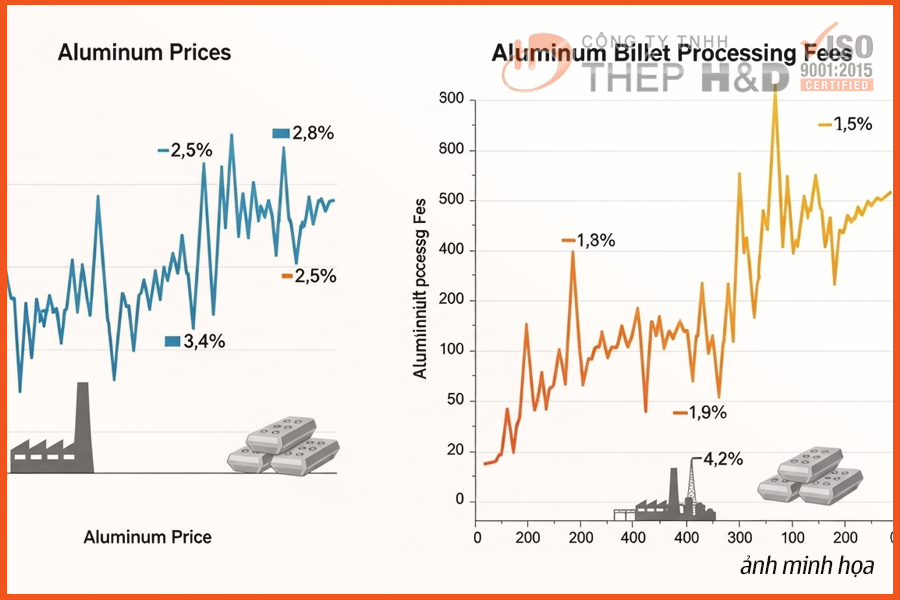
Data from SMM shows that the social inventory of aluminum billets decreased slightly by 0.15 million tons from the previous week, down to 10.75 million tons. This indicates that some consumption occurred, mainly from restocking when prices dropped. However, overall demand from end-user industries remains weak. The role of aluminum in mechanical engineering is significant, but purchasing caution still prevails.
Popular alloys such as aluminum 6061 and aluminum 6063 are staple products, and their fluctuations clearly reflect the market's health.
SMM predicts that if aluminum prices continue to stay high and volatile, downstream enterprises will maintain a cautious stance. The market is currently in a stalemate between high raw material costs and weak end-user demand. Therefore, aluminum billet processing fees are likely to continue fluctuating within a narrow range in the near future. Businesses need to closely monitor aluminum price trends to develop appropriate purchasing strategies, considering different material options, for example, comparing aluminum 5052 and 6061 to optimize cost and production efficiency.
Source: SMM (Shanghai Metals Market) / Hexun Futures
5052 aluminum sheet in O, H32 and H34 tempers differs clearly in strength, ductility...
Shanghai reopened after National Day with two down sessions: the SMM A00 aluminium in...
From 20 October 2026, Decree 344/2026/ND-CP opens a state ordering mechanism and ince...
Aluminum's physical figures differ between alloys, and each figure drives a concrete...
The SMM A00 aluminium ingot price fell in all three sessions of week 40/2026, closing...
Vietnam's car market sold 432,548 vehicles in the first eight months of 2026, the fas...
3mm aluminum sheet is the most requested thickness in the thin-to-medium range: stiff...
A6061 is a heat-treatable aluminium–magnesium–silicon alloy widely used for machine f...
Drewry's Intra-Asia Container Index closed at 1,491 USD/40ft on 24 September 2026, up...
The SMM A00 aluminium ingot price ended week 39/2026 at 24,240 CNY/t, up 60 CNY/t fro...


