





Aluminium sheet price, week 41/2026: SMM A00 drops to 23,650
Shanghai reopened after National Day with two down sessions: the SMM A00 aluminium in...


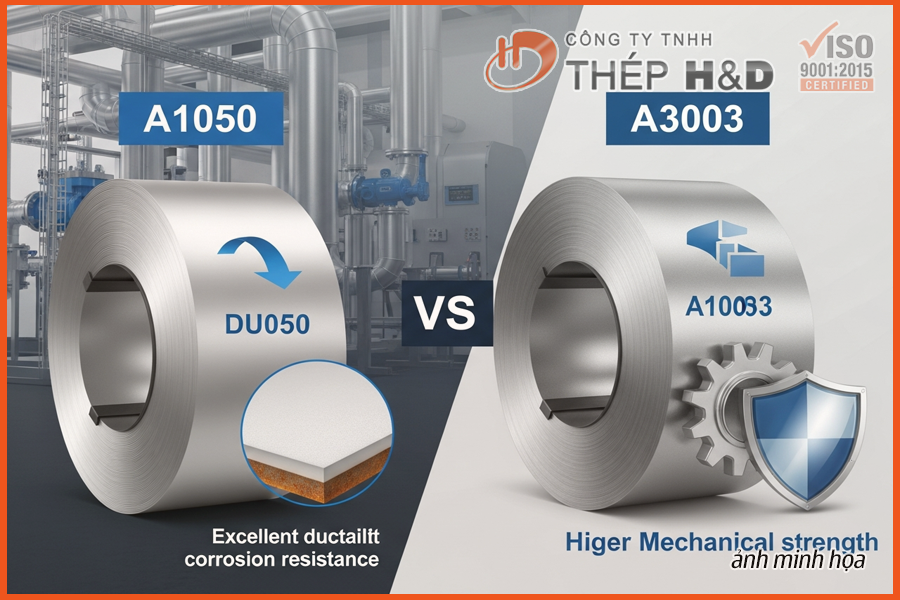
In industries such as petrochemicals, energy, food, and pharmaceuticals, piping systems and equipment often operate at high or low temperatures, requiring effective insulation cladding. This cladding not only helps maintain stable temperatures and save energy but also protects personnel from burn hazards and extends the lifespan of the equipment. The outer cladding material plays a crucial role in protecting the insulation layer from mechanical, chemical, and harsh environmental impacts.
Aluminum coils are a popular choice for insulation cladding due to their lightweight nature, good corrosion resistance, and aesthetic appeal. Among aluminum alloys, A1050 and A3003 are two widely used types. Aluminum A1050 is a high-purity aluminum alloy, notable for its superior ductility and corrosion resistance. Meanwhile, Aluminum A3003 is an aluminum-manganese alloy, providing higher mechanical strength and good corrosion resistance in various environments. Choosing between these two materials requires a careful analysis of mechanical load requirements, environmental conditions, and costs.
Aluminum A1050 belongs to the commercially pure aluminum group, with a minimum aluminum content of 99.5%. Other alloying elements are present in very small proportions, primarily as impurities:
| Element | Percentage (%) |
|---|---|
| Al | ≥ 99.5 |
| Si | 0.0 - 0.25 |
| Fe | 0.0 - 0.40 |
| Mg | 0.0 - 0.05 |
| Zn | 0.0 - 0.07 |
| Ti | 0.0 - 0.05 |
This chemical composition gives A1050 excellent corrosion resistance, especially in atmospheric and freshwater environments, due to the stable passive aluminum oxide layer that forms on its surface.
Aluminum A1050 has relatively low mechanical properties compared to other aluminum alloys, but it possesses outstanding ductility and formability. Specifically:
Aluminum A1050 is typically manufactured and quality-controlled according to international standards such as:
These standards ensure that the material meets the requirements for chemical composition, mechanical properties, and dimensional tolerances.
With its high corrosion resistance and ductility, Aluminum A1050 is widely used in:
Aluminum A3003 is an aluminum-manganese alloy, with manganese being the primary alloying element that enhances strength. Its typical chemical composition includes:
| Element | Percentage (%) |
|---|---|
| Al | 96.8 - 97.3 |
| Mn | 1.0 - 1.5 |
| Cu | 0.05 - 0.2 max |
| Fe | 0.7 max |
| Si | 0.6 max |
| Zn | 0.1 max |
The presence of Manganese (Mn) helps increase tensile and yield strength without significantly reducing corrosion resistance.
Aluminum A3003 has significantly higher mechanical strength than A1050, making it more suitable for moderate load-bearing applications:
Aluminum A3003 also complies with similar international standards as A1050, but with specific requirements for the 3xxx series alloys:
With a balance between strength and corrosion resistance, Aluminum A3003 is widely used in:
The choice between Aluminum A1050 and A3003 depends on the specific requirements of the insulation cladding project. The table below summarizes the main differences:
| Characteristic | Aluminum A1050 | Aluminum A3003 |
|---|---|---|
| Main Composition | Al ≥ 99.5% (pure aluminum) | Al ~97%, Mn (1.0-1.5%) |
| Tensile Strength | Low (90-120 MPa in O temper) | Medium (110-150 MPa in O temper) |
| Yield Strength | Low (35-60 MPa in O temper) | Medium (40-100 MPa in O temper) |
| Ductility | Very High (easy to bend, form) | High (easy to bend, but less than A1050) |
| Hardness | Low | Medium (better wear resistance) |
| Corrosion Resistance | Very Good (especially in atmospheric environments) | Good (due to Mn, better than A1050 in some industrial environments) |
| Weldability | Very Good | Good |
| Cost | Generally lower than A3003 | Generally higher than A1050 |
| Typical Applications | Non-load-bearing insulation cladding, electrical equipment, packaging | Light-load-bearing insulation cladding, kitchenware, construction |
A1050 is pure aluminum, featuring a homogeneous microstructure with few secondary phases, giving it high ductility and excellent corrosion resistance. Conversely, A3003 contains Manganese, forming Al-Mn intermetallic phases dispersed in the aluminum matrix, which increases strength and hardness through precipitation hardening and grain refinement, while maintaining good corrosion resistance.
A3003 outperforms A1050 in mechanical load-bearing capacity. With higher yield and tensile strengths, A3003 is more suitable for insulation cladding applications where the shell needs to withstand light mechanical impacts, shocks, or wind loads. A1050, with its lower strength, is more susceptible to deformation under similar impacts.
Both alloys have good corrosion resistance. A1050 exhibits superior corrosion resistance in atmospheric and freshwater environments due to its high pure aluminum content. A3003, thanks to Manganese, also has good corrosion resistance, particularly in some mildly acidic or alkaline industrial environments, where it can create a more stable protective oxide layer compared to pure aluminum.
A1050 has the highest ductility, making it easy to bend and form complex shapes with minimal cracking. A3003 is still easy to process, but its ductility is slightly lower. Both are easy to weld, but A1050 may require better temperature control to avoid deformation. Regarding cost, A1050 is generally less expensive than A3003 due to its simpler alloy composition.
Aluminum A1050 is the optimal choice for insulation cladding applications requiring high ductility, easy forming, and excellent corrosion resistance in standard environments, where mechanical load is not a decisive factor. Conversely, Aluminum A3003 provides higher mechanical strength, good corrosion resistance, and is more suitable for applications needing to withstand light loads or impacts, or in slightly harsher industrial environments.
A thorough evaluation of environmental factors, anticipated loads, and processing methods will help make the optimal aluminum coil material selection for the performance and longevity of the insulation cladding system.
Shanghai reopened after National Day with two down sessions: the SMM A00 aluminium in...
From 20 October 2026, Decree 344/2026/ND-CP opens a state ordering mechanism and ince...
Aluminum's physical figures differ between alloys, and each figure drives a concrete...
The SMM A00 aluminium ingot price fell in all three sessions of week 40/2026, closing...
Vietnam's car market sold 432,548 vehicles in the first eight months of 2026, the fas...
3mm aluminum sheet is the most requested thickness in the thin-to-medium range: stiff...
A6061 is a heat-treatable aluminium–magnesium–silicon alloy widely used for machine f...
Drewry's Intra-Asia Container Index closed at 1,491 USD/40ft on 24 September 2026, up...
The SMM A00 aluminium ingot price ended week 39/2026 at 24,240 CNY/t, up 60 CNY/t fro...
Aluminum tread plate is sheet with a raised pattern on one face, used for truck floor...


.jpg)