




Aluminum insulation jacketing: thickness by pipe size and sizing
The aluminum jacket over pipe insulation decides whether the insulation stays dry and...


Aluminum insulation jacketing (also called cladding) is the thin metal skin wrapped over mineral wool, glass wool or foam insulation on hot and cold pipes, tanks and equipment. It keeps out rain and sun, resists knocks and keeps the insulation dry; wet insulation loses most of its thermal value and lets the pipe underneath corrode. When ordering, insulators usually ask three things: how thick is enough, how much aluminum each metre of pipe needs, and which alloy to buy. This article answers all three with sourced figures.
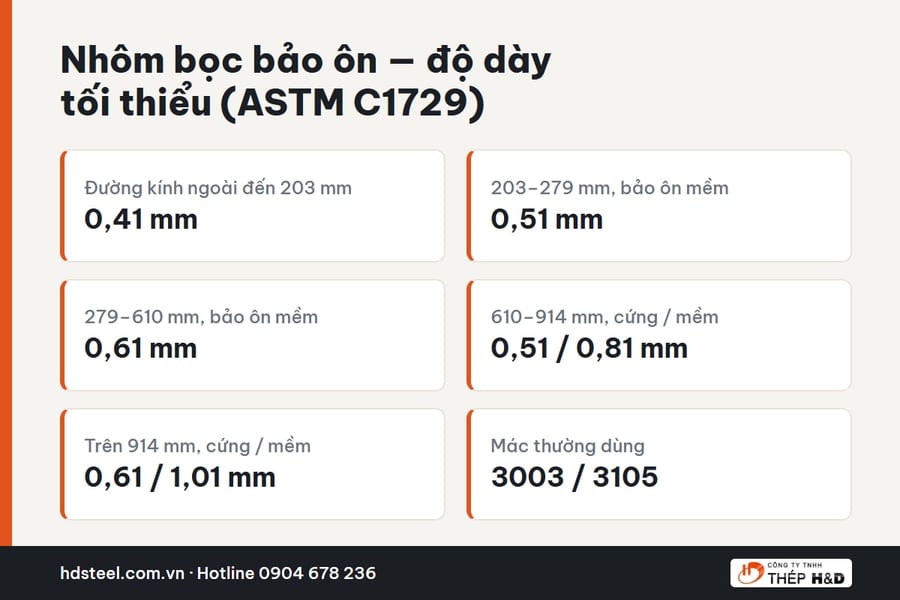
Minimum aluminum jacket thickness by insulation outer diameter (compiled by H&D Steel)
In the US and in many industrial project specifications, aluminum jacketing follows ASTM C1729 (Standard Specification for Aluminum Jacketing for Insulation). According to a technical presentation by the National Insulation Association (NIA), C1729 was first approved in 2010 and incorporates the composition and property requirements of the sheet standard ASTM B209. The standard classifies jacketing along three axes:
The full C1729 text is a paid document; the figures below come from two jacketing manufacturers' data sheets that reproduce the standard's table, and from the NIA presentation.
According to NIA, the required jacket thickness in C1729 depends on two things: the outer diameter of the insulation (larger needs thicker) and the rigidity of the insulation (less rigid needs thicker). Insulation is "non-rigid" when its compressive strength is below 15 psi, about 103 kPa. The aluminum jacketing data sheets from ITW Insulation Systems (Pabco/Childers) and Johns Manville print the same minimum thickness table:
| Insulation outer diameter | Rigid insulation | Non-rigid insulation |
|---|---|---|
| Up to 8 in (≈ 203 mm) | 0.41 mm (0.016 in) | 0.41 mm (0.016 in) |
| Over 8 to 11 in (≈ 203–279 mm) | 0.41 mm | 0.51 mm (0.020 in) |
| Over 11 to 24 in (≈ 279–610 mm) | 0.41 mm | 0.61 mm (0.024 in) |
| Over 24 to 36 in (≈ 610–914 mm) | 0.51 mm | 0.81 mm (0.032 in) |
| Over 36 in (≈ 914 mm) | 0.61 mm | 1.01 mm (0.040 in) |
Three points to read correctly. First, the diameter is the outer diameter of the insulation, not of the pipe. A DN100 pipe (114.3 mm) with 50 mm of insulation is about 214 mm across, already past the 8 in mark. Second, NIA states the required thickness excludes coatings, embossing or corrugation; embossed sheet must be measured on the metal. Third, these are minimums. A nominal 0.4 mm sheet on the minus side of its tolerance falls below 0.41 mm, and 0.5 mm still falls short of 0.51 mm. If the specification cites ASTM C1729, go up one step.
According to the ITW and Johns Manville data sheets, aluminum jacketing is usually made from 3105 or 3003. The two have similar composition and performance and are treated as interchangeable. Pure aluminum is soft and less suited to the job; adding manganese and magnesium and cold working make it stronger. The C1729 alloy list includes 1100 but not 1050. On building projects with no specification, soft and easy-to-roll A1050 is still widely used. If the drawing or tender documents cite ASTM C1729, order 3003 aluminum and ask for a mill certificate showing the alloy. A detailed A1050 vs A3003 comparison for insulation is in our article choosing A1050 or A3003 coil for insulation jacketing; 1050 data is on the 1050 aluminum sheet page.
For the outer finish, the ITW data sheet describes three options: smooth (sheds rain best but shows dents and glare), stucco embossed (hides scratches, slightly stiffer) and 3/16 in corrugated (noticeably stiffer, follows pipe movement better, up to 0.024 in thick). NIA notes the performance difference between them is small; the choice is mostly about appearance.
According to the NIA presentation, C1729 requires a moisture barrier on the inside of pipe jacketing, factory heat-laminated; glued-on barriers are not allowed. Polyfilm lets through more than ten times less water vapor than polykraft. The ITW data sheet gives the polyfilm as 3 mil (76 µm) thick and says it helps prevent pitting, crevice and galvanic corrosion between the aluminum jacket and a steel pipe. When buying plain coil to cut on site, this barrier has to be sourced separately.
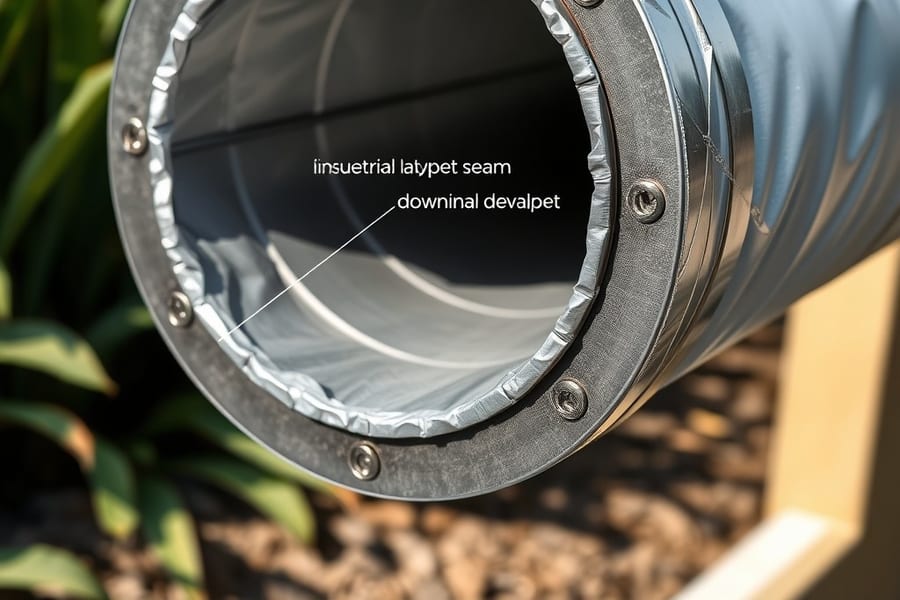
Aluminum jacketing lapped to shed water, with the flange cover overlapping the pipe jacket — AI-generated illustration
The cut length of each sheet is the insulation circumference plus the longitudinal overlap: L = π × D + lap. The table assumes a 50 mm longitudinal lap, a 1,000 mm wide coil with a 50 mm circumferential lap (each sheet covers 950 mm of pipe), and a 3003 density of about 2.73 g/cm³ from the Dinco data sheet. Follow the drawing or project specification for actual laps.
| Pipe + insulation | Outer diameter | Cut length | m² of aluminum / m of pipe | Chosen thickness | kg / m of pipe |
|---|---|---|---|---|---|
| DN50 + 40 mm wool | ≈ 140 mm | ≈ 491 mm | ≈ 0.52 | 0.5 mm | ≈ 0.71 |
| DN100 + 50 mm wool | ≈ 214 mm | ≈ 723 mm | ≈ 0.76 | 0.6 mm | ≈ 1.25 |
| DN200 + 50 mm wool | ≈ 319 mm | ≈ 1,052 mm | ≈ 1.11 | 0.7 mm | ≈ 2.12 |
Thicknesses in the table follow the non-rigid column above plus a margin for tolerance. The total order is the weight per metre times the run length, plus an allowance for elbows, tees, valves and flanges, where cutting waste is usually higher than on straight pipe. Each millimetre of aluminum weighs about 2.7 kg/m², so 0.5 mm sheet is roughly 1.37 kg/m².
Choose aluminum insulation jacketing in three steps: measure the insulation outer diameter, decide whether the insulation is rigid or non-rigid, then take the minimum thickness from the table and add a margin for tolerance. If the specification cites ASTM C1729, use 3003 or 3105 with an interior moisture barrier. Coil sizes are on our aluminum coil and slit strip A1050, 3003, 5052 page.
For aluminum coil for insulation jacketing in 1050 or 3003, in the right thickness for your pipe sizes and with mill certificates, send a request via our aluminum coil and sheet quotation page or call hotline/Zalo 0904 678 236 (Sales Department) for advice on the right specification.
The aluminum jacket over pipe insulation decides whether the insulation stays dry and...

Vietnam's domestic car assembly rose 25.1% in the first ten months of 2026, yet impor...

10mm aluminum plate is true thick plate, used for machine bases, fixture tables, load...

The third Vietbuild Hanoi 2026 international exhibition runs from 11 to 14 November a...

5mm aluminum sheet is stiff enough for truck floors, machine bases, fixtures and load...

The SMM A00 aluminium ingot price ended week 44/2026 at 23,780 CNY/t on 30 October, 1...

On 26 October 2026, CHALIECO announced it had won an EPC contract worth about US$833...

1mm aluminum sheet is light and easy to cut and fold, so it is widely used for small...

The SMM A00 aluminium ingot price ended week 43/2026 at 23,670 CNY/t on 23 October, 2...

On 21 October 2026, VIR reported that foreign investors are adding billions of dollar...


