091 327 0770 - 090 326 2566
info@hdsteel.com.vn

U.S. Expands Critical Minerals List: Far-Reaching Implications for Supply Chains and Trade Policy

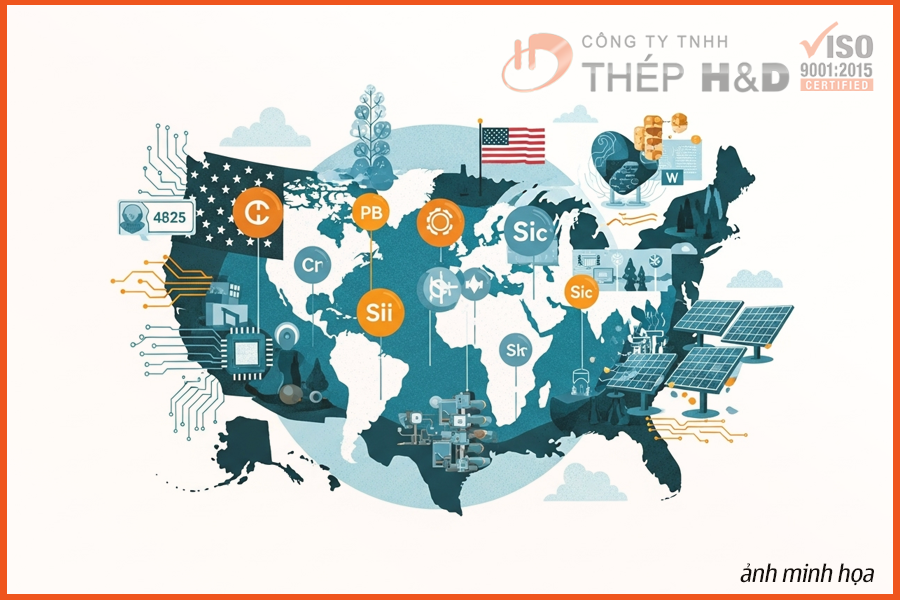
U.S. critical minerals list expands, impacting global supply chains

Washington D.C., September 10, 2025 – The U.S. Department of the Interior, through the U.S. Geological Survey (USGS), has unveiled a significantly expanded 2025 critical minerals list, growing from 50 to 54 minerals. This strategic move reflects Washington's escalating prioritization of supply chain security and economic resilience amidst geopolitical tensions and rapidly evolving technological demands. The addition of six new minerals – potash, silicon, copper, silver, rhenium, and lead – alongside the removal of arsenic and tellurium, marks a pivotal shift in the nation's resource policy.

Key Changes and New Methodology

This revision of the list is not merely a numerical adjustment but a methodological advancement. The 2025 list is underpinned by a new, more sophisticated economic model developed by the USGS. This model focuses on assessing the potential supply chain disruption risks that foreign trade issues could pose to the U.S. economy. By quantifying economic effects and prioritizing minerals by their disruption risk, the U.S. is adopting a more data-driven and comprehensive approach to identifying materials essential for national security and industrial development.

The newly added minerals are all integral to various strategic industries:

  • Potash: Crucial for agriculture and fertilizer production, ensuring food security.
  • Silicon: A foundational element for the semiconductor, electronics, and solar industries.
  • Copper: An essential industrial metal for infrastructure, electronics, renewable energy, and electric vehicles.
  • Silver: Now recognized as strategically critical for national security, clean energy technologies, AI, electronics, and defense.
  • Rhenium: A superalloy metal used in jet engines and gas turbines.
  • Lead: Important in batteries, ammunition, and other industrial applications.

Conversely, the removal of arsenic and tellurium from the list indicates a re-evaluation of their risk profile or a shift in their strategic necessity.

Strategic Rationale Behind the Expansion

The decision to expand the critical minerals list is driven by several key strategic factors:

  1. Supply Chain Security: The U.S. heavily relies on imports for many of these minerals. Designating them as 'critical' enables the government to implement measures to reduce this dependency, especially from geopolitically sensitive sources, thereby mitigating risks of trade disruptions and economic harm.
  2. Growing Strategic Importance: Minerals like silver and copper are increasingly recognized for their indispensable roles in emerging technologies and defense applications. Silver, for instance, is a vital component in solar panels, electric vehicles, and advanced electronics, while copper is the backbone of global electrification.
  3. National Infrastructure and Technological Advancement: The newly added minerals are foundational for building and maintaining modern infrastructure, from smart grids to advanced transportation systems. They also drive innovation in sectors such as artificial intelligence and renewable energy.

Far-Reaching Implications for Industry and Policy

The expansion of the U.S. critical minerals list carries significant implications for investors, managers, and technical experts globally:

  • Tariff and Trade Policy Leverage: With expanded critical mineral designation, the U.S. could implement targeted trade measures, including tariffs or tariff relief, to protect domestic supply chains and encourage domestic mining and processing. This could create a new playing field for domestic producers and influence global pricing.
  • Enhanced Funding and Regulatory Support: Critical mineral status often leads to greater federal funding, streamlined permitting, and official stockpiling programs. This is particularly crucial for metals like silver and copper, where securing domestic production is a high priority. Mining and processing companies may see new opportunities for government support.
  • Supply Chain Security Reinforcement: The updated list underpins strategies to reduce dependence on foreign sources, particularly from geopolitically sensitive regions. This will foster diversification of supply and investment in advanced extraction and recycling technologies.
  • Market and Investment Impact: The inclusion of silver, copper, and other industrial minerals signals significant long-term demand increases due to their roles in clean energy technologies and infrastructure modernization. This is expected to attract investor interest and drive focus within the mining and processing sectors. Investors should consider companies well-positioned to benefit from these policy shifts.

As mandated by the U.S. Energy Act of 2020, periodic reassessment of mineral criticality is required, reflecting a recognition that the evolving technological landscape demands frequent re-evaluation. The National Mining Association (NMA) has applauded the expansion, while also emphasizing that many critical minerals are co-produced with other materials, such as aluminum – the material for modern and future industries, suggesting the need for policies to be broadly applicable to all U.S. mined materials.

Conclusion

In summary, the 2025 critical minerals list expansion reveals a heightened U.S. emphasis on securing supply chains for minerals fundamental to economic security, national defense, and technological leadership. These changes will have significant consequences for trade policy, domestic mining incentives, and industry strategic planning, shaping the future of critical industries for decades to come.

References:

  • Reuters (2025). U.S. critical minerals list expands ahead of possible tariffs.
  • U.S. Geological Survey (USGS). Department of the Interior releases draft 2025 List of Critical Minerals. 
  • NMA (National Mining Association). NMA Applauds Expansion of USGS Critical Minerals List. 
  • USAGOLD. Silver Gains Strategic Status: US Proposes Critical Minerals Designation Amid Supply Concerns.

Related Post

5052 Aluminum: O, H32 or H34, Bend Radius and Buying Mistakes

5052 Aluminum: O, H32 or H34, Bend Radius and Buying Mistakes

5052 aluminum sheet in O, H32 and H34 tempers differs clearly in strength, ductility...

Aluminium sheet price, week 41/2026: SMM A00 drops to 23,650

Aluminium sheet price, week 41/2026: SMM A00 drops to 23,650

Shanghai reopened after National Day with two down sessions: the SMM A00 aluminium in...

Decree 344: Incentives for Power Equipment Makers from 20 Oct

Decree 344: Incentives for Power Equipment Makers from 20 Oct

From 20 October 2026, Decree 344/2026/ND-CP opens a state ordering mechanism and ince...

Physical Properties of Aluminum: 1050, 3003, 5052 Data for Shops

Physical Properties of Aluminum: 1050, 3003, 5052 Data for Shops

Aluminum's physical figures differ between alloys, and each figure drives a concrete...

Aluminium sheet price, week 40/2026: SMM A00 eases to 24,030

Aluminium sheet price, week 40/2026: SMM A00 eases to 24,030

The SMM A00 aluminium ingot price fell in all three sessions of week 40/2026, closing...

Vietnam car market grows fastest in Southeast Asia in 8M 2026

Vietnam car market grows fastest in Southeast Asia in 8M 2026

Vietnam's car market sold 432,548 vehicles in the first eight months of 2026, the fas...

3mm Aluminum Sheet: Weight, Tolerance, Alloy and Buying Errors

3mm Aluminum Sheet: Weight, Tolerance, Alloy and Buying Errors

3mm aluminum sheet is the most requested thickness in the thin-to-medium range: stiff...

6061 aluminum plate: T6 vs T651, thickness and buying pitfalls

6061 aluminum plate: T6 vs T651, thickness and buying pitfalls

A6061 is a heat-treatable aluminium–magnesium–silicon alloy widely used for machine f...

Intra-Asia freight at record high before Golden Week 2026

Intra-Asia freight at record high before Golden Week 2026

Drewry's Intra-Asia Container Index closed at 1,491 USD/40ft on 24 September 2026, up...

Aluminium sheet price, week 39/2026: SMM A00 at 24,240 CNY/t

Aluminium sheet price, week 39/2026: SMM A00 at 24,240 CNY/t

The SMM A00 aluminium ingot price ended week 39/2026 at 24,240 CNY/t, up 60 CNY/t fro...