091 327 0770 - 090 326 2566
info@hdsteel.com.vn

Global Steel Outlook 2050: China's Demand Shifts, Green Steel Era Dawns

China's Steel Demand Share to Plummet: Reshaping the Global Steel Industry Landscape by 2050

China's steel demand decline, global market shifts

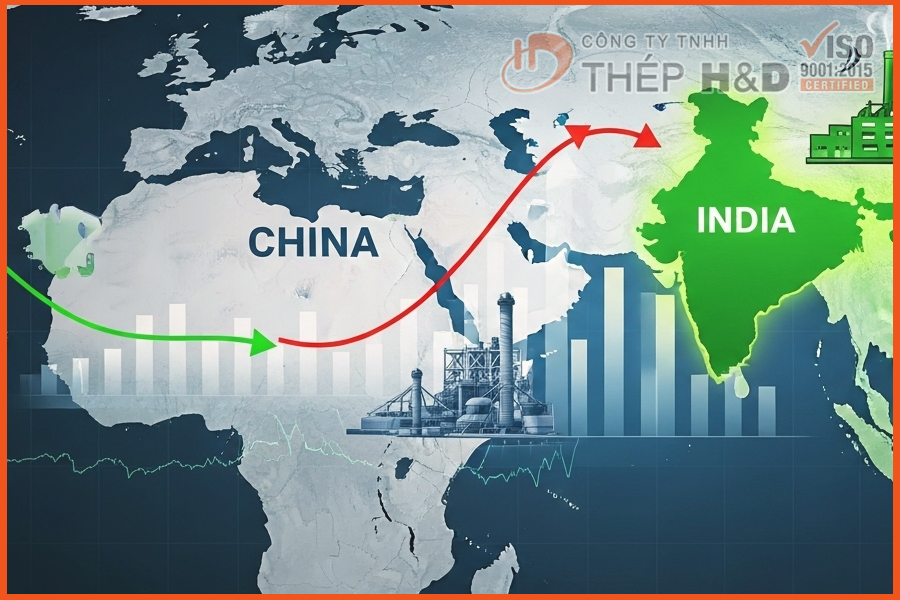
London, September 08, 2025 – A new report from Wood Mackenzie forecasts that China's share of global steel demand is set to significantly decline to approximately 36% by 2050, down from 49% in 2024. This reduction, equivalent to China's steel consumption shrinking by roughly 5-7 million tonnes annually over the next decade, marks a profound structural shift in the global steel industry. It is a consequence of China's economic rebalancing, moving away from construction-led growth, and grappling with severe overcapacity.

Context and China's Declining Steel Demand Forecast

For decades, China has been the primary engine driving global steel demand, with its construction sector playing a central role. However, Wood Mackenzie indicates that this paradigm is changing. China's steel demand will contract due to:

  • Economic Rebalancing: China is transitioning its economic model from investment and export-driven growth to domestic consumption and high-tech industries, which are less steel-intensive.
  • Construction Sector Slowdown: Specifically, steel demand from the housing sector is projected to fall sharply, from its current 40% share to 23% in the long term. This reflects a saturation of the real estate market and debt control policies.
  • Overcapacity: The Chinese steel sector faces significant overcapacity issues, expected to rise to over 250 million tonnes by 2035 and exceed 350 million tonnes by 2050. This puts immense pressure on prices and profitability, driving the need for industry restructuring.
  • Shift to New Sectors: Domestic steel demand is shifting towards sectors like renewable energy and electric vehicles, which require less steel per unit of output compared to traditional construction. By 2030, energy transition sectors are expected to account for around 10% of total steel demand.

The Rise of New Steel Demand Hubs

While China's demand slows, other regions globally are emerging as new growth drivers for steel consumption:

  • India: Projected to experience the most robust growth, with its share of global steel demand tripling from 8% to 21% by 2050. This growth is fueled by rapid industrialization, massive infrastructure investments, and a young population.
  • Southeast Asia: Countries like Vietnam, Thailand, and Indonesia are also expected to double their share of global steel demand, from 5% to 10% by 2050, driven by economic development and urbanization.

This geographical shift will create new opportunities and challenges for steel producers, raw material suppliers, and investors worldwide.

Decarbonization Transformation and Impact on Steel Production

Beyond the geographical shift in demand, the global steel industry is also undergoing a technological revolution in production methods to meet decarbonization goals:

  • Increased Electric Arc Furnace (EAF) Production: Steel production via EAFs, which utilize scrap steel and Direct Reduced Iron (DRI), is projected to rise from about 28% of global steel output today to 50% by 2050. This transition requires an investment of approximately US$130 billion.
  • Greener Feedstocks: The share of greener feedstocks like DRI and high-grade scrap will increase from the current 36% to 54% by 2050.
  • Impact on Raw Materials: The decline in China's traditional steel demand and the rise of green steel technologies will reshape iron ore demand, scrap availability, and trading hubs. China will face excess iron ore and steelmaking capacity, while other regions become strategic centers for both raw materials and cleaner steel production.

Implications for Investors and Technical Experts

These changes present significant opportunities and challenges for industry stakeholders:

  • Steel Producers: Need to restructure operations, invest in green technologies, and seek new markets in India and Southeast Asia. Traditional blast furnace operations in China will face immense pressure to reduce capacity or transition.
  • Raw Material Suppliers: Iron ore demand growth will slow, while demand for scrap and DRI will increase. Supply chains will become more regionalized, requiring flexibility in sourcing strategies.
  • Investors: Need to re-evaluate investments in the steel sector, focusing on companies with clear decarbonization strategies and strong positions in new growth markets. New technologies and alternative materials, such as aluminum materials: Materials for modern industry and the future, will also play an increasingly important role in this context.
  • Technical Experts: Need to develop expertise in EAF technologies, green steel production, and sustainable supply chain management.

Challenges and Outlook

This transition will not be easy. Overcapacity in China and protectionist trade policies globally could hinder investment in "green steel." To accelerate this process, stronger government support and clear policies are needed to incentivize innovation and investment in sustainable technologies.

However, this shift also ushers in a new era for the steel industry, where innovation, efficiency, and sustainability will be key to success. Companies that can adapt quickly to changes in demand and technology will be the leaders of the future.

References:

  • Mining.com – “China’s steel demand share to drop 36% by 2050: Wood Mackenzie” (03/09/2025)
  • Wood Mackenzie – “China’s steel industry at critical crossroads of overcapacity and decarbonisation” (03/04/2025)
  • Anadolu Agency – “China’s steel demand to shrink as India, Southeast Asia drive future growth” (03/09/2025)
  • AIST – “China and Global Steel Demand Forecast Through 2050” (June 2025)
  • Wood Mackenzie – “Steel decarbonisation to redefine supply chains by 2050” (19/10/2023)

Bài viết liên quan

Chuỗi cung ứng bán dẫn miền Bắc: Hanyang mở rộng ở Phú Thọ

Chuỗi cung ứng bán dẫn miền Bắc: Hanyang mở rộng ở Phú Thọ

Hanyang Digitech, nhà cung ứng mô-đun DRAM và ổ SSD cho Samsung tại KCN Phú Hà (Phú T...

Tấm nhôm lót sàn xe tải: trọng lượng, cách lắp và lỗi hay gặp

Tấm nhôm lót sàn xe tải: trọng lượng, cách lắp và lỗi hay gặp

Bảng trọng lượng tấm nhôm lót sàn theo độ dày, so sánh với thép gân cùng độ dày và ví...

Giá nhôm tấm tuần 47/2026: SMM A00 giảm còn 22.340 CNY/tấn

Giá nhôm tấm tuần 47/2026: SMM A00 giảm còn 22.340 CNY/tấn

Giá nhôm thỏi SMM A00 chốt tuần 47/2026 ở 22.340 CNY/tấn ngày 20/11, thấp hơn 790 CNY...

FDI tăng 74%, công nghiệp hỗ trợ cơ khí vẫn khó vào chuỗi

FDI tăng 74%, công nghiệp hỗ trợ cơ khí vẫn khó vào chuỗi

Vốn FDI đăng ký 10 tháng 2026 đạt 54,85 tỷ USD, tăng 74%, nhưng trong khoảng 1.000 do...

Nhôm bọc bảo ôn: chọn độ dày theo đường kính ống và cách tính

Nhôm bọc bảo ôn: chọn độ dày theo đường kính ống và cách tính

Lớp nhôm bọc bên ngoài bảo ôn quyết định bảo ôn có khô và bền hay không. Bài viết đưa...

Công nghiệp phụ trợ ô tô: lắp ráp tăng 25%, linh kiện vẫn nhập

Công nghiệp phụ trợ ô tô: lắp ráp tăng 25%, linh kiện vẫn nhập

Sản lượng ô tô lắp ráp trong nước 10 tháng 2026 tăng 25,1%, nhưng nhập khẩu linh kiện...

Nhôm tấm 10mm: trọng lượng, dung sai, chọn mác và gia công

Nhôm tấm 10mm: trọng lượng, dung sai, chọn mác và gia công

Nhôm tấm 10mm là tấm bản dày dùng làm đế máy, bàn gá, bản mã chịu tải và chi tiết pha...

Triển lãm Vietbuild Hà Nội 11–14/11: xưởng nhôm kính nên xem gì

Triển lãm Vietbuild Hà Nội 11–14/11: xưởng nhôm kính nên xem gì

Triển lãm Quốc tế Vietbuild Hà Nội 2026 lần III diễn ra từ 11 đến 14/11 tại VEC Đông...

Nhôm tấm 5mm: trọng lượng, dung sai, chọn mác và gia công

Nhôm tấm 5mm: trọng lượng, dung sai, chọn mác và gia công

Nhôm tấm 5mm đủ cứng để làm sàn xe, đế máy, gá và bản mã chịu lực mà vẫn cắt, khoan,...

Giá nhôm tấm tuần 44/2026: SMM A00 nhích lên 23.780 CNY/tấn

Giá nhôm tấm tuần 44/2026: SMM A00 nhích lên 23.780 CNY/tấn

Giá nhôm thỏi SMM A00 chốt tuần 44/2026 ở 23.780 CNY/tấn ngày 30/10, cao hơn 110 CNY/...

Call H&D
Send H&D an SMS
Directions to H&D
Contact H&D on Zalo
Message H&D on Messenger