





Aluminium sheet price, week 41/2026: SMM A00 drops to 23,650
Shanghai reopened after National Day with two down sessions: the SMM A00 aluminium in...


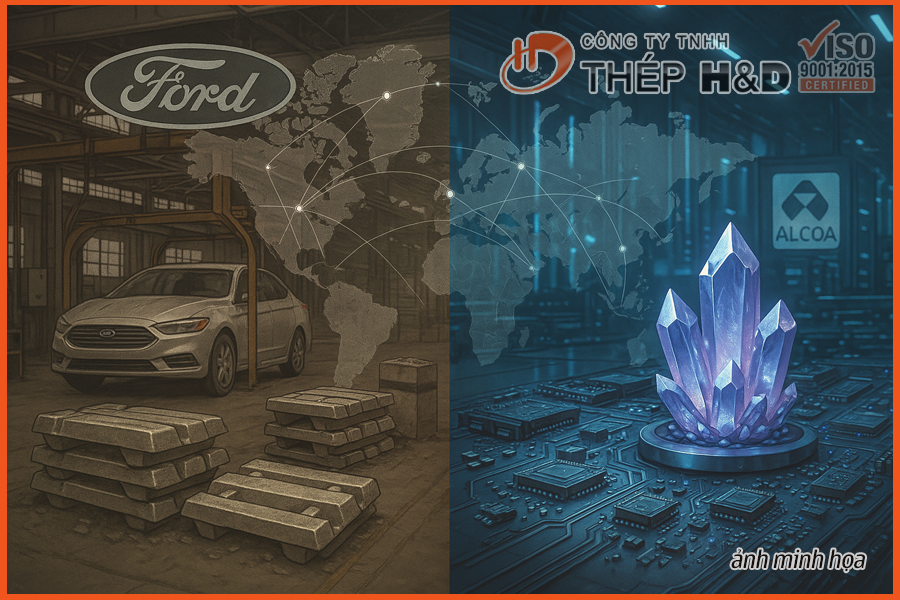
Hanoi & Pittsburgh, October 22, 2025 – The global metals market and manufacturing sectors are witnessing dramatically contrasting developments. While Ford Vietnam grapples with a severe aluminum shortage, forcing the suspension of production for several key models, Alcoa Corporation is making significant strides with a strategic gallium project backed by three governments. These two stories not only reflect distinct challenges and opportunities but also highlight the fragility of global supply chains and the increasing importance of critical minerals. This specialized bulletin will provide an in-depth analysis of these two contrasting situations, offering a comprehensive perspective for investors, managers, and technical experts.
Ford Vietnam is facing a severe production crisis due to a shortage of aluminum, an essential material in the modern automotive industry. According to Techz.vn, five of Ford's key models in Vietnam have had their production halted, raising significant concerns about sales, market share, and brand reputation. This incident not only affects Ford's operations but also impacts its entire supply chain and dealership network.
While Ford faces difficulties, Alcoa Corporation (NYSE: AA), a global leader in aluminum production, is achieving success with a promising strategic project. Alcoa has secured multinational support from the U.S., Australian, and Japanese governments for a groundbreaking gallium development project co-located at its Wagerup alumina refinery in Western Australia. This project aims to produce approximately 100 metric tons of gallium annually, a critical mineral essential for high-tech industries and renewable energy applications.
| Aspect | Ford Vietnam (Aluminum Shortage) | Alcoa (Gallium Project) |
|---|---|---|
| Industry | Automotive manufacturing | Aluminum refining, critical minerals |
| Main Issue | Supply chain disruption, raw material (aluminum) shortage | Strategic development of critical mineral (gallium) production |
| Geographic Focus | Vietnam (local manufacturing) | Western Australia (mining & processing), US-Aus-Japan collaboration |
| Short-term Impact | Production halt, revenue loss, market share risk | Capital investment, project development phase |
| Long-term Outlook | Risk of market share erosion without supply chain recovery | Potential new revenue stream, enhanced geopolitical leverage |
| Investor Sentiment | Negative due to operational risk | Positive due to growth potential and diversification |
| Strategic Response | Needs supply chain diversification and innovation | Government-backed joint venture fosters stability and growth potential |
The contrast between Ford and Alcoa vividly illustrates the challenges and opportunities reshaping the global industrial landscape in 2025. For investors and managers, the following points warrant careful consideration:
2025 is shaping up to be a year of significant volatility and transformation for the metals and manufacturing industries. While Ford Vietnam faces urgent challenges due to an aluminum shortage, Alcoa is capitalizing on the growing demand for critical minerals like gallium. These developments serve as a strong reminder of the necessity for agile supply chain strategies, adaptability to geopolitical shifts, and investment in future materials and technologies. Investors and technical experts should closely monitor these trends to make informed decisions, especially given the increasing demand for aluminum sheets 1050, 3003, 5052, 6061, 7075 and other alloys across various industries.
References:
Shanghai reopened after National Day with two down sessions: the SMM A00 aluminium in...
From 20 October 2026, Decree 344/2026/ND-CP opens a state ordering mechanism and ince...
Aluminum's physical figures differ between alloys, and each figure drives a concrete...
The SMM A00 aluminium ingot price fell in all three sessions of week 40/2026, closing...
Vietnam's car market sold 432,548 vehicles in the first eight months of 2026, the fas...
3mm aluminum sheet is the most requested thickness in the thin-to-medium range: stiff...
A6061 is a heat-treatable aluminium–magnesium–silicon alloy widely used for machine f...
Drewry's Intra-Asia Container Index closed at 1,491 USD/40ft on 24 September 2026, up...
The SMM A00 aluminium ingot price ended week 39/2026 at 24,240 CNY/t, up 60 CNY/t fro...
Aluminum tread plate is sheet with a raised pattern on one face, used for truck floor...


.jpg)