




Vietnam auto supporting industry: assembly up 25%, parts imported
Vietnam's domestic car assembly rose 25.1% in the first ten months of 2026, yet impor...


On 11 November 2026, Bao Xay dung published an analysis of the "paradox" in Vietnam's automotive supporting industry: the market is growing fast, but the share of parts made locally remains thin. On the same day, October sales data from the Vietnam Automobile Manufacturers' Association (VAMA) showed the market pausing after months of growth. This article summarizes the key figures and what they mean for truck body builders, parts makers and special-vehicle workshops.
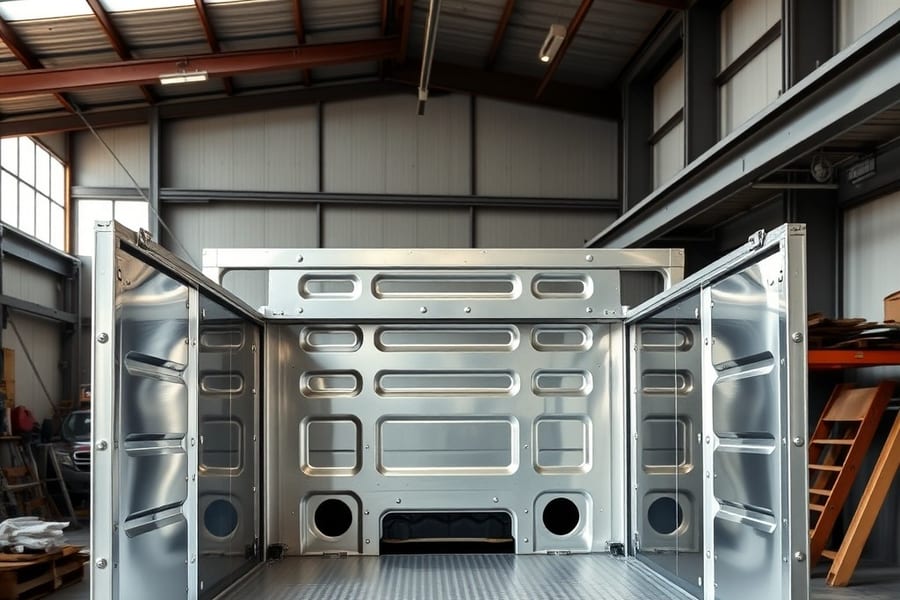
Truck bodies, floors and walls are highly localized parts where aluminum sheet replaces steel to save weight — AI-generated illustration
According to the General Statistics Office, as cited by Bao Xay dung, Vietnam produced and assembled more than 468,000 cars in the first ten months of 2026, up 25.1% year on year. Customs data cited in the same article show auto parts and components imports of US$5.66 billion in the first nine months, up 37.6%, mainly from China, South Korea, Japan and Thailand. In other words, plants are running harder, but most high-value parts are still bought abroad.
The Vietnam Institute of Strategy and Policy for Industry and Trade (VIOIT) estimates localization for vehicles under 9 seats at only about 12–20%, with many popular models at 7–15%. For trucks and buses the rate is about 40–45%, and for special-purpose vehicles about 50–70%. Vietnamese firms make around 300 types of parts such as seats, wiring, glass, tyres and engineering plastics, while engines, gearboxes, electronic controls and sensors are still imported. Local production costs are said to be about 10–20% higher than in the region.
Notably, the article mentions a domestic company supplying aluminum parts for VinFast cars and electric scooters, and Vingroup pledging to share 12–24 month production plans with local suppliers. This signals rising demand for metal components, including aluminum.
According to VAMA, total sales by reporting companies in October 2026 reached 28,957 vehicles, down 17% from September and 24% from October 2025. Of these, 12,753 were assembled locally and 16,204 were fully imported. The ten-month total reached 310,986 vehicles. VinFast, which does not report through VAMA, delivered 22,896 electric cars in October and passed 200,000 units after ten months.
Note that the two data sources differ in scope: VAMA shows locally assembled vehicles from its reporting group down 2% over ten months, while the Statistics Office shows national assembly output up 25.1%. The gap is mainly because VAMA data exclude VinFast and Hyundai Thanh Cong. In addition, the breakdown by vehicle type published by some outlets does not add up to the 28,957 total, so this article does not use those figures. Commercial vehicles, which include trucks, were reported to have fallen more than the overall market in October.
The highest localization is in trucks, buses and special-purpose vehicles, meaning cargo bodies, floors, side walls, doors, tool boxes and structural parts. This is the work of local automotive fabrication shops, and also where aluminum sheet replaces steel to cut weight and prevent rust.
October's pause is a good time to review material lists for first-quarter 2027 orders: fix the grade, thickness and sheet size for each part so it can be ordered in one go, rather than buying many grades piecemeal when the market picks up again. A common mistake is using 1050 for load-bearing walls because it is cheaper; after a while the panels dent and must be replaced. Weekly reference prices are available in the weekly aluminum sheet price table.
For 5052, 3003, 1050 aluminum sheet or tread plate for truck bodies, floors and parts, please send a request via our aluminum sheet and coil quotation page or call hotline/Zalo 0904 678 236 (Sales Department) for advice on the right grade and thickness.
Vietnam's domestic car assembly rose 25.1% in the first ten months of 2026, yet impor...

10mm aluminum plate is true thick plate, used for machine bases, fixture tables, load...

The third Vietbuild Hanoi 2026 international exhibition runs from 11 to 14 November a...

5mm aluminum sheet is stiff enough for truck floors, machine bases, fixtures and load...

The SMM A00 aluminium ingot price ended week 44/2026 at 23,780 CNY/t on 30 October, 1...

On 26 October 2026, CHALIECO announced it had won an EPC contract worth about US$833...

1mm aluminum sheet is light and easy to cut and fold, so it is widely used for small...

The SMM A00 aluminium ingot price ended week 43/2026 at 23,670 CNY/t on 23 October, 2...

On 21 October 2026, VIR reported that foreign investors are adding billions of dollar...
Weekly table of SMM A00 ingot prices, LME 3-month and USD/VND, updated every Monday,...


