






Nhôm A5052: chọn O, H32 hay H34, bán kính chấn và lỗi khi mua
Cùng là nhôm A5052 nhưng tấm trạng thái O, H32 và H34 có độ bền, độ dẻo và bán kính c...


When choosing a stainless steel material, 201 Stainless Steel and 304 Stainless Steel are the two most common names on the market. Although they look similar, they have significant differences in chemical composition, which leads to variations in durability, corrosion resistance, and cost. Understanding these differences will help you make an accurate decision, save costs, and ensure the quality of your product. This article will provide a detailed comparison of 201 and 304 stainless steel.
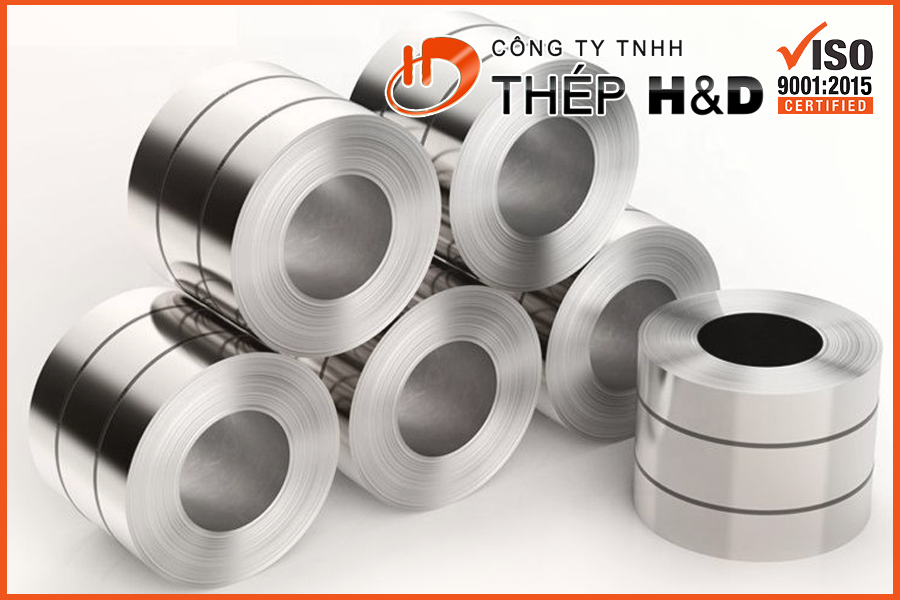
The origin of all differences between these two types of stainless steel lies in their chemical composition. 201 stainless steel was created as a low-cost alternative to 304 by reducing the amount of Nickel (an expensive raw material) and increasing the amount of Manganese.
| Element | 201 Stainless Steel (% by Weight) | 304 Stainless Steel (% by Weight) | Role |
|---|---|---|---|
| Nickel (Ni) | 3.5 - 5.5% | 8.0 - 10.5% | Enhances corrosion resistance, stabilizes the Austenitic phase. |
| Manganese (Mn) | 5.5 - 7.5% | < 2.0% | Increases hardness, partially replaces Nickel to reduce cost. |
| Chromium (Cr) | 16.0 - 18.0% | 18.0 - 20.0% | Forms the passive oxide layer, determines rust resistance. |
Thus, it is clear that 304 Stainless Steel is superior in terms of Nickel and Chromium content, the two key elements that determine corrosion resistance. Conversely, 201 Stainless Steel has a higher Manganese content, which increases hardness but reduces its resistance to rust.
Due to its higher Manganese content, 201 stainless steel has about 10% higher hardness and tensile strength than 304 stainless steel at room temperature. However, this same hardness makes 201 more difficult to deep draw or form than 304. 304 stainless steel is softer and more ductile, allowing for easier bending, forming, and welding without pre-heating.
This is the biggest difference. With significantly higher Chromium and Nickel content, 304 stainless steel offers superior corrosion resistance. It can withstand many environments, including mild acidic conditions and high humidity areas. In contrast, 201 stainless steel is prone to pitting corrosion and rusting when exposed to salt, chlorine, or acidic environments. Therefore, 201 is not recommended for outdoor applications or in industries that require high sanitation, such as food and medical.
201 stainless steel is significantly cheaper than 304 stainless steel. This is its biggest competitive advantage. However, choosing 201 just for its low price can lead to higher maintenance and replacement costs in the long run if used in the wrong environment. While 304 has a higher initial cost, it is a sustainable investment for long-term applications.
| Criteria | 201 Stainless Steel | 304 Stainless Steel |
|---|---|---|
| Rust Resistance | Fair | Very Good |
| Strength / Hardness | Higher | Standard |
| Formability (Bending, Drawing) | Fair | Very Good |
| Cost | Cheaper | More Expensive |
| Suitable Environment | Indoors, dry conditions | Indoors, outdoors, humid environments |
Choosing the right material not only ensures quality but also optimizes the cost of your project. For more detailed advice on 201 and 304 Stainless Steel products, as well as to receive the most competitive price quotes, please contact H&D Company today.
Cùng là nhôm A5052 nhưng tấm trạng thái O, H32 và H34 có độ bền, độ dẻo và bán kính c...
Sàn Thượng Hải mở cửa lại sau Quốc khánh với hai phiên giảm liền: giá nhôm thỏi SMM A...
Từ ngày 20/10/2026, Nghị định 344/2026/NĐ-CP mở cơ chế đặt hàng và ưu đãi cho doanh n...
Các con số vật lý của nhôm không giống nhau giữa các mác, và mỗi con số dẫn tới một q...
Giá nhôm thỏi SMM A00 giảm ba phiên liên tiếp trong tuần 40/2026, chốt 24.030 CNY/tấn...
Sau 8 tháng 2026, thị trường ô tô Việt Nam bán 432.548 xe, mức tăng cao nhất trong 6...
Nhôm tấm 3mm là độ dày được hỏi nhiều nhất trong nhóm tấm mỏng vì đủ cứng để làm thùn...
Nhôm A6061 là hợp kim nhôm–magie–silic hoá bền bằng nhiệt luyện, được dùng nhiều nhất...
Chỉ số cước container nội Á của Drewry chốt ngày 24/9/2026 ở 1.491 USD/40ft, tăng 6%...
Giá nhôm thỏi SMM A00 chốt tuần 39/2026 ở 24.240 CNY/tấn, cao hơn 60 CNY/tấn so với t...


