091 327 0770 - 090 326 2566
info@hdsteel.com.vn

Kết Luận

Phay CNC đã và đang là một công nghệ biến đổi, thúc đẩy tự động hóa và hiệu quả trong ngành công nghiệp ô tô. Với khả năng cung cấp độ chính xác, tốc độ và tính linh hoạt vượt trội, nó không chỉ giúp các nhà sản xuất đáp ứng nhu cầu thị trường ngày càng cao mà còn mở đường cho những đổi mới trong thiết kế và kỹ thuật ô tô. Khi ngành công nghiệp tiếp tục phát triển, đặc biệt là với sự bùng nổ của xe điện, vai trò của phay CNC sẽ ngày càng trở nên quan trọng, đảm bảo rằng các phương tiện của tương lai sẽ an toàn hơn, hiệu quả hơn và được tùy chỉnh tốt hơn.

Nguồn tham khảo:

  • BreakingAC.com
  • Dassault Systèmes
  • RapidDirect
  • Xometry
  • 3ERP
  • ACEMICROMATIC
  • Aztalan
  • Methods Machine Tools
  • Toolpath
  • Phillips Corporation India

---

: ## Driving Efficiency: How CNC Milling Transforms Automotive Automation

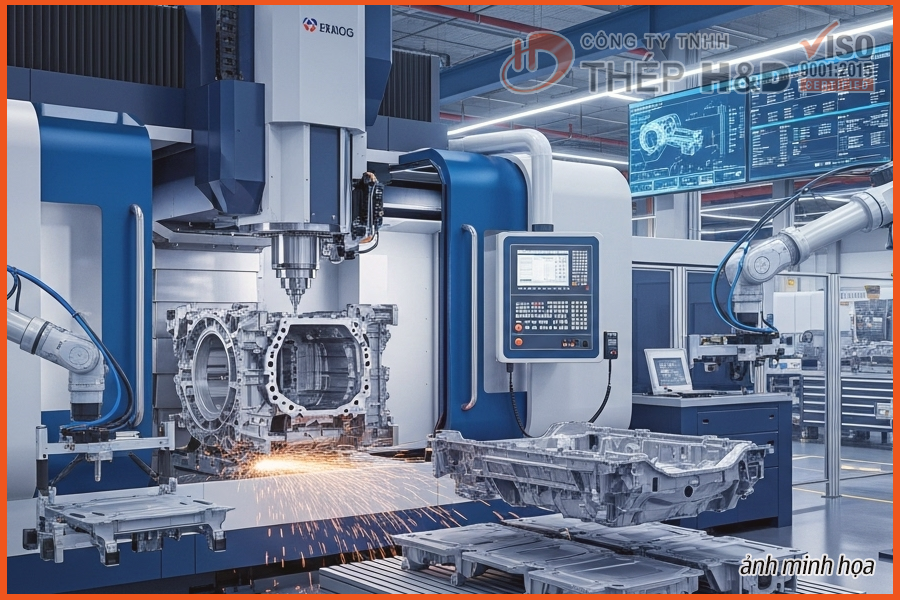
CNC milling in the automotive industry

September 23, 2025 – The automotive industry is undergoing a manufacturing revolution, largely driven by the advanced capabilities of Computer Numerical Control (CNC) milling. Far from being just a machining method, CNC milling has become the backbone of automation in automotive production, delivering unprecedented efficiency, absolute precision, and flexible customization. The integration of CNC milling with advanced automation systems is reshaping how automotive components are designed, manufactured, and assembled, thereby fostering innovation and elevating the quality of the final product.

Automation and Superior Efficiency

CNC milling has revolutionized automotive manufacturing processes by automating complex machining tasks. With the aid of robotics and computer-controlled supervision, CNC milling machines can operate continuously with minimal human intervention. This brings several key benefits:

  • Increased Production Speed: CNC machines can perform machining operations much faster and more efficiently than manual methods, significantly shortening production cycles.
  • Reduced Labor Costs: Automation reduces the need for manual labor, allowing personnel to focus on innovation and oversight rather than repetitive tasks.
  • Continuous Operation: CNC machines can run 24/7, maximizing throughput and ensuring timely market responsiveness.
  • Enhanced Safety: By automating machining processes, CNC milling eliminates many inherent hazards on the shop floor, creating a safer working environment for employees.

Absolute Precision and Repeatability

In the automotive industry, precision is paramount, directly impacting vehicle performance, safety, and longevity. CNC milling excels in its ability to produce parts with extremely tight tolerances and high repeatability:

  • High Accuracy: Computer-controlled systems ensure that every part is machined to exact design specifications, eliminating human error.
  • Consistency: The repeatability of CNC milling guarantees that thousands, even millions, of parts are produced identically, which is essential for seamless assembly and reliable performance.
  • Improved Assembly: Highly accurate CNC-milled parts fit perfectly during assembly, reducing the need for adjustments, saving time, and lowering costs.

Customization and Manufacturing Flexibility

The automotive market increasingly demands diversity and personalization. CNC milling provides the necessary flexibility to meet these requirements:

  • Custom Component Production: It enables the production of unique vehicle parts, special editions, or bespoke components with short lead times.
  • Rapid Design Changes: The ease with which CNC programs can be adjusted allows manufacturers to quickly adapt to design changes or product requirements without investing in expensive tooling.
  • Rapid Prototyping Support: CNC milling is ideal for quickly producing functional, high-quality prototypes, allowing designers and engineers to test and verify designs before mass production.

Wide-Ranging Applications in the Automotive Sector

CNC milling is utilized in the manufacturing of a wide array of critical automotive components, including:

  • Engine and Powertrain Components: Engine blocks, cylinder heads, crankshafts, gearboxes, and other complex parts that demand high precision.
  • Suspension and Braking Systems: Components like brake calipers, rotors, steering knuckles, and suspension arms, which must withstand extreme stress and heat.
  • Exhaust and Lighting Systems: Production of parts with intricate geometries and high durability requirements.
  • Interior and Exterior Components: Decorative trims, molds, and body panels.
  • Electric Vehicles (EVs): CNC milling plays a crucial role in producing parts for EVs, including battery casings, motor housings, and other lightweight components. For instance, various aluminum alloys, such as nhôm tấm 1050, 3003, 5052, 6061, 7075, are frequently used in EV manufacturing for their strength-to-weight ratio, and CNC milling is essential for shaping these materials with precision.

Future Trends and Challenges

The future of CNC milling in the automotive industry will continue to see significant advancements:

  • Multi-axis Machining and Robotic Integration: 5-axis and higher CNC milling machines, combined with robotic arms, will enable more complex surface machining and simultaneous multi-surface operations, further reducing changeover times and increasing product output.
  • Greater Production Flexibility: Equipment will be capable of rapidly switching between different parts to meet varying demand and customization requirements.
  • Continuous Automation: Advancements in automation will expand unattended operation capabilities, improving safety and decreasing errors while maintaining consistent quality.
  • Sustainability: CNC milling contributes to sustainable manufacturing by minimizing waste through precise material removal and optimized machining paths.

However, the industry also faces challenges such as high initial investment costs, the need for specialized operating and maintenance skills, and the imperative to continuously update technology to maintain a competitive edge.

Conclusion

CNC milling has been and continues to be a transformative technology, driving automation and efficiency in the automotive industry. By offering unparalleled precision, speed, and flexibility, it not only helps manufacturers meet escalating market demands but also paves the way for innovations in automotive design and engineering. As the industry continues to evolve, particularly with the surge in electric vehicles, the role of CNC milling will become even more critical, ensuring that the vehicles of tomorrow are safer, more efficient, and better customized.

References:

  • BreakingAC.com
  • Dassault Systèmes
  • RapidDirect
  • Xometry
  • 3ERP
  • ACEMICROMATIC
  • Aztalan
  • Methods Machine Tools
  • Toolpath
  • Phillips Corporation India

Related Post

Aluminium sheet price, week 41/2026: SMM A00 drops to 23,650

Aluminium sheet price, week 41/2026: SMM A00 drops to 23,650

Shanghai reopened after National Day with two down sessions: the SMM A00 aluminium in...

Decree 344: Incentives for Power Equipment Makers from 20 Oct

Decree 344: Incentives for Power Equipment Makers from 20 Oct

From 20 October 2026, Decree 344/2026/ND-CP opens a state ordering mechanism and ince...

Physical Properties of Aluminum: 1050, 3003, 5052 Data for Shops

Physical Properties of Aluminum: 1050, 3003, 5052 Data for Shops

Aluminum's physical figures differ between alloys, and each figure drives a concrete...

Aluminium sheet price, week 40/2026: SMM A00 eases to 24,030

Aluminium sheet price, week 40/2026: SMM A00 eases to 24,030

The SMM A00 aluminium ingot price fell in all three sessions of week 40/2026, closing...

Vietnam car market grows fastest in Southeast Asia in 8M 2026

Vietnam car market grows fastest in Southeast Asia in 8M 2026

Vietnam's car market sold 432,548 vehicles in the first eight months of 2026, the fas...

3mm Aluminum Sheet: Weight, Tolerance, Alloy and Buying Errors

3mm Aluminum Sheet: Weight, Tolerance, Alloy and Buying Errors

3mm aluminum sheet is the most requested thickness in the thin-to-medium range: stiff...

6061 aluminum plate: T6 vs T651, thickness and buying pitfalls

6061 aluminum plate: T6 vs T651, thickness and buying pitfalls

A6061 is a heat-treatable aluminium–magnesium–silicon alloy widely used for machine f...

Intra-Asia freight at record high before Golden Week 2026

Intra-Asia freight at record high before Golden Week 2026

Drewry's Intra-Asia Container Index closed at 1,491 USD/40ft on 24 September 2026, up...

Aluminium sheet price, week 39/2026: SMM A00 at 24,240 CNY/t

Aluminium sheet price, week 39/2026: SMM A00 at 24,240 CNY/t

The SMM A00 aluminium ingot price ended week 39/2026 at 24,240 CNY/t, up 60 CNY/t fro...

Aluminum tread plate: choosing alloy, pattern and thickness

Aluminum tread plate: choosing alloy, pattern and thickness

Aluminum tread plate is sheet with a raised pattern on one face, used for truck floor...