091 327 0770 - 090 326 2566
info@hdsteel.com.vn


The 6,000 Billion VND Road Project Connecting Northern Mountainous Provinces: A Catalyst for Upland Development Amidst Implementation Challenges

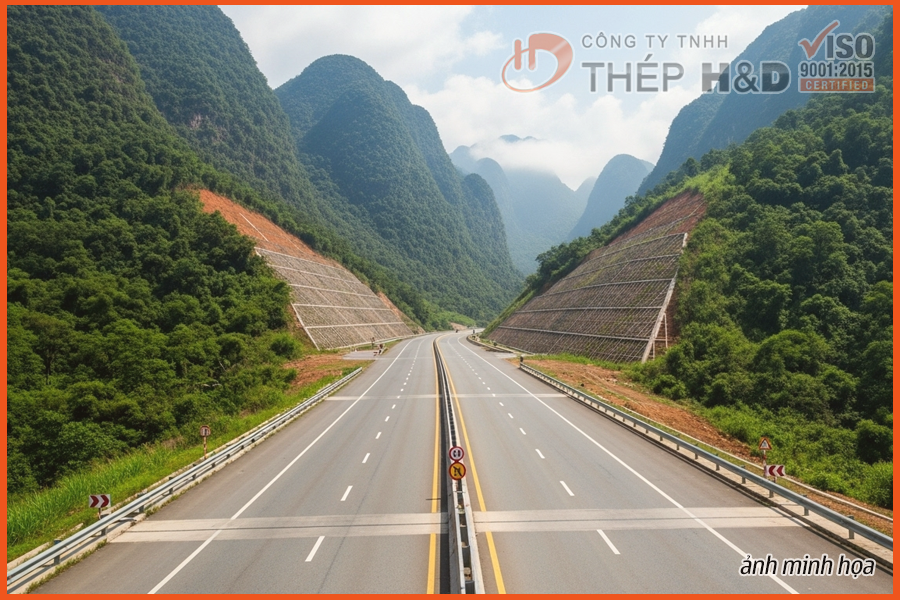
Hanoi, October 16, 2025 – The road project connecting Vietnam's Northern mountainous provinces, with a total investment exceeding 6,000 billion VND, stands as a pivotal infrastructure undertaking, promising to be a powerful development driver for the country's challenging regions. This route, supported by the Asian Development Bank (ADB) and other funding sources, aims not only to enhance transport connectivity but also to boost trade, tourism, and national defense and security. However, the project's implementation has encountered significant challenges, particularly concerning terrain and land clearance.

Project Overview and Strategic Importance

The road project connecting the Northern mountainous provinces spans approximately 199.77 km, designed to link provinces such as Lai Châu and Lào Cai with the Nội Bài - Lào Cai expressway. Commenced on June 5, 2019, the project is slated for completion by June 30, 2026. Its primary objective is to improve transportation infrastructure, facilitating the movement of goods and passengers, thereby fostering sustainable socio-economic development in the mountainous provinces.

Key project highlights:

  • Total Investment: Over 6,000 billion VND.
  • Total Length: Approximately 199.77 km.
  • Main Route: Connecting Lai Châu and Lào Cai with the Nội Bài - Lào Cai expressway.
  • Funding Sources: Loan from the Asian Development Bank (ADB) and other capital.
  • Objectives: Promote trade, economic development, tourism, and strengthen border defense and security.

Improved transport connectivity will help reduce travel time and logistics costs, expand markets for local agricultural products, and attract investment into local industries and services. Concurrently, it will contribute to enhancing the quality of life for residents by increasing access to healthcare, education, and labor markets.

Implementation Challenges

Despite its immense strategic significance, the project has faced and continues to face numerous difficulties:

  1. Complex Terrain: The Northern mountainous provinces feature rugged terrain, steep hills, and fragmented rivers and streams, posing significant challenges for surveying, design, and construction. This leads to high construction costs and delays.
  2. Landslides: Frequent landslides, especially during the rainy season, cause damage to infrastructure, disrupt traffic, and pose potential dangers to workers. Mitigating landslides requires substantial resources and complex engineering solutions.
  3. Land Clearance: There are still some unresolved issues regarding land clearance in certain areas, affecting the overall project timeline. This remains a persistent problem, demanding close coordination between local authorities and residents.
  4. Material Price Volatility: Construction material prices can fluctuate, impacting the total investment and financial planning of the project.

Implications for Stakeholders

For Investors:

  • Infrastructure Investment Opportunities: The project opens up investment opportunities in infrastructure-related sectors, logistics, tourism, and urban development in the mountainous provinces. The road's development will generate new demand for services and products.
  • Risk Assessment: Thoroughly assess risks related to terrain, environment, and land clearance progress when considering similar projects in the future.

For Managers:

  • Effective Project Management: Requires strong project management capabilities, coordination among stakeholders (government, contractors, communities), and timely resolution of emerging issues.
  • Local Economic Development: Leverage the road's advantages to formulate policies that attract investment and develop key local economic sectors, such as eco-tourism and high-tech agriculture. This is analogous to optimizing the applications of aluminium from daily life to industrial production to maximize material potential.

For Technical Experts:

  • Engineering Solutions for Complex Terrain: Research and apply advanced construction technologies, robust materials, and effective landslide prevention solutions, tailored to the specific geological and climatic conditions of the mountainous region. For instance, selecting appropriate aluminium sheets 1050, 3003, 5052, 6061, 7075 for bridge structures or traffic signs requires a deep understanding of material properties.
  • Environmental Management: Develop technical solutions to minimize the project's environmental impact, particularly in waste rock disposal and ecosystem protection.
  • Material Innovation: Explore new, sustainable construction materials that offer better resilience to the harsh mountainous conditions.

Conclusion

The road project connecting the Northern mountainous provinces exemplifies Vietnam's commitment to developing transportation infrastructure, especially in strategic regions. Despite facing numerous challenges, the project's importance in fostering socio-economic development and strengthening national defense and security is undeniable. Its completion will usher in a new era for the Northern mountainous provinces, laying a solid foundation for prosperity and integration. To achieve this goal, close coordination among the government, investors, contractors, and local communities, coupled with the application of advanced engineering solutions, will be key to success.

References:

  • Tiền Phong Online
  • Báo Lao Động
  • Cafef.vn
  • Báo Mới

Bài viết liên quan

Giá nhôm tấm tuần 41/2026: SMM A00 rơi về 23.650 CNY/tấn sau lễ

Giá nhôm tấm tuần 41/2026: SMM A00 rơi về 23.650 CNY/tấn sau lễ

Sàn Thượng Hải mở cửa lại sau Quốc khánh với hai phiên giảm liền: giá nhôm thỏi SMM A...

Nghị định 344: ưu đãi chế tạo thiết bị điện trong nước từ 20/10

Nghị định 344: ưu đãi chế tạo thiết bị điện trong nước từ 20/10

Từ ngày 20/10/2026, Nghị định 344/2026/NĐ-CP mở cơ chế đặt hàng và ưu đãi cho doanh n...

Tính chất vật lý của nhôm: số liệu 1050, 3003, 5052 cho xưởng

Tính chất vật lý của nhôm: số liệu 1050, 3003, 5052 cho xưởng

Các con số vật lý của nhôm không giống nhau giữa các mác, và mỗi con số dẫn tới một q...

Giá nhôm tấm tuần 40/2026: SMM A00 giảm còn 24.030 CNY/tấn

Giá nhôm tấm tuần 40/2026: SMM A00 giảm còn 24.030 CNY/tấn

Giá nhôm thỏi SMM A00 giảm ba phiên liên tiếp trong tuần 40/2026, chốt 24.030 CNY/tấn...

Thị trường ô tô 8 tháng 2026 tăng nhanh nhất Đông Nam Á

Thị trường ô tô 8 tháng 2026 tăng nhanh nhất Đông Nam Á

Sau 8 tháng 2026, thị trường ô tô Việt Nam bán 432.548 xe, mức tăng cao nhất trong 6...

Nhôm tấm 3mm: trọng lượng, dung sai, chọn mác và lỗi khi mua

Nhôm tấm 3mm: trọng lượng, dung sai, chọn mác và lỗi khi mua

Nhôm tấm 3mm là độ dày được hỏi nhiều nhất trong nhóm tấm mỏng vì đủ cứng để làm thùn...

Nhôm A6061: chọn T6 hay T651, độ dày và lỗi khi mua tấm

Nhôm A6061: chọn T6 hay T651, độ dày và lỗi khi mua tấm

Nhôm A6061 là hợp kim nhôm–magie–silic hoá bền bằng nhiệt luyện, được dùng nhiều nhất...

Cước vận tải biển nội Á lập đỉnh 5 tuần liền trước Golden Week

Cước vận tải biển nội Á lập đỉnh 5 tuần liền trước Golden Week

Chỉ số cước container nội Á của Drewry chốt ngày 24/9/2026 ở 1.491 USD/40ft, tăng 6%...

Giá nhôm tấm tuần 39/2026: SMM A00 giữ 24.240 CNY/tấn

Giá nhôm tấm tuần 39/2026: SMM A00 giữ 24.240 CNY/tấn

Giá nhôm thỏi SMM A00 chốt tuần 39/2026 ở 24.240 CNY/tấn, cao hơn 60 CNY/tấn so với t...

Nhôm chống trượt: cách chọn mác, kiểu gân và độ dày

Nhôm chống trượt: cách chọn mác, kiểu gân và độ dày

Nhôm chống trượt là tấm nhôm có gân nổi một mặt, dùng cho sàn xe, cầu thang và sàn xư...