






Nhôm A5052: chọn O, H32 hay H34, bán kính chấn và lỗi khi mua
Cùng là nhôm A5052 nhưng tấm trạng thái O, H32 và H34 có độ bền, độ dẻo và bán kính c...


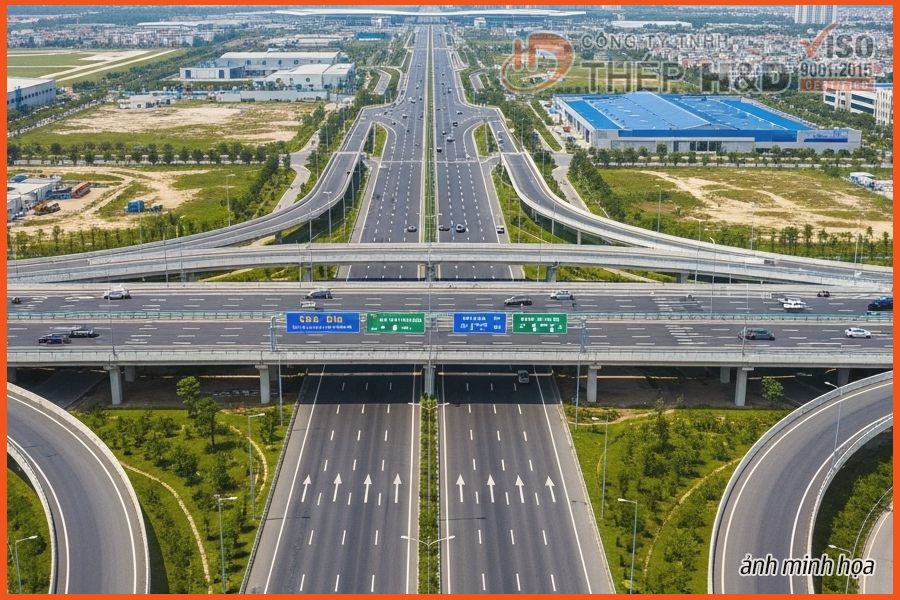
A transportation infrastructure mega-project has been proposed to transform the economic landscape of Northern Vietnam: the expressway connecting Gia Binh Airport (Bac Ninh) to Hanoi. This project is more than just a road; it is a strategic development axis expected to alleviate severe pressure on the over-capacity Noi Bai International Airport and catalyze a boom in the industrial, logistics, and e-commerce sectors of the entire Northern Key Economic Region.
According to the proposal, the 27.7 km section passing through Bac Ninh province features an impressive design scale. This is not a typical expressway but a multi-lane artery, planned with a cross-section of up to 120 meters. This structure includes:
The project will permanently occupy approximately 604 hectares of land, passing through 8 communes and wards, and intersecting with residential areas as well as the Thuan Thanh 3 Industrial Park, indicating its extensive scale and impact.
With a proposed total investment exceeding VND 47.6 trillion for the Bac Ninh section, the project is planned under a Public-Private Partnership (PPP) model, specifically a Build-Transfer (BT) contract. Notably, the BT contract form was paused in 2020, but special mechanisms and policies were specifically designed for the Gia Binh Airport project under a Government Resolution issued in August 2025, allowing this model's reapplication to accelerate progress. This is a significant signal of the government's determination to mobilize private capital for strategic infrastructure projects.
Gia Binh Airport is planned as a 4E-level airport with an initial capacity of 30 million passengers per year, capable of accommodating the most modern wide-body aircraft. This connecting expressway, together with the airport, will form one of the country's most advanced aviation and road transport infrastructure complexes. It not only solves Noi Bai's congestion problem but also opens up a new economic corridor, attracting investment into high-tech industrial parks, logistics hubs, and satellite cities, effectively redrawing the economic development map of the entire Red River Delta region.
Cùng là nhôm A5052 nhưng tấm trạng thái O, H32 và H34 có độ bền, độ dẻo và bán kính c...
Sàn Thượng Hải mở cửa lại sau Quốc khánh với hai phiên giảm liền: giá nhôm thỏi SMM A...
Từ ngày 20/10/2026, Nghị định 344/2026/NĐ-CP mở cơ chế đặt hàng và ưu đãi cho doanh n...
Các con số vật lý của nhôm không giống nhau giữa các mác, và mỗi con số dẫn tới một q...
Giá nhôm thỏi SMM A00 giảm ba phiên liên tiếp trong tuần 40/2026, chốt 24.030 CNY/tấn...
Sau 8 tháng 2026, thị trường ô tô Việt Nam bán 432.548 xe, mức tăng cao nhất trong 6...
Nhôm tấm 3mm là độ dày được hỏi nhiều nhất trong nhóm tấm mỏng vì đủ cứng để làm thùn...
Nhôm A6061 là hợp kim nhôm–magie–silic hoá bền bằng nhiệt luyện, được dùng nhiều nhất...
Chỉ số cước container nội Á của Drewry chốt ngày 24/9/2026 ở 1.491 USD/40ft, tăng 6%...
Giá nhôm thỏi SMM A00 chốt tuần 39/2026 ở 24.240 CNY/tấn, cao hơn 60 CNY/tấn so với t...


