091 327 0770 - 090 326 2566
info@hdsteel.com.vn


Investing in 3D Printing (Additive Manufacturing) in 2025: Trends, Consolidation Drivers, and Market Outlook

October 15, 2025 – The additive manufacturing (AM), or 3D printing, industry is undergoing a significant transformation in 2025. After years of initial hype, the market is now witnessing a more disciplined investment approach, focusing on practical solutions and profitability. This shift is reshaping the competitive landscape, driving consolidation trends, and creating new opportunities for investors, managers, and technical experts.

Current Investment Landscape

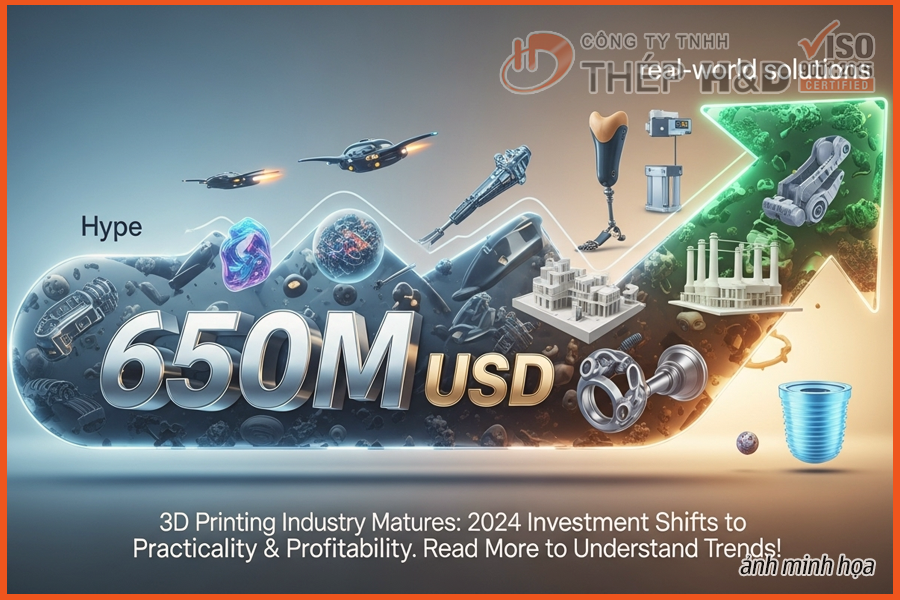
Total investment in AM for 2024 remained stable at approximately $650 million across about 40 deals. This figure, while lower than the pandemic-era highs, signals industry maturation and a focus on sustainable, problem-solving technologies. Investors now demand clear evidence that AM startups can solve tangible customer problems, rather than merely offering incremental improvements in speed or cost.

Key Investors in the 3D Printing Sector

Some of the most active 3D printing investors and funds include:

  • btov Partners (Berlin): Focuses on early-stage hardware and deep tech startups, with a strong track record in manufacturing and mobility.
  • Amadeus Capital (Cambridge, UK): While sector-agnostic, it has notable investments in robotics, biotech, and tech hardware, including AM-adjacent fields.
  • AM Ventures and SIP Capital: Referenced as significant players, focusing on industrial AM and reindustrialization opportunities.
  • InnoSource Ventures and Ninepointfive: These funds are active in early-stage and disciplined investment strategies.

Seedtable’s 2025 database identifies 23 top active investors in 3D printing, comprising a mix of European and global funds, with check sizes ranging from $100,000 to $250 million, and investment stages from pre-seed to late series.

Key Investment Trends

  1. Investor Discipline: The “hype cycle” of the early 2020s has ended. Investors now demand clear evidence that AM startups can solve tangible customer problems, not just offer incremental improvements in speed or cost.
  2. Geographical Spread: Europe and the U.S. remain core markets, with a mix of local and global funds participating. There is also growing interest from defense and government-linked funds, such as the NATO Innovation Fund, reflecting AM’s strategic importance.
  3. Early-Stage Focus: Many funds are targeting pre-seed, seed, and Series A, seeking to shape the next generation of AM technologies before the field consolidates further.

Areas of Focus in AM

| Area | Description | Trends & Evidence | |---|---|---| | Materials | New polymers, metals, ceramics, and composites for industrial and biomedical AM | Investment is shifting toward materials that enable new applications (e.g., high-temperature, biocompatible, recyclable) and reduce environmental impact. Materials like aluminum sheets and aluminum alloys are being researched for optimization in metal 3D printing. | | Software | AI/ML-driven design, simulation, workflow automation, and digital twins | Software is increasingly seen as a differentiator, enabling mass customization, quality control, and integration with Industry 4.0 ecosystems. | | Hardware | Industrial-scale systems, niche (e.g., bioprinting, construction), and post-processing | Focus is on reliability, scalability, and total cost of ownership. Investors are wary of “me-too” hardware startups and favor those with clear ROI for end users. |

Potential Consolidation Drivers

The AM industry is ripe for consolidation, driven by:

  • Market Maturation: As AM moves beyond the early adopter phase, larger companies are likely to acquire innovative startups to fill technology or market gaps, especially in software and materials.
  • Economic Pressure: Slower growth and reduced venture capital “froth” mean weaker companies may seek exit via acquisition rather than further funding rounds.
  • Strategic Imperatives: Defense, aerospace, and medical sectors are investing in AM for supply chain resilience, creating attractive targets for both corporate and private equity buyers.
  • Technology Stack Integration: Companies offering end-to-end solutions (materials + hardware + software) are seen as prime candidates for acquisition by industrial conglomerates.

Potential Consolidation Targets

The following types of companies are likely consolidation candidates:

  • Materials Innovators: Startups with unique, high-performance, or sustainable materials pipelines.
  • Vertical Software Providers: Firms specializing in AM-specific CAD/CAM, simulation, or production management.
  • Niche Hardware Players: Companies with proven technology in high-growth sectors (e.g., bioprinting, construction, energy).
  • Service Bureaus: Regional or specialist AM service providers, especially those with proprietary workflows or customer networks.

Implications for Industry Professionals

  • Investors: Need to focus on AM companies that solve specific industrial problems, have clear profitability roadmaps, and potential for integration into larger value chains. Investments in advanced materials, intelligent software, and sustainable solutions will be key.
  • Managers: Should evaluate AM technologies to improve manufacturing efficiency, product customization, and supply chain resilience. A deeper understanding of the applications of aluminum in industry and daily life can also provide insights into how AM can complement traditional manufacturing processes.
  • Technical Experts: Have significant opportunities to develop new materials, optimize printing processes, and integrate AM into existing production systems. A focus on sustainable and efficient solutions will be critical for success.

Conclusion

2025 marks a new era for investment in 3D printing, where discipline and real-world problem-solving capabilities are prioritized over hype. With a focus on materials, software, and niche solutions, the AM industry is poised for consolidation, leading to a more mature, integrated, and potentially more profitable market. Stakeholders must adapt to this evolving landscape to seize opportunities and position themselves for sustainable growth.

References:

  • 3DPrint.com
  • 3D Printing Industry
  • Seedtable
  • Castle Placement
  • All3DP
  • Perplexity AI

Bài viết liên quan

Nhôm A5052: chọn O, H32 hay H34, bán kính chấn và lỗi khi mua

Nhôm A5052: chọn O, H32 hay H34, bán kính chấn và lỗi khi mua

Cùng là nhôm A5052 nhưng tấm trạng thái O, H32 và H34 có độ bền, độ dẻo và bán kính c...

Giá nhôm tấm tuần 41/2026: SMM A00 rơi về 23.650 CNY/tấn sau lễ

Giá nhôm tấm tuần 41/2026: SMM A00 rơi về 23.650 CNY/tấn sau lễ

Sàn Thượng Hải mở cửa lại sau Quốc khánh với hai phiên giảm liền: giá nhôm thỏi SMM A...

Nghị định 344: ưu đãi chế tạo thiết bị điện trong nước từ 20/10

Nghị định 344: ưu đãi chế tạo thiết bị điện trong nước từ 20/10

Từ ngày 20/10/2026, Nghị định 344/2026/NĐ-CP mở cơ chế đặt hàng và ưu đãi cho doanh n...

Tính chất vật lý của nhôm: số liệu 1050, 3003, 5052 cho xưởng

Tính chất vật lý của nhôm: số liệu 1050, 3003, 5052 cho xưởng

Các con số vật lý của nhôm không giống nhau giữa các mác, và mỗi con số dẫn tới một q...

Giá nhôm tấm tuần 40/2026: SMM A00 giảm còn 24.030 CNY/tấn

Giá nhôm tấm tuần 40/2026: SMM A00 giảm còn 24.030 CNY/tấn

Giá nhôm thỏi SMM A00 giảm ba phiên liên tiếp trong tuần 40/2026, chốt 24.030 CNY/tấn...

Thị trường ô tô 8 tháng 2026 tăng nhanh nhất Đông Nam Á

Thị trường ô tô 8 tháng 2026 tăng nhanh nhất Đông Nam Á

Sau 8 tháng 2026, thị trường ô tô Việt Nam bán 432.548 xe, mức tăng cao nhất trong 6...

Nhôm tấm 3mm: trọng lượng, dung sai, chọn mác và lỗi khi mua

Nhôm tấm 3mm: trọng lượng, dung sai, chọn mác và lỗi khi mua

Nhôm tấm 3mm là độ dày được hỏi nhiều nhất trong nhóm tấm mỏng vì đủ cứng để làm thùn...

Nhôm A6061: chọn T6 hay T651, độ dày và lỗi khi mua tấm

Nhôm A6061: chọn T6 hay T651, độ dày và lỗi khi mua tấm

Nhôm A6061 là hợp kim nhôm–magie–silic hoá bền bằng nhiệt luyện, được dùng nhiều nhất...

Cước vận tải biển nội Á lập đỉnh 5 tuần liền trước Golden Week

Cước vận tải biển nội Á lập đỉnh 5 tuần liền trước Golden Week

Chỉ số cước container nội Á của Drewry chốt ngày 24/9/2026 ở 1.491 USD/40ft, tăng 6%...

Giá nhôm tấm tuần 39/2026: SMM A00 giữ 24.240 CNY/tấn

Giá nhôm tấm tuần 39/2026: SMM A00 giữ 24.240 CNY/tấn

Giá nhôm thỏi SMM A00 chốt tuần 39/2026 ở 24.240 CNY/tấn, cao hơn 60 CNY/tấn so với t...