






5052 Aluminum: O, H32 or H34, Bend Radius and Buying Mistakes
5052 aluminum sheet in O, H32 and H34 tempers differs clearly in strength, ductility...


Aluminum (Al) is a metal in Group IIIA of the periodic table, with 3 electrons in its outermost shell. With an electron configuration of [Ne] 3s²3p¹, aluminum tends to lose these 3 electrons to form the Al³⁺ ion, exhibiting a very strong reducing property (second only to alkali and alkaline earth metals). Therefore, aluminum can participate in many vigorous chemical reactions, especially at high temperatures.
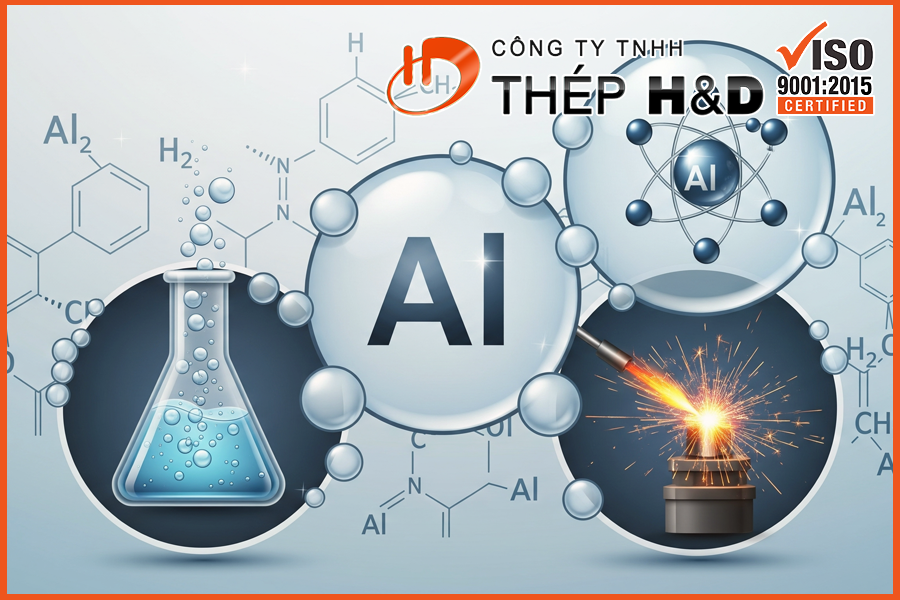
One of the most interesting paradoxes about aluminum is that despite its high chemical reactivity, aluminum objects are very durable in air and water. The reason is that aluminum reacts instantly with oxygen in the air to form an extremely thin, transparent, insoluble, and very strong layer of aluminum oxide (Al₂O₃). This layer envelops and protects the aluminum block inside from corrosive agents, preventing them from making contact and reacting. This is the secret to aluminum's natural corrosion and rust resistance.
At high temperatures, aluminum reacts directly with most non-metals such as oxygen, chlorine, and sulfur to form the corresponding oxides or salts.
Aluminum easily reduces H⁺ ions in strong acid solutions like HCl and dilute H₂SO₄ to release Hydrogen gas.
Important Note: Aluminum is passivated in concentrated, cold HNO₃ and H₂SO₄ solutions. This occurs because these strong oxidizing acids create a thick, durable Al₂O₃ layer that prevents further reaction.
The Al₂O₃ layer and aluminum metal itself can be destroyed by strong alkaline solutions like NaOH and KOH. This reaction, which releases Hydrogen gas, demonstrates the amphoteric nature of aluminum and its compounds.
At very high temperatures, aluminum can reduce the oxides of metals that are below it in the activity series (like Fe, Cr, Cu). This reaction releases an enormous amount of heat.
The thermite reaction is crucial in metallurgy for preparing high-melting-point metals and is used in thermite welding for railway tracks.
| Reaction Type | Typical Equation |
|---|---|
| With Oxygen | 4Al + 3O₂ → 2Al₂O₃ |
| With Acid (HCl, dilute H₂SO₄) | 2Al + 6HCl → 2AlCl₃ + 3H₂↑ |
| With Base (NaOH, KOH) | 2Al + 2NaOH + 2H₂O → 2NaAlO₂ + 3H₂↑ |
| Thermite Reaction | 2Al + Fe₂O₃ → 2Fe + Al₂O₃ |
5052 aluminum sheet in O, H32 and H34 tempers differs clearly in strength, ductility...
Shanghai reopened after National Day with two down sessions: the SMM A00 aluminium in...
From 20 October 2026, Decree 344/2026/ND-CP opens a state ordering mechanism and ince...
Aluminum's physical figures differ between alloys, and each figure drives a concrete...
The SMM A00 aluminium ingot price fell in all three sessions of week 40/2026, closing...
Vietnam's car market sold 432,548 vehicles in the first eight months of 2026, the fas...
3mm aluminum sheet is the most requested thickness in the thin-to-medium range: stiff...
A6061 is a heat-treatable aluminium–magnesium–silicon alloy widely used for machine f...
Drewry's Intra-Asia Container Index closed at 1,491 USD/40ft on 24 September 2026, up...
The SMM A00 aluminium ingot price ended week 39/2026 at 24,240 CNY/t, up 60 CNY/t fro...


