






5052 Aluminum: O, H32 or H34, Bend Radius and Buying Mistakes
5052 aluminum sheet in O, H32 and H34 tempers differs clearly in strength, ductility...


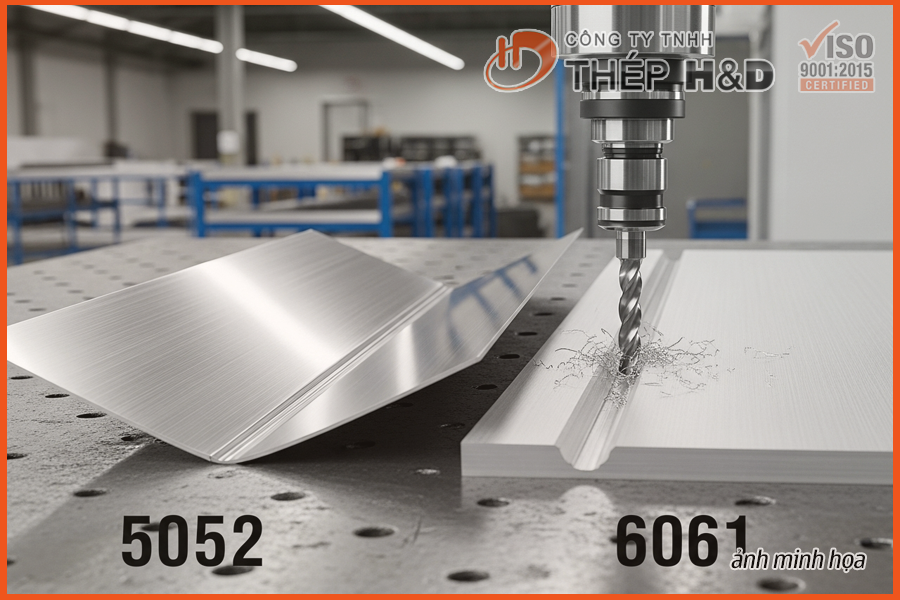
Aluminum alloys are a crucial group of materials in many industries, known for their unique combination of light weight, high strength, and corrosion resistance. Among them, Aluminum 5052 and Aluminum 6061 are two widely used alloys, each possessing distinct characteristics suited for specific application requirements. Aluminum 5052 belongs to the 5000 series (Al-Mg alloy), renowned for its excellent corrosion resistance, especially in saltwater environments, and high formability. Conversely, aluminum 6061, part of the 6000 series (Al-Mg-Si alloy), is highly regarded for its strength after heat treatment (T6) and good CNC machinability.
This article will delve into a detailed analysis of the differences between Aluminum 5052 and Aluminum 6061, focusing on two critical aspects in manufacturing: formability and CNC machinability. A clear understanding of these properties is paramount for selecting the optimal material, ensuring production efficiency, and achieving the desired quality of the final product.
Aluminum 5052 is a non-heat-treatable aluminum-magnesium alloy. Its primary chemical composition includes Magnesium (Mg) ranging from 2.2-2.8% and Chromium (Cr) from 0.15-0.35%. Other elements such as Silicon (Si), Iron (Fe), Copper (Cu), Manganese (Mn), and Zinc (Zn) are present in low concentrations (≤0.4%). The high magnesium content is a key factor that provides 5052 with excellent corrosion resistance, particularly in marine environments, and significantly enhances its formability.
In its common H32 temper, aluminum 5052 exhibits the following typical mechanical properties:
With low density and no heat-treatable properties, 5052 possesses high ductility, making it flexible for forming processes without significant thermal distortion.
Aluminum 5052 conforms to international standards such as ASTM B209 (for aluminum sheet and plate) and JIS H4160 (for wrought aluminum alloys). Common tempers include H32, H34, and H38, indicating varying degrees of cold work hardening.
Aluminum 5052 is rated as having very good formability. Thanks to its high elongation and relatively low hardness, this material can be easily bent, deep-drawn, cold-rolled, and subjected to other forming processes without cracking. However, to prevent edge cracking during deep bending, a minimum bend radius, typically 3-5 times the material thickness, should be observed.
The CNC machinability of 5052 is considered moderate. Due to its softer nature and high magnesium content, the material tends to produce sticky chips that can adhere to cutting tools, leading to rapid tool wear if machined at high speeds. This necessitates lower cutting speeds and the use of effective coolants/lubricants to achieve the desired surface finish.
With its superior corrosion resistance and high formability, aluminum 5052 is widely used in:
Aluminum 6061 is a heat-treatable aluminum-magnesium-silicon alloy. Its primary chemical composition includes Magnesium (Mg) ranging from 0.8-1.2% and Silicon (Si) from 0.4-0.8%. Additionally, it contains Copper (Cu) from 0.15-0.4% and Chromium (Cr) from 0.04-0.35%. The combination of magnesium and silicon allows 6061 to achieve high strength through heat treatment (aging).
In its common T6 temper (artificially aged), aluminum 6061 exhibits superior strength:
The tensile and yield strengths of 6061-T6 are significantly higher than those of 5052, but its elongation is lower, indicating poorer formability.
Similar to 5052, aluminum 6061 also conforms to ASTM B209 and JIS H4160 standards. The most common temper is T6, which signifies that the material has been solution heat-treated and artificially aged to achieve maximum strength.
The formability of aluminum 6061 is inferior to that of 5052, especially in the T6 temper due to its high hardness. This material can crack during bending or deep drawing if not pre-annealed or if the bend radius is too small. To improve formability, it is sometimes necessary to anneal the material to the O temper before forming, then re-heat treat it to achieve the desired strength.
Aluminum 6061 has good CNC machinability. With moderate hardness and a stable grain structure, 6061 causes less tool wear, allowing for higher cutting speeds and producing a smooth surface finish. Chips are generally more manageable than those from 5052, helping to reduce clogging and improve machining efficiency.
Thanks to its high strength and precise machinability, aluminum 6061 is widely used in applications requiring structural integrity:
The fundamental difference lies in the alloy composition. 5052 has a high Magnesium content (2.2-2.8%) as its primary alloying element, providing excellent corrosion resistance and high ductility. In contrast, 6061 combines Magnesium (0.8-1.2%) and Silicon (0.4-0.8%), which enables the material to be heat-treated, achieving significantly higher strength after T6 heat treatment.
Aluminum 5052 (H32) has lower tensile and yield strengths ( 193-241 MPa and ≥145 MPa respectively) but higher elongation (10-25%), making it suitable for applications requiring complex forming and corrosion resistance. Conversely, aluminum 6061 (T6) has much higher tensile and yield strengths ( 290-310 MPa and ≥240 MPa respectively) but lower elongation (8-12%), making it ideal for high-load bearing structures and precision machining applications.
| Property | Aluminum 5052 (H32) | Aluminum 6061 (T6) |
|---|---|---|
| Main Composition | Mg (2.2-2.8%), Cr | Mg (0.8-1.2%), Si (0.4-0.8%), Cu |
| Heat Treatable | No | Yes |
| Tensile Strength | 193-241 MPa | 290-310 MPa |
| Yield Strength | ≥145 MPa | ≥240 MPa |
| Elongation | 10-25% | 8-12% |
| Formability | Very Good | Poorer |
| CNC Machinability | Moderate, sticky chips | Good |
| Corrosion Resistance | Excellent (especially saltwater) | Good |
| Standards | ASTM B209, JIS H4160 | ASTM B209, JIS H4160 |
Aluminum 5052 and 6061 are two important aluminum alloys in industry, but with distinct characteristics. 5052 stands out for its superior formability and excellent corrosion resistance, especially in saltwater environments, thanks to its high magnesium content. Conversely, 6061, with its combination of magnesium and silicon, achieves high mechanical strength after T6 heat treatment and better CNC machinability.
The choice between 5052 and 6061 depends on the specific requirements of the application:
5052 aluminum sheet in O, H32 and H34 tempers differs clearly in strength, ductility...
Shanghai reopened after National Day with two down sessions: the SMM A00 aluminium in...
From 20 October 2026, Decree 344/2026/ND-CP opens a state ordering mechanism and ince...
Aluminum's physical figures differ between alloys, and each figure drives a concrete...
The SMM A00 aluminium ingot price fell in all three sessions of week 40/2026, closing...
Vietnam's car market sold 432,548 vehicles in the first eight months of 2026, the fas...
3mm aluminum sheet is the most requested thickness in the thin-to-medium range: stiff...
A6061 is a heat-treatable aluminium–magnesium–silicon alloy widely used for machine f...
Drewry's Intra-Asia Container Index closed at 1,491 USD/40ft on 24 September 2026, up...
The SMM A00 aluminium ingot price ended week 39/2026 at 24,240 CNY/t, up 60 CNY/t fro...


